Most families assume that when aging parents need help, everyone will naturally pitch in — yet personal finance author Suze Orman says a quiet financial trap is draining women’s retirement savings, a concern backed by new research from the University of Michigan and retirement rules from the IRS.
In a Thanksgiving email message shared with TheStreet, Orman pointed to a viral Saturday Night Live commercial parody titled “Sister” — which racked up more than 9 million views on YouTube in just over a week — as a sharp, bittersweet mirror of reality.
“It is fabulous because it is pitch-perfect in capturing the truth with humor,” Orman wrote in the message. “Women are typically the ones who step in and care for mom and dad in their later years. Sisters do the work. Brothers, not so much.”
While the sketch drew laughs for depicting brothers coasting while their sister handles everything from medications to deep-cleaning Mom’s house, Orman warned that the real-world price tag is anything but funny.
She also suggests a financial solution involving Roth IRAs that families can implement to rectify the imbalance.
University of Michigan data shows a widening caregiving gap
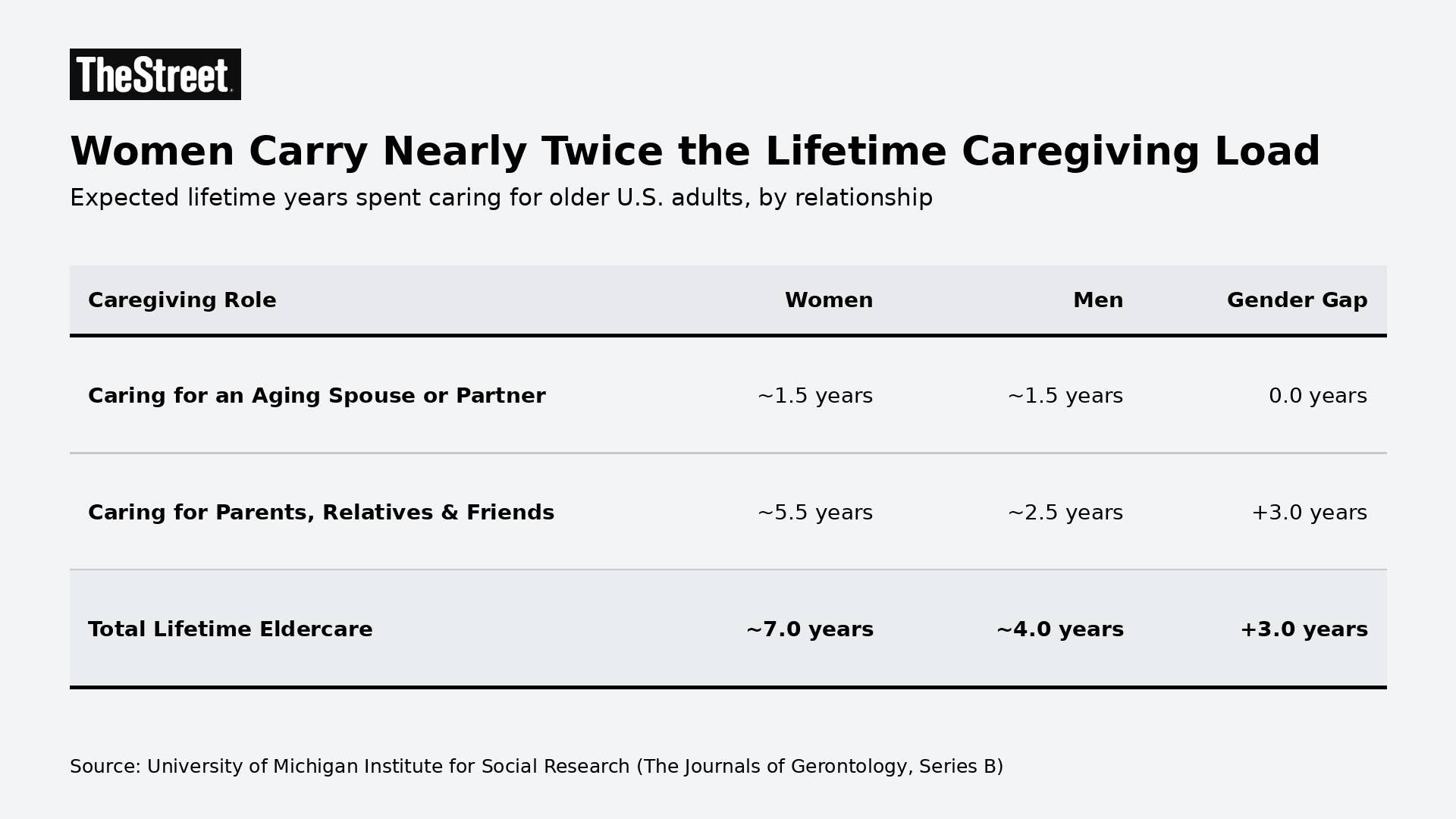
Orman’s warning lands right alongside demographic findings from the University of Michigan Institute for Social Research, which found that U.S. women can now expect to spend about seven years of their adult lives caring for aging family members or friends, compared with roughly four years for men.
Published in The Journals of Gerontology, Series B, the study revealed that the lifetime caregiving gap between women and men widened from two years in 2011 to three years in 2023.
Crucially, lead author Vicki Freedman and co-author Crystal Yee To Ng found that men and women spend roughly the same amount of time — about 1.5 years — caring for an aging spouse or partner. Instead, the disparity is driven almost entirely by care provided to parents, grandparents, and extended relatives.
“This study uses a demographic technique to calculate how many years of caregiving to an older adult a man or woman can expect to provide over their lifetimes if current rates hold into the future,” Freedman said in the university’s announcement.
Orman also cited survey data showing that 62% of respondents view it as an unspoken expectation that daughters will step into the primary caregiver role.
How caregiving compounds women’s retirement risk
The hidden danger, Orman emphasized, is that eldercare often strikes just as women are trying to rebuild or maximize their retirement savings.
“Women already lose out on valuable earnings when they take time off for child-rearing,” Orman wrote. “To compound those lost earnings, scaling back or stopping paid work to care for an aging adult compounds this harsh financial hit. It’s not just lifetime earnings, but may also impact Social Security benefits as well, given less time in a paid job contributing to Social Security.”
That warning echoes broader retirement guidance Orman has issued for 2027, noting that stepping out of the workforce or cutting hours in your 50s and early 60s strips away peak earning years and the compound growth those contributions would have generated.
To keep one sibling from bearing the entire burden alone, Orman urged caregivers to establish clear rules with their families:
- Split the logistics: Long-distance siblings can manage insurance paperwork, medical appointments, and mail-order prescription refills.
- Fund respite care: Family members who aren’t providing daily hands-on care can pay for hired help once or twice a week, or cover a housekeeper for the aging parent and the caregiving sibling.
- Compensate lost wages: “And for those families with the financial means, a sister who is providing substantial care should be paid for her work,” Orman wrote. “Especially if she scales back or quits a paying job.”
Orman’s 2027 Roth IRA strategy for working caregivers
For daughters and sisters who manage to keep working while carrying heavy caregiving duties, Orman proposed a specific financial fix: Siblings who benefit from that unpaid labor should pool their money to fund her Roth IRA.
Under IRS rules, a saver must have enough earned income — either their own or a spouse’s if filing jointly — to qualify for a Roth IRA contribution, but the actual cash deposited into the account can come as a tax-free gift from siblings or other relatives.
More Retirement:
- Annuities can be a retirement safety net to prevent outliving savings
- Vanguard flags a retirement fear built into 401(k) plans
- Suze Orman has a serious retirement warning for 2027
For the 2027 tax year, the IRS announced that the base annual IRA contribution limit remains $7,500, while savers age 50 and older can contribute up to $8,600 including the $1,100 catch-up allowance. Single filers can make the full contribution in 2027 with a modified adjusted gross income below $158,000, while married couples filing jointly qualify below $250,000.
“With the new adjustment in place now, the IRS is giving taxpayers and employers the information needed to make retirement planning decisions for the year ahead,” the IRS stated in its 2027 retirement plan announcement.
Orman’s bottom line for women carrying the family load this holiday season is for them to stop waiting for relatives to volunteer. They must proactively name the exact financial and practical support they need.
“With no shame, no blame, and no hesitation, you are to tell everyone who benefits from your caregiving exactly how they need to support you,” Orman wrote.
Related: Dave Ramsey warns on 401(k) move; Fidelity, Schwab take issue