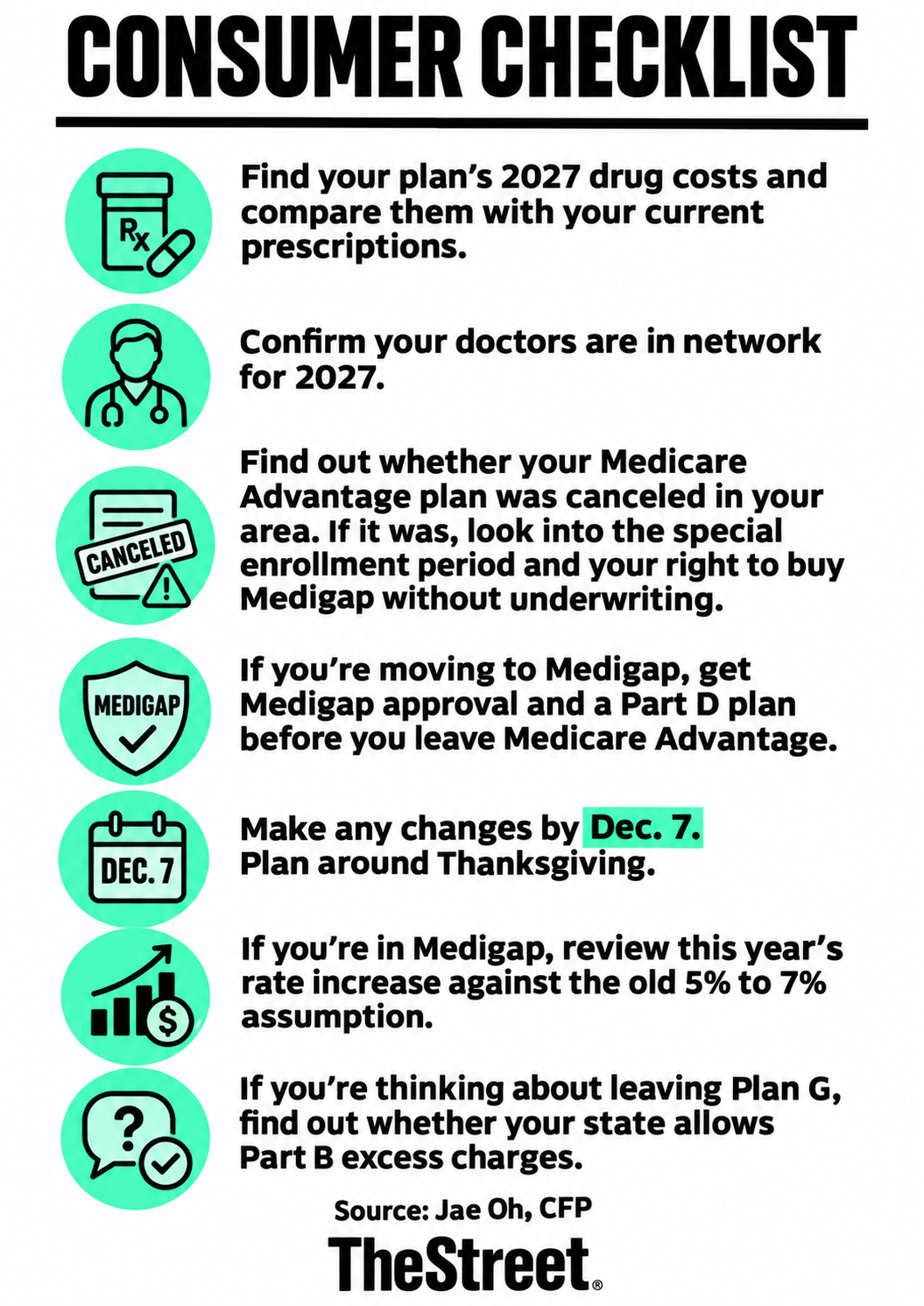
Medicare’s annual election period ends Dec. 7, and the Thanksgiving holiday leaves even fewer working days than the calendar shows.
I interviewed Jae Oh, author of “Maximize Your Medicare,” who said this year’s drug costs could be reason enough for some people to change Medicare Advantage plans. People in a Medicare Advantage plan that has been canceled have a rare chance to move to Medigap without medical underwriting, he added. And for anyone who believes Medigap premiums rise by a predictable 5% to 7% a year, Oh said that assumption no longer holds.
Below is a transcript of my interview with Oh, edited for brevity and clarity.
When does Medicare’s annual election period end?
Bob Powell: Medicare’s annual election period ends Dec. 7. The clock is ticking.
Jae Oh: It is. Dec. 7 is just a few days away, and Thanksgiving falls in between. That really cuts down the number of days you effectively have left.
What happens if you do nothing with Medicare Advantage?
Powell: Let’s start with people who have a Medicare Advantage plan. What should they be thinking about?
Oh: First, if you do nothing, your existing plan will automatically renew.
What if your Medicare Advantage plan was canceled?
Oh: Second, if your plan has been canceled where you live, you actually have more time than Dec. 7. You’re covered through the end of the year, and you get a special enrollment period. It lets you choose another Medicare Advantage plan for January, and it also gives you a special enrollment period into Medigap.
It’s one of the unintended consequences of plans leaving an area or being canceled: You get this right without medical underwriting. Say you chose a Medicare Advantage plan years ago and have had buyer’s remorse since. This is your window to make that change.
Can you switch from Medicare Advantage to Medigap?
Powell: People whose plans weren’t canceled may also be able to switch from Medicare Advantage to Medigap, but they may face underwriting.
Oh: That’s certainly the case, and with time this short, that window is closing even faster. Switching from Medicare Advantage to Medigap is possible.
The reason to talk about it now is Part D. Leaving your Medicare Advantage plan is no problem. But you need your Part D drug plan and your Medigap policy in place, so you’re not left in no man’s land without the extra coverage that caps your out-of-pocket health care costs.
Can you still change plans after Jan. 1?
Powell: People who stay in a Medicare Advantage plan, whether it’s their current one or a new one, get one more chance to change in the first quarter of 2027.
Oh: Very few people use this option, but it exists. If, and only if, you’re a member of a Medicare Advantage plan on Jan. 1, you can change once to another Medicare Advantage plan during the first quarter.
What should you check before picking a Medicare Advantage plan?
Powell: What’s your checklist for choosing a Medicare Advantage plan: doctor networks, drug formularies?
Oh: The first spot for me is the network. You’re trying to lower your costs, and the best way to do that is to avoid surprises. Checking the network reduces, as far as you can control it, the chance of a bad surprise when you show your insurance card at the billing counter.
Second, our client base nationwide is showing us that stand-alone prescription drug plan costs, and the drug costs inside Medicare Advantage plans, have moved more than in other years. [They’ve moved] enough that it could be reason to change Medicare Advantage plans. That’s our anecdotal evidence.
Why should Medigap enrollees reevaluate their plans now?
Powell: I don’t usually think of the annual election period as a time to change my Medigap plan. Should people in original Medicare and Medigap reevaluate now?
Oh: I think we’ve discussed this before. A growing trend, and it continues, is that Medigap rate increases are very high. The old idea of 5% to 7% a year is no longer valid. We are seeing 15%, 20%, 30%.
One takeaway for your audience: I don’t find it a productive use of time to try to outguess the carriers. They weigh many inputs when they set rates. But it’s not complete guesswork. They have to get their rates approved by the state.
Should you drop Medigap Plan G to save money?
Powell: People often say they’ll get Medigap Plan G because it covers so much. But switching to a plan that covers less may not save much on premiums. Is that fair to say?
Oh: It’s complicated. It’s always complicated. For me, the main feature of Plan G is that it covers Part B excess charges, and some states don’t allow Part B providers to charge them at all. You may be unlikely to run into a Part B excess charge, but if you do, the cost is very high, and that creates uncertainty.
And 2027 will be yet another year in which Medicare payments to doctors decline in nominal terms.
Related: She was ready to retire. Six months later, she still couldn’t let go of work