For decades, the standard career-transition playbook has told departing workers to roll their workplace 401(k) straight into an individual retirement account (IRA) to unlock wider investment menus and consolidate old accounts.
Yet for workers leaving a job in their mid-to-late 50s — whether through early retirement, a buyout, or a layoff — following that conventional wisdom too quickly can permanently erase a major federal tax break.
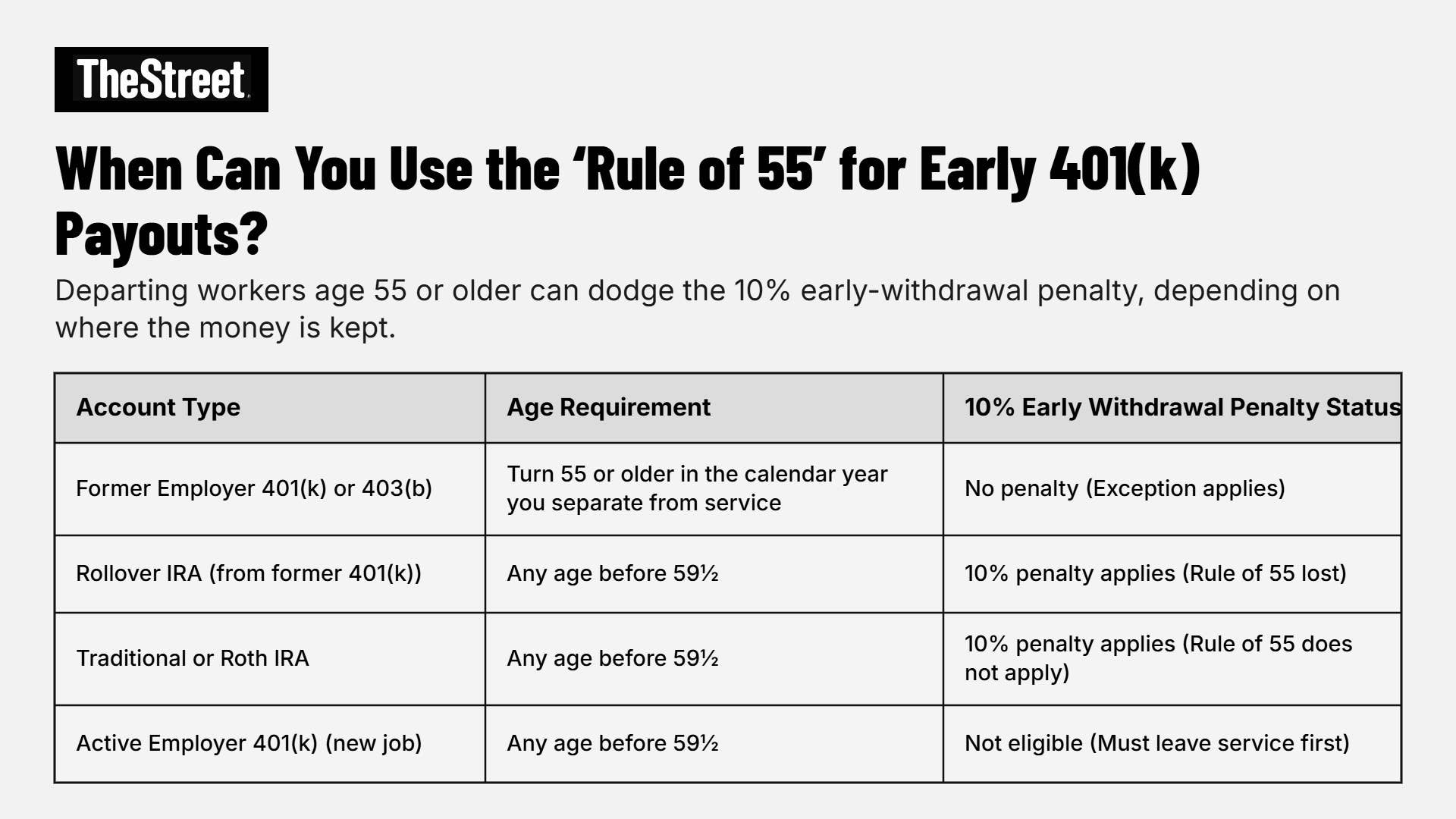
Fidelity Investments highlights how the Internal Revenue Service’s (IRS) Rule of 55 allows employees who leave a job during or after the calendar year they turn 55 to withdraw money from that employer’s 401(k) or 403(b) without paying the standard 10% early-withdrawal penalty.
However, Fidelity warns that rolling the balance into an IRA immediately slams that penalty-free window shut, while Vanguard and Charles Schwab point to separate plan restrictions, tax bills, and hidden pitfalls that can catch early retirees off guard.
Fidelity warns against rolling into an IRA too soon
Under general federal retirement rules, tapping a tax-advantaged retirement account before age 59½ triggers a 10% additional tax on top of regular income taxes.
The IRS carves out an exception for workplace plans when workers separate from service late in their careers.
“An employee who receives a distribution from a qualified plan after separation from service is not subject to the 10% additional tax on early distributions if the distribution occurs in the year of turning 55 or older,” the IRS wrote.
In its guidance on early retirement withdrawals, Fidelity emphasizes that this penalty exemption is strictly tied to the workplace plan of the employer you just left — and vanishes the moment those savings are transferred into an IRA.
“Remember that it only applies to a former employer’s retirement plan. Rollover IRAs from 401(k)s are not included in this rule and withdrawals could incur a penalty,” Fidelity’s Michael Rusinak wrote in Fidelity’s Rule of 55 guide.
Even so, Fidelity notes that the provision can serve as a valuable bridge for workers who have built up substantial workplace savings and want to step away from full-time work before Medicare or Social Security kicks in.
“If you’ve done the retirement analysis to see that you can have a successful, strong, and resilient retirement plan with retirement at age 55, then this rule allows earlier access to some assets to help fund your lifestyle,” Rusinak added.
Fidelity also points out an often-overlooked nuance for workers who decide to unretire or take a part-time role: Taking a new job does not revoke Rule of 55 eligibility on the prior employer’s plan, provided the funds remain untouched inside that former workplace account.
Fidelity, Schwab, Vanguard, IRS.
Vanguard spotlights plan rules and ordinary income taxes
While Fidelity underscores the danger of moving money out of a 401(k) prematurely, Vanguard cautions workers not to mistake a penalty-free withdrawal for a tax-free windfall — or assume every employer’s plan allows flexible payouts.
In its breakdown of early 401(k) distributions, Vanguard notes that the IRS permits the exception, yet individual employers write the rules on how departed workers can actually pull their cash out.
“The IRS allows you to take any number of withdrawals in any amount, but your employer might have specific requirements for withdrawal timing,” Vanguard wrote in its early-withdrawal guide.
More Retirement:
- Annuities can be a retirement safety net to prevent outliving savings
- Vanguard flags a retirement fear built into 401(k) plans
- Suze Orman has a serious retirement warning for 2027
If a company’s 401(k) prohibits partial distributions to former employees, a worker trying to tap a small slice of savings could be forced to take a lump-sum payout of the entire account — potentially pushing their taxable income into a much higher bracket for the year.
Vanguard also warns that workers who switched jobs multiple times cannot use the rule to raid older 401(k) accounts left behind at previous employers.
“The Rule of 55 generally applies to the qualified retirement plan associated with the employer you left during or after the calendar year you turned 55. It doesn’t automatically give you penalty-free access to 401(k) accounts from employers you left earlier,” Vanguard noted.
Charles Schwab warns on involuntary cash-outs and lost compounding
Charles Schwab echoes those warnings while flagging a subtle operational trap: Even if you intentionally leave your money inside your former employer’s 401(k) to use the Rule of 55, drawing the balance down too low can trigger an automatic rollover that strips away your penalty protection.
“Also, be aware your employer might automatically roll over your 401(k) to an IRA once your 401(k) balance drops below a certain level. You won’t lose this money, but it may end up in an IRA, which does not allow penalty-free early withdrawals,” Hayden Adams wrote in Schwab’s Rule of 55 guide.
Schwab also urges workers in their mid-50s to weigh the long-term opportunity cost of tapping retirement accounts early, especially if they land another job or have taxable brokerage savings available to cover living expenses.
“Even if you’re eligible to withdraw money penalty-free from your 401(k) or other qualified retirement plan early, consider taking early distributions carefully. Just because you can take withdrawals, doesn’t mean you should. Remember, if you’re withdrawing money from your retirement savings, they can no longer benefit from potential compounding returns,” Adams explained.
For workers leaving a job at 55 or older, the three brokerage giants agree on one critical step before filing any rollover paperwork: Verify your plan’s distribution rules first, because once an IRA rollover is completed, the Rule of 55 door cannot be reopened.
Related: Suze Orman warns of sobering retirement fact; urges Roth IRA fix