We like to believe a product’s nationality is settled by a sticker. “Made in the USA” means American. Built somewhere else means foreign. It is a clean story, and for most of the last century, it mostly held up for the car sitting in your driveway.
A vehicle’s passport was its assembly line. Detroit meant American. Stuttgart meant German. The badge on the hood and the plant that stamped the steel told you where a car belonged, and which government would go to bat for it when trade fights broke out.
That logic is coming apart. Washington has spent the past two years deciding that a car’s real citizenship lives in its software and its ownership, not on its loading dock.
On Thursday, June 25, that shift claimed its first true casualty, a carmaker that builds one of its electric vehicles in South Carolina and still got shown the door.
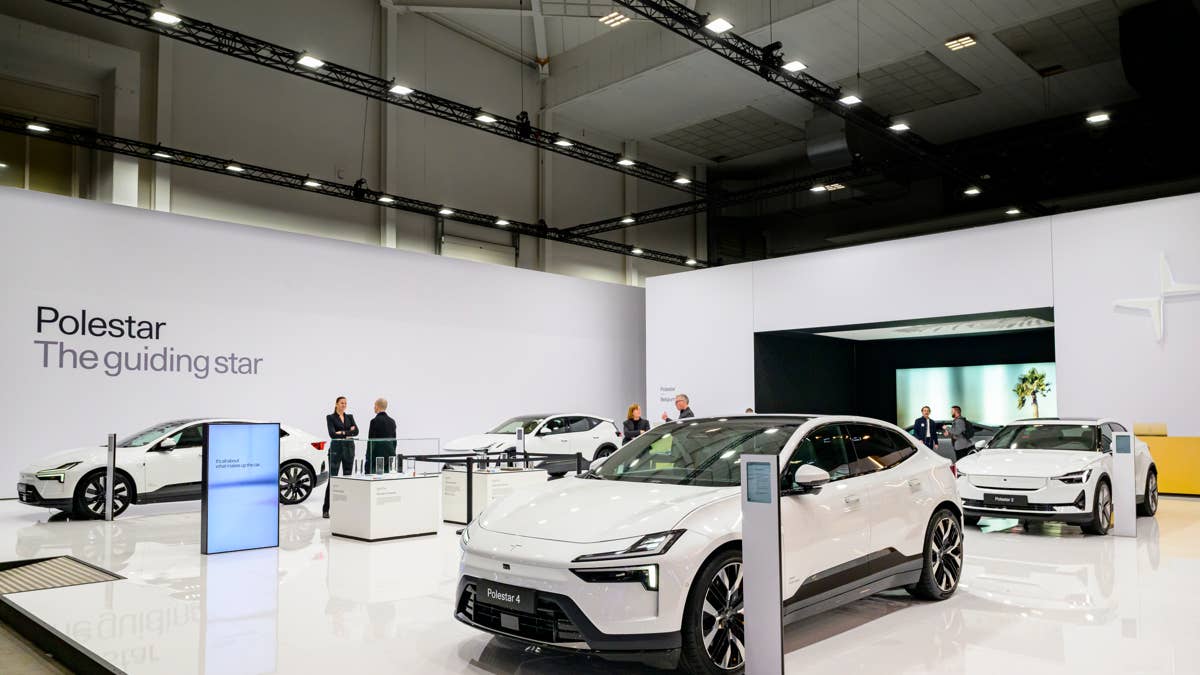
The brand is Polestar (PSNY), the Swedish-badged, Chinese-owned electric vehicle (EV) maker that just confirmed it will stop selling new cars in the United States. The reason has almost nothing to do with the cars themselves.
What the U.S. Connected Vehicle Rule actually does
The policy at the center of this is the Connected Vehicle Rule, finalized in the final days of the Biden administration in January 2025 and left in place by the Trump administration, according to Electrek.
It bars connected vehicles with what the government calls a “sufficient nexus” to China or Russia from the U.S. market. The software restrictions hit model year 2027, and the hardware restrictions follow in 2030.
More Automotive:
- Tesla rival forced to make big changes amid EV shift
- Why Jim Cramer says Ford’s real story isn’t trucks or EVs
- Rivian has bad news for hundreds of its workers
Geely, the Chinese conglomerate that owns Polestar, sits at the heart of a sprawling family of car brands that runs from Volvo to Lotus.
Washington’s worry is not the steel or the seats. It is the dashboard. Modern EVs push constant streams of data through onboard software and cellular connections, and regulators argue that a car tied to Beijing is a rolling listening post.
China has become the world’s largest car exporter, with electric vehicles leading the charge, yet high U.S. tariffs have already shut most Chinese-branded models out of the American market, according to CNN.
The Connected Vehicle Rule comes at the same fear from a different angle. It targets the data and software inside the car, rather than the price tag on the window.
Here is the part most buyers never think about. Polestar runs Android Automotive, the operating system originally built by Intel and Google, and leans on Google apps for its in-car experience, according to Electrek.
The American-sounding software did not save it. Under the rule, what matters is who owns the company and where the broader software stack traces back, not which Silicon Valley logo sits on the touchscreen.
What Polestar’s U.S. exit means for buyers and the stock
The Commerce Department’s Bureau of Industry and Security (BIS) refused to authorize Polestar’s 2027 models, according to Edmunds. That one decision ends the brand’s U.S. new-car sales after less than a decade on the market.
Polestar said it will continue selling existing stock of the Polestar 3 and Polestar 4 and will keep servicing the cars already on the road.
Investors did not love this development. Polestar shares fell more than 11% on June 25, according to TheStreet’s market coverage.
Related: EV target takes unexpected turn in one of the world’s top markets
If you already own one of the vehicles, the practical hit is smaller than the headline suggests, though resale value is the real question mark. If you were planning to buy a 2027 Polestar, that plan is finished.
For the thousands of Americans already driving one, Polestar says service and support continue, including access to its service network, according to InsideEVs. The bigger unknown is resale value. A brand walking away from a market rarely helps used prices, and shoppers tend to mark down cars that no longer have a future showroom behind them.
Here is how the brand got to this point, by the numbers.
- Polestar sold roughly 5,400 vehicles in the U.S. last year, down from about 13,000 the year before, according to CarBuzz.
- The company posted record 2025 results of more than 60,000 cars sold and revenue above $3 billion, Electrek noted.
- Gross margin swung to negative 3.2% in the first quarter of 2026, down from a positive 10.3% a year earlier, according to Electrek.
- About 94% of first-quarter retail sales already came from outside the U.S., Edmunds noted.
I have followed Polestar’s U.S. push since its 2022 Nasdaq debut, and the math never really worked.
When I ran the latest numbers, the U.S. exit reads less like an amputation and more like pruning a branch that was never bearing much fruit. America made up a sliver of Polestar’s sales and a large share of its discounting headaches, with the Polestar 3 carrying up to $22,000 in incentives, according to CarBuzz.
The brand spent heavily here and got thin returns.
What the Volvo split signals for other automakers
The most revealing detail is not that Polestar got banned. It is that Volvo did not. Both are owned by Geely (GELYF), yet the same Bureau of Industry and Security cleared Volvo’s 2027 lineup in May and rejected Polestar weeks later, according to CarBuzz. Same parent, opposite answer.
What strikes me about that split is how much discretion sits inside the rule. Volvo trades as a separate, more established automaker with a deeper U.S. footprint. Polestar is wired more tightly into Geely’s shared platforms and software.
The government did not ban a country’s cars. It ranked corporate structures, and Polestar landed on the wrong side of the line.
That should make a few Detroit boardrooms nervous. Buick and Lincoln are both waiting on approval for popular China-built models, and Polestar’s rejection hints that the green light is not guaranteed, according to CarBuzz.
The Connected Vehicle Rule just showed it can wall off a partly American-built EV on ownership alone, and plenty of supply chains still run through China.
Polestar is not vanishing. It is leaning into Europe, where it already does around 80% of its business, and chasing growth in Southeast Asia, Latin America, and Canada, with its next model built on the continent, according to CNN.
“The automotive industry is entering a new phase, based on regional dynamics,” Polestar CEO Michael Lohscheller said, as Edmunds reported.
For American drivers, the lesson is quieter and more lasting. The “Made in America” badge on your next EV may matter less than the passport of the code running underneath it.
Where a car is screwed together is becoming a footnote. Who owns the company, and whose software it speaks, is becoming the whole story.
The next brand to learn that the hard way may be one you were actually planning to buy.
Related: China is about to repeat an EV move that blindsided U.S.