Alphabet was founded in 1998 as Google, a company focused on internet search. In 2004, the company went public, and since then, it has expanded into a wide array of products and services, including Google Maps, the Android operating system, the Google Pixel phone, and Waymo self-driving taxis.
In the process, it’s generated hundreds of billions of dollars in profit and rewarded shareholders with dividend payments, stock splits, and even share buybacks.
Alphabet began repurchasing its shares a little over a decade after it went public. Here’s a closer look at Alphabet’s stock buybacks over the years, how share repurchases impact investors, and why the company hasn’t bought back any shares in 2026.
When was Alphabet’s first stock buyback?
Alphabet conducted its first stock buyback in the fourth quarter of 2015, more than a decade after its IPO. The company announced in October 2015 the board of directors’ authorization to repurchase up to $5.099 billion worth of its Class C stock. By the end of 2015, it had repurchased $1.78 billion of its own stock.
The announcement came more than a year after the tech giant introduced its non-voting Class C stock, which was formed via a 2-for-1 stock split in April 2014. The announcement also followed the company’s reorganization earlier in October 2015, when Alphabet was formed to hold all of Google’s outstanding stock, and Google became a subsidiary of Alphabet.
How much stock has Alphabet bought back in total?
Between 2015 — the first year of its authorized stock buyback program — and 2025, Alphabet repurchased $348 billion worth of shares. This averages out to approximately $31.6 billion per year in share repurchases over that decade.
Google’s buybacks grew over the years as its profit and free cash flow (net cash from operating activities minus purchases of property and equipment) increased.
Related: Alphabet’s stock splits: History & prospects explained
The company’s stock repurchase-to-free cash flow ratio (which expresses the amount of free cash a company uses on stock buybacks) went from 0.11 (or 11%) in 2015 to a high of 0.99 (or 99%) in 2022.
A ratio exceeding 1 (or 100%) indicates that a company is spending more than its free cash flow on stock buybacks.
Still, the amount of cash used to buy back stock increased further in 2023 ($61.5 billion) and 2024 ($62.2 billion) before pulling back in 2025 ($45.7 billion).
Alphabet’s stock buyback history by year
The following is a table of data compiled from Alphabet’s annual reports. The ratio of stock repurchases to free cash flow was calculated by TheStreet. Dollar amounts are in billions of dollars.
| Year | Revenue | Net income | Stock repurchased | Net cash provided by operating activities | Purchases of property and equipment | Free cash flow | Stock repurchase-to-free cash flow ratio |
|---|---|---|---|---|---|---|---|
|
2025 |
$402.8 |
$132.2 |
$45.7 |
$164.7 |
$91.4 |
$73.3 |
0.62 |
|
2024 |
$350.0 |
$100.1 |
$62.2 |
$125.3 |
$52.5 |
$72.8 |
0.86 |
|
2023 |
$307.4 |
$73.8 |
$61.5 |
$101.7 |
$32.3 |
$69.5 |
0.89 |
|
2022 |
$282.8 |
$60.0 |
$59.3 |
$91.5 |
$31.5 |
$60.0 |
0.99 |
|
2021 |
$257.6 |
$76.0 |
$50.3 |
$91.7 |
$24.6 |
$67.0 |
0.75 |
|
2020 |
$182.5 |
$40.3 |
$31.1 |
$65.1 |
$22.3 |
$42.8 |
0.73 |
|
2019 |
$161.9 |
$34.3 |
$18.4 |
$54.5 |
$23.5 |
$31.0 |
0.59 |
|
2018 |
$136.8 |
$30.7 |
$9.1 |
$48.0 |
$25.1 |
$22.8 |
0.40 |
|
2017 |
$110.9 |
$12.7 |
$4.8 |
$37.1 |
$13.2 |
$23.9 |
0.20 |
|
2016 |
$90.3 |
$19.5 |
$3.7 |
$36.0 |
$10.2 |
$25.8 |
0.14 |
|
2015 |
$75.0 |
$16.3 |
$1.8 |
$26.6 |
$10.0 |
$16.6 |
0.11 |
Source: Alphabet
Why hasn’t Alphabet bought back any stock in 2026 so far?
As of this article’s last update, Alphabet hasn’t repurchased any stock in 2026, compared to buybacks of $28.3 billion during the first half of 2025, partly due to its focus on spending for its artificial intelligence initiatives. Capital expenditures more than doubled to nearly $81 billion in the first half of 2026 from $39.6 billion in the same half of 2025.
Also, Alphabet maintained its dividend payout, further straining its cash on hand. It maintained its 22-cent-per-share quarterly dividend through the second quarter of 2026, and the company said it intends to continue paying quarterly cash dividends. This suggests that, at least for the time being, the company is prioritizing AI spending and continued dividends over stock repurchases.
Still, Alphabet said that as of June 30, 2026, it had $69.5 billion available remaining under the board of directors’ authorization for Class A and Class C share repurchases.
| Period | Revenue | Net income | Repurchases of stock | Net cash provided by operating activities | Purchases of property and equipment | Free cash flow | Stock repurchase-to-free cash flow Ratio |
|---|---|---|---|---|---|---|---|
|
Jan–Jun 2026 |
$229.7 |
$174.8 |
$0 |
$84.9 |
$80.6 |
$4.3 |
0.00 |
|
Jan–Jun 2025 |
$186.7 |
$62.7 |
$28.3 |
$63.9 |
$39.6 |
$24.3 |
1.17 |
Source: Alphabet
More on stock buybacks:
- Oracle’s stock buybacks: History & investor impact explained
- AMD’s stock buybacks explained: History, balance & outlook
- Micron Technology’s stock buybacks explained
How do Alphabet’s shareholders benefit from stock repurchases?
Stock repurchases boost earnings per share by reducing the number of shares outstanding. In turn, increased earnings often inspire investor confidence, causing buyers to outnumber sellers, driving up the stock price.
At the same time, repurchased stock can be put back into circulation as employee stock options, rather than issuing new shares that would dilute investors’ stakes in the company.
Alphabet’s stock price performance
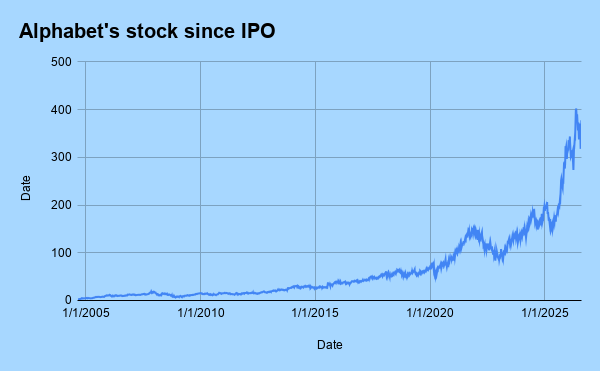
Alphabet’s stock price, as reflected in its Class A shares, rose more than 40-fold from its 2004 IPO through early August 2026. The stock has outperformed the S&P 500 Index, which rose more than sixfold in the same time period.
Alphabet’s stock closed at a split-adjust record high of $402.62 on May 13, 2026.
Related: Alphabet’s dividend history, yield & future prospects explained