The economic story of post-pandemic America isn’t one of clear recovery or continued decline — it’s both at once.
New tracking data from CivicScience reveals a country split down the middle when it comes to personal finances. As of 2026, about one in three U.S. adults say they’re financially better off than they were before COVID-19. But nearly the same share says they’re worse off, depicting an uneven and intensely personal recovery.
Read:More personal finance articles by Nifty 50+
A Nation Divided on Financial Progress
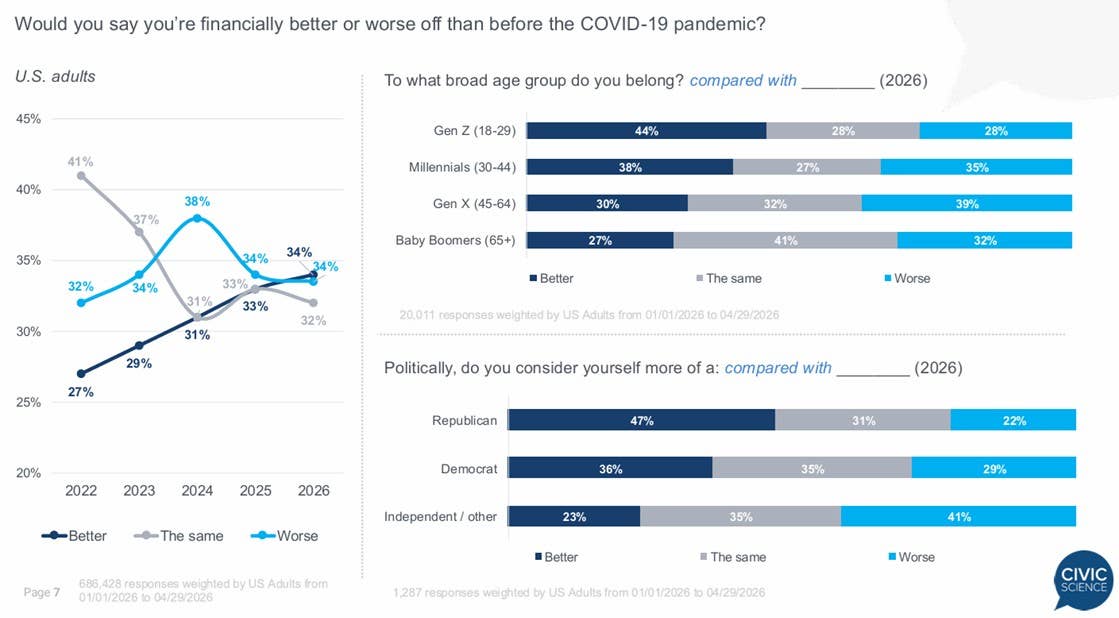
The latest numbers suggest a kind of stalemate. Roughly 34% of Americans say they’re doing better financially than before the pandemic, while another 34% say they’re doing worse. About 32% say their situation hasn’t changed. That balance didn’t happen overnight. In 2022, many Americans were still finding their footing. At that point, 41% — the largest share — said their finances were about the same as before the pandemic while 32% reported being worse off. Just 27% said they were better off.
By 2024, frustration appeared to peak. The share of Americans who said they were worse off climbed to 38%, while 31% reported improvement. Now, two years later, the data suggests some leveling out, but not necessarily a full recovery.
Younger Americans See More Gains
Who’s benefiting from the rebound depends a lot on age.
Among Gen Z adults, ages 18 to 29, optimism is highest. About 44% say they’re better off financially than before the pandemic, while 28% say they’re worse off and another 28% report no change.
Millennials aren’t far behind. Among those ages 30 to 44, 38% say they’re better off, compared to 35% who say they’re worse off and 27% who say things haven’t changed. The picture shifts as Americans get older.
For Gen X adults, ages 45 to 64, just 30% say they’re better off. A larger share (39%) says they’re worse off, while 32% say their finances are about the same. Among Baby Boomers, ages 65 and older, improvement is even less common. Only 27% say they’re better off, while 32% report being worse off and 41% say their situation hasn’t changed.
Political Differences Shape Perception
Political identity also appears to influence how Americans view their financial standing.
Republicans are the most likely to say they’ve come out ahead. Nearly half (47%) report being better off financially than before the pandemic. Another 31% say their situation hasn’t changed, while 22% say they’re worse off.
Democrats are more evenly split. About 36% say they’re better off, 35% say their finances are unchanged, and 29% report being worse off.
Independents and those who identify with other affiliations are the most likely to say they’re struggling. In that group, 41% report being worse off, compared to just 23% who say they’re better off and 35% who say things are the same.
An Unequal Recovery That Persists
Taken together, the findings highlight just how uneven the pandemic’s long-term economic impact has been.
Younger Americans are more likely to feel like they’ve gained ground, while older adults are more likely to report stagnation or decline. Political affiliation introduces another dimension, determining how people interpret their financial reality.
CivicScience’s data, based on large samples of U.S. adults collected through April 2026, indicates that although some Americans have regained — or even improved — their financial footing, many others continue to feel left behind.
More than six years after the pandemic began, the numbers point to a recovery that has not reached everyone equally — and may not feel like a recovery at all, depending on who you ask.