The last time Audi, a subsidiary of Volkswagen Group (VWAGY), tried to build the smartest small car in Europe, it lost money doing it.
The original A2, launched in 1999, wore an all-aluminum body, and one diesel version burned just three liters of fuel per 100 kilometers, a feat Audi’s own anniversary retrospective still calls a first for a four-door car.
Buyers admired it. They didn’t buy it.
Audi built the A2 at its Neckarsulm plant and pulled the plug in 2005 after roughly 176,000 units, according to Audi.
The car cost too much to build at scale, and Audi priced it accordingly, closer to a midsize A4 than a small hatchback. That mismatch, not the engineering, is why it failed.
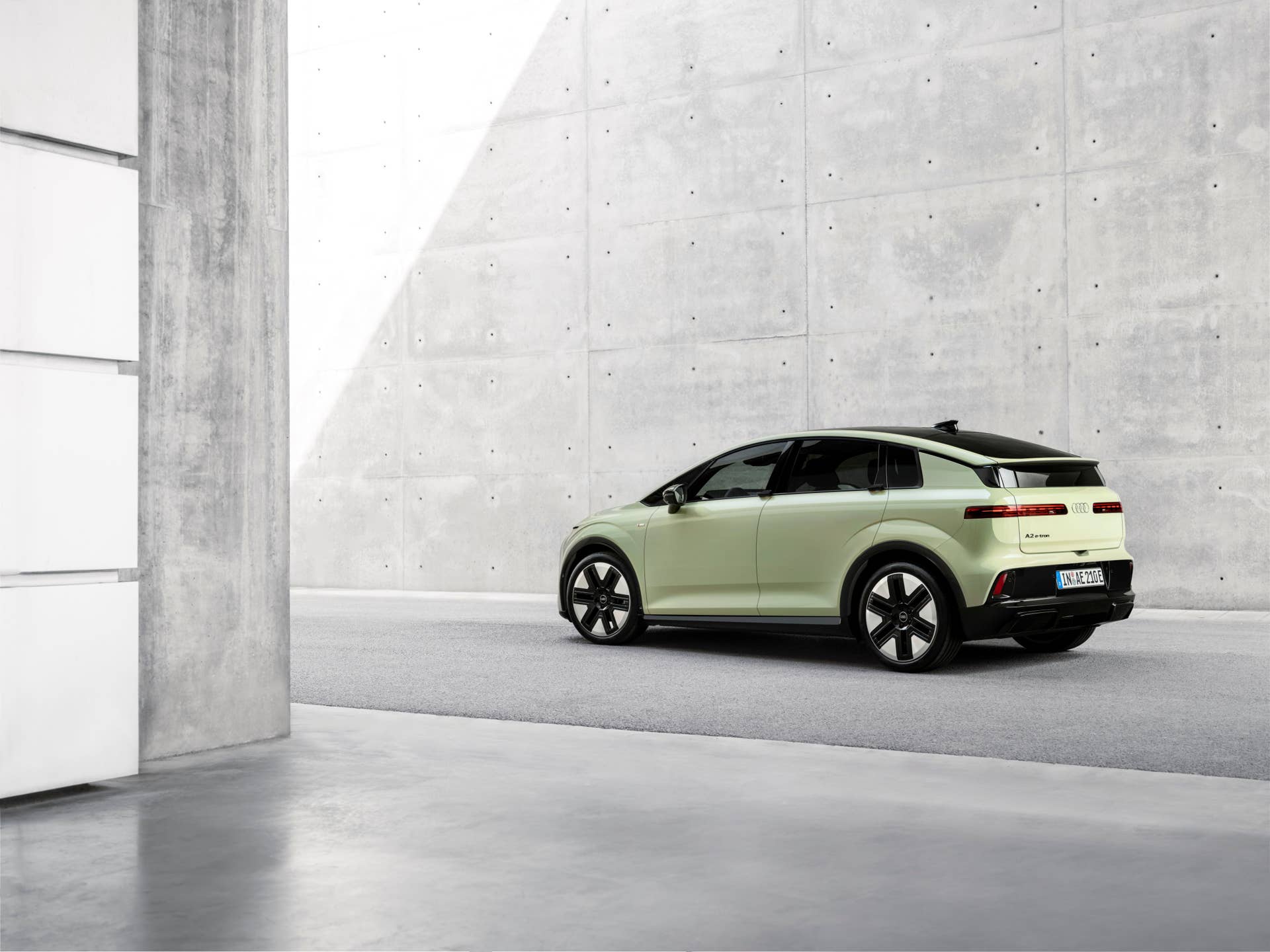
On Monday, Sept. 7, Audi CEO Gernot Doellner brought the A2 badge back in Paris, this time on an electric car. The timing matters more than the nostalgia.
Audi is reviving its most famous commercial failure at the exact moment Chinese automakers are proving that cheap and small can win in Europe.
Efficiency, not a lower price, is the pitch
The new A2 e-tron uses 12.8 kilowatt-hours per 100 kilometers, which Audi says “consumes less energy than any other series-production model from the brand before it,” according to the company’s launch statement.
That translates into a WLTP range of up to 646 kilometers, meaning fewer charging stops during daily driving.
Related: Automotive giant’s stock surges amid plan to cut 50,000 jobs
None of that comes cheap. German pricing starts at 38,200 euros, or roughly $44,364, according to Just Auto.
Chinese entrants such as BYD’s Dolphin and Seagull compete in the same size class for a fraction of that price, which means Audi isn’t chasing the same buyer at all.
Audi spreads that premium across four power outputs, from 125 to 240 kilowatts, and battery sizes up to 84 kilowatt-hours, according to Yahoo Autos.
The trim range lets Audi capture multiple price points without dropping into budget territory.
Chinese brands are winning the segment Audi just entered
Chinese-brand vehicles overtook Tesla in European battery-electric sales for the first time in May 2025, according to Euronews, a shift the outlet linked to aggressive pricing, even after the European Union imposed tariffs on Chinese-made EVs.
The tariff didn’t reverse the trend. It only slowed it.
The scale of that shift is bigger than one brand. Chinese-branded vehicles held roughly 16.5% of the European Union’s passenger car market by March 2026, and about 31% of the battery-electric segment specifically, according to data from the European Automobile Manufacturers’ Association.
That means almost one in three electric cars sold in the EU now carries a Chinese badge.
Audi’s own numbers show the pressure directly. Global deliveries fell 7% in the first half of 2026, with a nearly 20% drop in China alone, Reuters reported.
Audi blamed pricing pressure and shifting subsidy rules in China, the same forces now spreading into Europe.
The new Audi A2 skips its old hometown
Audi is building the A2 e-tron in Ingolstadt, not Neckarsulm, reusing more than 1,200 existing production parts and roughly 250 robots from other models to keep costs down, according to Yahoo Autos.
That detail is easy to miss and hard to ignore once you know what’s happening to Neckarsulm. It’s one of four German plants Volkswagen flagged as facing an uncertain production future under Future Plan 2030, a restructuring approved by the supervisory board on Sept. 3, Motor1 confirmed.
The plan adds another 50,000 job cuts on top of 50,000 already confirmed, pushing total planned reductions to 100,000, Reuters reported.
The financial backdrop explains the caution. Volkswagen’s operating margin contracted to 3.8% in the first half of 2026, down from a peak of 7.9% in 2022, according to Reuters. Building on old tooling, in a plant that isn’t under review, is a cost decision as much as an engineering one.
Volkswagen’s stock jumped, but the hard problem didn’t move
Volkswagen’s Frankfurt-listed shares rose more than 8% on Sept. 3, the day its supervisory board approved Future Plan 2030. Investors read deeper job cuts as a signal that fixed costs, not sales, would carry the turnaround.
That’s a bet on execution, not on China. Citi analysts noted the restructuring doesn’t change the competitive pressure in Europe, ongoing China losses, or raw material costs, and Volkswagen’s profit from its China joint ventures is projected to fall to as little as 200 million euros this year, down from 958 million euros in 2025.
More Auto Stocks:
- Elon Musk’s $30,000 Cybercab is about to face its biggest test
- EV maker’s biggest ever recall hits 27,000-plus sedans
- Top EV executive joins the AI boom. Now what?
The company’s own target is a 9% operating margin by 2030, up from the 3.8% it posted in the first half of 2026.
Management has until June 2027 to decide the fate of the four plants under review, Neckarsulm included, so the market’s optimism has a fairly specific deadline attached to it.
For investors, the A2 e-tron is a small test of that larger bet. If Audi can build a premium EV on reused tooling without inflating costs, that’s an early sign the margin math behind September’s rally might actually work.
Germany’s answer to a price war might not be a lower price
Ford is reportedly in advanced talks to sell part of a Spanish plant to China’s Geely, and BYD has said it’s discussing idle European factory space with Stellantis and other automakers, according to Electrek.
Legacy manufacturing capacity in Europe is changing hands, and Chinese brands are increasingly the ones doing the buying.
Audi chose a different path. It revived a discontinued model and used domestic cost discipline, not a price war, to make the economics work.
Whether that combination sells better in 2026 than it did in 2005 is the real question hanging over Ingolstadt. The badge on the hood is the least important part of the bet.
Ordering opens in Germany on Sept. 10, and early reservation numbers will offer the first real signal.
If Audi’s efficiency argument draws buyers who could have paid far less for a Chinese compact, the A2 name gets its second chance. If it doesn’t, Audi will have relearned the same lesson twice.
Related: The failed Honda-Nissan merger just got a second life