Not every company can instill enough confidence in Wall Street‘s biggest analysts for them to predict near-100% gains in the stock.
Csquare (CSQR) just did that in less than a month of going public.
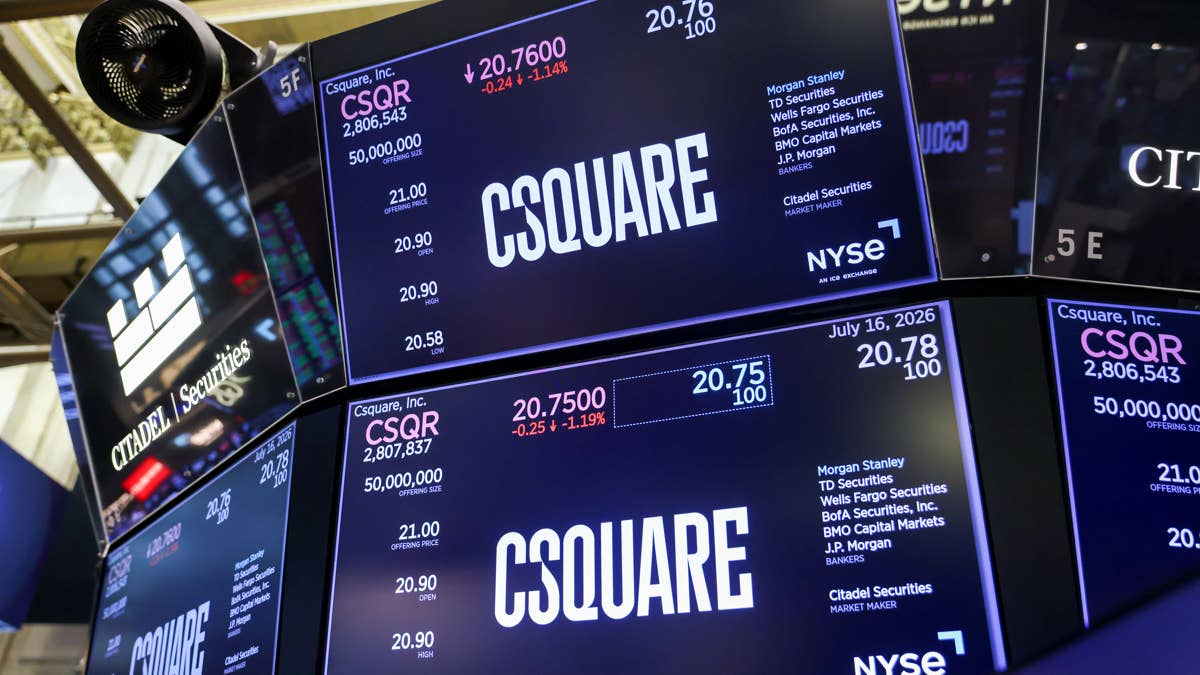
The data center operator listed on the New York Stock Exchange on Thursday, July 16, 2026, and a wave of big banks started covering the stock that same day.
One of them stood out from the rest with a single call that turned a quiet post-IPO stock into one of the most debated names in the data center market.
Why Bank of America thinks Csquare stock can climb to $46
Bank of America Securities started coverage of Csquare on August 10, 2026, with a Buy rating and a $46 price target.
At roughly $21.52, the stock’s price at the time, that target implied about a 114% increase, according to CNBC.
Analyst Michael Funk set the target using a projected 2027 EV/EBITDA multiple of 22x.
That measure compares a company’s total value to its core earnings. A higher multiple means investors are paying more for each dollar of those earnings.
Funk says the stock underprices Csquare’s growth. He also says the company is well placed to serve a market where supply can’t keep up with demand.
The three reasons behind the bullish Csquare call
Funk built the case on three points, according to Investing.com.
First, data center supply cannot keep up with demand from AI and cloud workloads.
Second, Csquare can add capacity faster and at lower development cost than many rivals, which helps it capture that demand.
Third, the valuation multiple should rise as growth speeds up.
Csquare also has a large backer. Investment firm Brookfield controls the company and holds about 67% of the voting power after the IPO, according to the IPOScoop.
That backing supports plans to expand and modernize existing sites rather than build everything from scratch.
What Csquare does and how its business is growing
Csquare runs enterprise colocation data centers, which are facilities where businesses rent space, power, and cooling to house their own servers.
The company operated 62 sites across 21 metro areas with about 385 megawatts of sellable capacity as of June 30, 2026, according to its SEC filing.
More AI Coverage:
- Jim Cramer reveals 6 AI stocks to watch in 2026
- OpenAI investors must consider latest CFO comments
- Kevin O’Leary’s colossal Utah data center hits a wall
Csquare’s second-quarter results, released August 6, 2026, showed steady demand.
Revenue rose 14.5% from a year earlier to $280.4 million, and colocation revenue climbed17.5% to $210.6 million, according to a company press release.
Bookings hit a record $64.7 million, the 13th straight quarter of record bookings.
Adjusted EBITDA, a measure of core operating profit, grew 21% to $120.3 million, with the margin widening to 46.2%.
The loss behind the record quarter
The same quarter carried a large loss that investors should understand before reading too much into the growth.
Csquare posted a net loss of $48.8 million in the second quarter, more than the $13.9 million loss a year earlier.
Most of that came from interest on debt the company carried before the IPO, plus one-time listing costs.
Related: Peter Schiff says SpaceX is a warning for hyped stocks
To address the debt, Csquare used IPO proceeds to repay borrowings and expects to cut annual interest expense by about $63 million.
Even so, the company still reported long-term debt of $4.89 billion as of June 30, 2026, according to its quarterly SEC filing.
That debt load is the main reason several analysts stayed cautious.
Why the rest of Wall Street sees far less upside
Bank of America’s $46 target sits well above every other bank that started coverage on the same day.
Here is how the initiations compared, according to CNBC:
August 10 analyst initiations on Csquare stock
- Bank of America: Buy, $46
- Jefferies: Buy, $29
- Scotiabank: Sector outperform, $30
- Bernstein: Outperform, $27
- Morgan Stanley: Overweight, $26
- Wells Fargo: Overweight, $25
- JPMorgan: Neutral, $24
The average target across the group sits near $26.56, which points to about a 16% increase rather than a double, according to TipRanks.
For context, Bank of America’s BofA Securities division was a participating underwriter of Csquare’s initial public offering. The lead underwriters were Morgan Stanley, TD Securities, and Wells Fargo Securities.
The risks investors should weigh before buying
A single high target does not settle the debate, and Csquare carries clear risks.
InvestingPro’s valuation model flagged the stock as overvalued against its estimated fair value, even with the bullish coverage, according to Investing.com.
Wells Fargo pointed to leverage as a primary risk, since heavy debt raises the cost of expansion and leaves less room for error.
There is also a policy risk. New York recently paused approvals for large new data centers while it studies grid and utility-bill effects, a reminder that expansion plans can stall.
Investors weighing the stock can watch three things:
- whether bookings keep setting records,
- whether debt and interest expense keep falling,
- and whether Csquare converts its expansion pipeline into paying capacity.
What the $46 target really tells investors
The Bank of America call is a useful example of how one target can sit far outside the consensus.
Funk’s $46 rests on Csquare hitting strong 2027 earnings and the market paying a higher multiple for them. Both need to happen for the target to hold.
The more cautious banks accept the growth but want proof that the company can lower its debt while it expands.
For readers, the practical takeaway is simple.
A doubling forecast is a projection, not a promise. Watch whether Csquare hits the earnings and multiple assumptions behind that $46 target each quarter.
Related: Morgan Stanley says SpaceX investors miss the bigger story