For years, Tesla’s robotaxi story has been easy to describe and hard to measure.
Elon Musk made promises, Wall Street argued about them, and the actual number of driverless miles stayed small enough to ignore. In July, Tesla’s unsupervised fleet had logged about 380,000 miles in total.
That changed over the summer. Tesla now has a growth curve it can point to, and one of Wall Street’s bigger Tesla bulls says the curve just bent upward.
If you own Tesla, or an index fund where it ranks among the biggest holdings, this is the number the stock now trades on. Car sales still pay the bills, but the Robotaxi is what investors are paying for.
That makes the pace of growth, not just the promise, the thing worth watching. A service that adds a few thousand miles a month is a science project. One that doubles every few weeks starts to look like a business.
However, a less flattering detail sits a few pages deeper in the same research.
Tesla’s (TSLA) Robotaxi service “has hit an inflection point,” Bank of America analyst Alexander Perry wrote in an Oct. 22 research note reviewed by TheStreet.
He kept a Buy rating and a $460 price objective, about 19% above the $386.47 price the bank used, while trimming his 2027 earnings estimate to $2.26 a share from $2.47.
Tesla’s Robotaxi miles doubled in about four weeks
The bank’s math is simple. Unsupervised miles grew from 380,000 on July 22 to 1 million on Sept. 3, then to roughly 2 million by Sept. 30, Perry wrote.
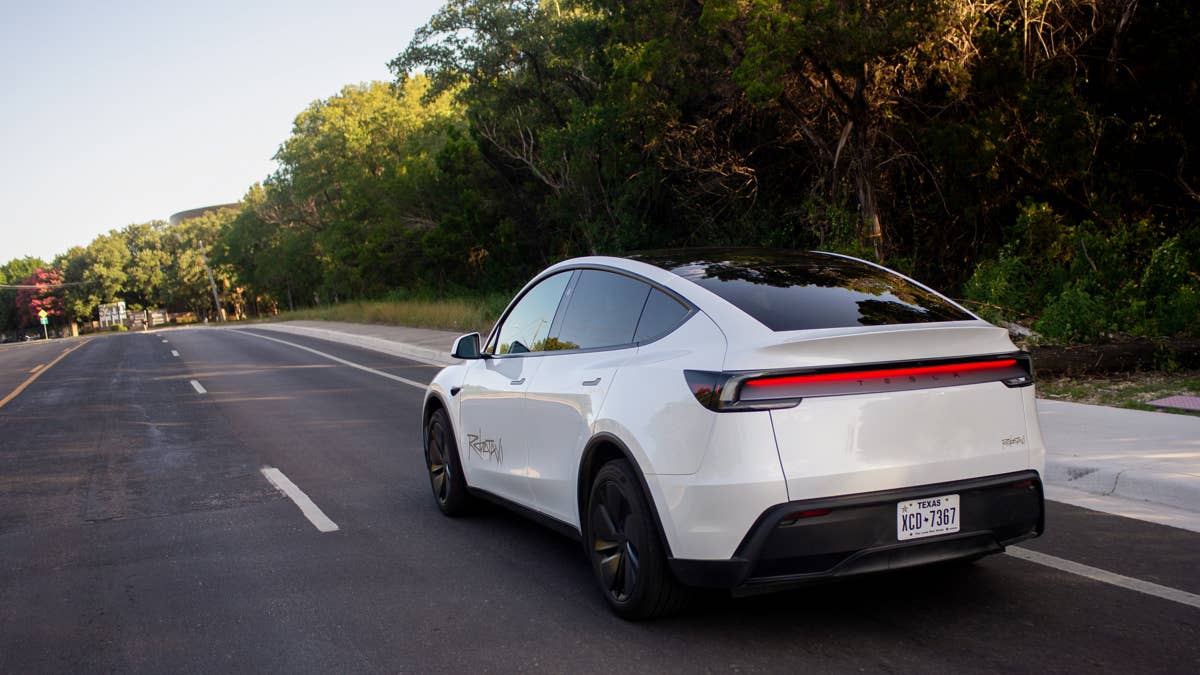
Weekly growth sped up from 17% to about 20% after Tesla added the two-seat Cybercab to its Austin fleet, the note said. Cybercabs now make up 45% of the Texas fleet, according to the bank.
Tesla’s own executives described the same surge on the Oct. 21 earnings call. “Accumulative unsupervised miles 8x in the quarter, as we had weekly double-digit growth throughout the quarter,” said Chief Financial Officer Vaibhav Taneja.
Related: Tesla Robotaxi prices just jumped. Here is what riders pay now
Production is no longer the bottleneck, Tesla says. “Right now, we’re building at the rate that the Robotaxi service needs the vehicles,” said Lars Moravy, Tesla’s vice president of vehicle engineering.
Perry credited the software. “We believe TSLA’s comfort in scaling its robotaxi service more rapidly is being enabled by running on a more advanced version of FSD [Full Self-Driving] compared to the consumer fleet,” he wrote.
Why Tesla’s base business still matters
Under the Robotaxi story, Tesla’s quarter was mixed. Revenue was flat at $28.05 billion, while adjusted earnings of 48 cents a share beat estimates, Electrek reported.
The auto business did its job. Automotive gross margin, excluding regulatory credits, rose to 18.1% from 15.4% a year earlier, according to Electrek.
More Tesla:
- SpaceX shares soar on possible tie-up with Tesla
- Sam Altman praises the Tesla Roadster he gave up on
- Wall Street bank makes radical Tesla call after Q3 deliveries news
Here is what else stood out in the quarter, according to the bank and coverage of the results:
- More than 75% of North American buyers signed up for paid Full Self-Driving at delivery, up from more than 55% in the second quarter, according to the Bank of America note.
- Operating expenses jumped 39%, and research and development spending rose 69% to $2.76 billion, Electrek reported.
- Tesla cut its 2026 capital spending target to about $20 billion from $25 billion, Taneja said on the call.
- Also during the call, Musk said Tesla is “almost sold out of all Megapacks for 2027” as data centers buy its batteries.
The shares still slipped. Tesla was down about 1% in late-morning trading on Oct. 22.
The free cash flow bill arrives first
This is the part of the note I spent the most time on. Perry’s model has Tesla’s free cash flow turning negative, at about minus $4.6 billion in 2026 and minus $11.3 billion in 2027.
That is a sharp swing from the $1.53 billion Tesla generated in the third quarter alone, and from the $6.2 billion the bank shows for all of 2025. The model also has capital spending rising to about $25.4 billion in 2027 and Tesla adding $9.5 billion in debt that year.
In my analysis, that is the real trade-off investors are signing up for. Tesla is funding Robotaxis, Optimus robots, and AI chips at the same time, and the bank expects the cash to flow out well before Robotaxi profits flow in.
Electrek‘s Fred Lambert flagged a related problem. With only about $13 billion spent through September, he wrote, “either Q4 spending explodes, or the 2026 plan is quietly slipping into 2027.”
Waymo still has a huge head start
Two million miles is real progress, but scale matters. Waymo, owned by Alphabet (GOOGL), had driven 171 million fully autonomous miles by the end of 2025, according to Sherwood News, citing the company.
By that measure, Tesla’s total is a little over 1% of where Waymo stood 10 months ago. At 20% weekly growth, though, Tesla’s miles would double roughly every four weeks, which is why Perry sees the curve as the story.
Costs still have to come down. “Are we at our goal of $0.30 today? No,” Taneja said of Tesla’s target cost per mile, adding that the company sees “a path” to get there.
Regular Tesla owners will wait longer. Ashok Elluswamy, Tesla’s vice president of AI software, said “somewhere around Q2 next year” is when some customer cars could get unsupervised self-driving.
Optimus and Megapacks are the next catalysts
Perry sees the Robotaxi business turning into a real profit line within about 14 months, and he expects Tesla’s other new products to help along the way.
Optimus production has started on Fremont’s high-volume line, but reaching about 1 million units a year “will likely take at least a year,” he wrote. Megapack prices and margins should benefit in the fourth quarter and 2027 as demand outpaces supply, the note said.
Much will likely depend, however, on whether Tesla can keep the 20% weekly pace once the novelty fades. Growth from a small base is the easiest kind to post.
Perry’s verdict was clear. “We reiterate our Buy rating and $460 PO [price objective] as we see TSLA moving past early autonomy monetization, with Robotaxi a meaningful earnings driver by YE27 [the end of 2027].”