In many ways, Alphabet (GOOGL) stock investors entered the earnings season looking for proof that AI was strengthening its Search business without forcing another major bump in spending.
Though the quarter delivered evidence of robust demand, it wasn’t the confirmation Wall Street was hoping for.
For perspective, Alphabet reported its Q2 2026 earnings on July 22, 2026, and Google stock fell 7.1% to $317.69 on Thursday, July 23, wiping nearly $294 billion from its market value, according to MarketWatch reporting.
Google Cloud sales jumped 82%, margins expanded sharply, and backlog climbed to $514 billion. However, Alphabet raised 2026 capex guidance to as much as $205 billion, stoking fears that AI returns may arrive more slowly than the bills, as free cash flow turned negative.
Nevertheless, Bank of America kept its Buy rating after the quarter, arguing that the market may be overlooking what Alphabet’s spending is already producing.
Though Search revenue was roughly in line with expectations, Alphabet’s consolidated operating margin expanded to 34% from 32%, while operating income rose 30%.
BofA analysts therefore believed the company had been punished too harshly, as investors overlooked accelerating Cloud growth and other signs that its AI investments are beginning to generate returns.
Alphabet Q2 earnings at a glance
- Q2 revenue reached $119.8 billion, while net revenue excluding TAC came in at $103.6 billion, above the $101.1 billion consensus.
- GAAP EPS was $9.11, compared with Wall Street’s $2.90 estimate.
- Google Search revenue rose 17% to $63.3 billion, while YouTube advertising revenue increased 13% to $11.1 billion.
- Google Cloud revenue surged 82% to $24.8 billion, with operating income of $8.8 billion and a 35.6% margin.
- Alphabet raised 2026 capex guidance to $195 billion–$205 billion, while Q2 free cash flow was negative $5.9 billion.
- BofA maintained its Buy rating and $430 price target, forecasting $553 billion in 2027 revenue and $15.01 in EPS.
Source: Bank of America post-earnings note on Alphabet stock.
BofA thinks Alphabet’s AI spending is already paying off
BofA analysts reiterated their Buy rating and $430 price target on Alphabet stock post-earnings, arguing that there’s a clear mismatch between what investors are viewing and what the quarter actually showed.
More AI:
- Workers just sent AI companies an ultimatum
- Palantir CEO has a blunt verdict on OpenAI and Anthropic
- Elon Musk pulls no punches with AI rivals as Grok 4.5 debuts
The market was clearly looking at Alphabet bumping its 2026 CapEx guidance to $195 billion to $205 billion, along with negative free cash flows and a greater likelihood of elevated spending in 2027.
Those concerns are legitimate, as it’s now forecasting a negative $16 billion of free cash flow in 2026 and another negative $18.5 billion in 2027.
However, the bank believes that’s far from a speculative AI investment, where Alphabet is already seeing measurable revenue, margin, and backlog benefits.
At the same time, BofA analysts believe Google Cloud is effectively becoming Alphabet’s incremental growth and valuation engine.
Cloud sales accelerated 82% year over year to $24.8 billion, compared to the Street’s 65% forecast, while operating margin surged to 35.6%, comfortably above the 31.3% consensus. Typically, with rapid growth, we usually see margin pressure, but Alphabet instead produced faster growth and better profitability, which suggests that AI infrastructure is perhaps generating attractive utilization with stronger pricing.
Moreover, the demand indicators are still healthy and point to a capacity-driven CapEx increase.
Cloud backlog surged to $514 billion, up $50 billion sequentially; customers are consuming more than 50% above contractual commitments, and Alphabet is winning new Cloud customers at over 2 times last year’s pace.
At the same time, Search remains an important supporting pillar.
Search revenue grew 17%, which shows that AI products haven’t materially impacted Google’s core advertising engine. However, sales were mostly in line with expectations. which doesn’t exactly validate the thesis that AI Overviews and AI Mode are producing a major Search acceleration.
How does BofA arrive at its $430 price target?
BofA values Alphabet stock at 27 times the adjusted 2027 core Google GAAP EPS of $15.55. That produces an operating-business value of approximately $419 per share. It then adds $11 per share of estimated year-end 2026 cash, resulting in the $430 target.
Interestingly, the bank, in acknowledging the heightened CapEx, weaker cash flow, and AI spending concerns, lowered its target multiple from 28 times to 27 times.
However, at the same time, the bank’s analysts raised their 2027 revenue estimate by 3% to $553 billion and consolidated EPS estimate by 2% to $15.01. So in effect, the higher earnings forecast offset the lower multiple, leaving the target unchanged.
When the report was released, Google’s stock was trading at anafter-hours price of $332, trading at 22 times BofA’s 2027 GAAP EPS, aligning with its 10-year historical average.
BofA considers the stock to be attractively priced, especially with sales expected to ramp up to 27% in 2027, compared to an average of nearly 14% from 2023 through 2025.
Additionally, as we saw with SpaceX, BofA’s sum-of-the-parts analysis added a complicated new layer.
BofA says that once Alphabet’s faster-growing businesses are valued separately, its core Search advertising and Google Play operations trade at just 13 times earnings, versus 20 times for the S&P 500. That opens up the question for investors, who need to know how much value belongs to mature advertising versus newer AI, cloud, and Waymo assets.
What are the weaknesses in BofA’s argument?
Perhaps the biggest issue with Alphabet’s predicament is that its profit and loss statement is improving more quickly than the cash flow.
Case in point is its negative $5.9 billion in Q2 free cash flow, which constrained its ability to repurchase shares, and its statement that buybacks are unlikely to resume for the rest of 2026. Alphabet also plans a $40 billion at-the-market equity program, which could create dilution precisely when investors are questioning capital discipline.
Furthermore, BofA expects capex to rise to $200 billion in 2026 and to roughly $300 billion in 2027. That essentially means the Cloud businesses must continue converting backlog into sales at very high rates while maintaining margins near the mid-30% range.
If Cloud growth slows down before depreciation and infrastructure costs peak, Alphabet risks facing simultaneous top-line deceleration, margin compression, and ongoing negative free cash flow.
At the same time, there is also an earnings-quality issue.
Alphabet’s reported $9.11 EPS, which was heavily influenced by $98 billion of other income, linked to the Anthropic revaluation. That gain doesn’t reflect recurring operational performance, so the headline EPS beat cannot be treated as evidence that the underlying business sped past estimates by a comparable amount.
What Alphabet’s AI spending bet means for investors
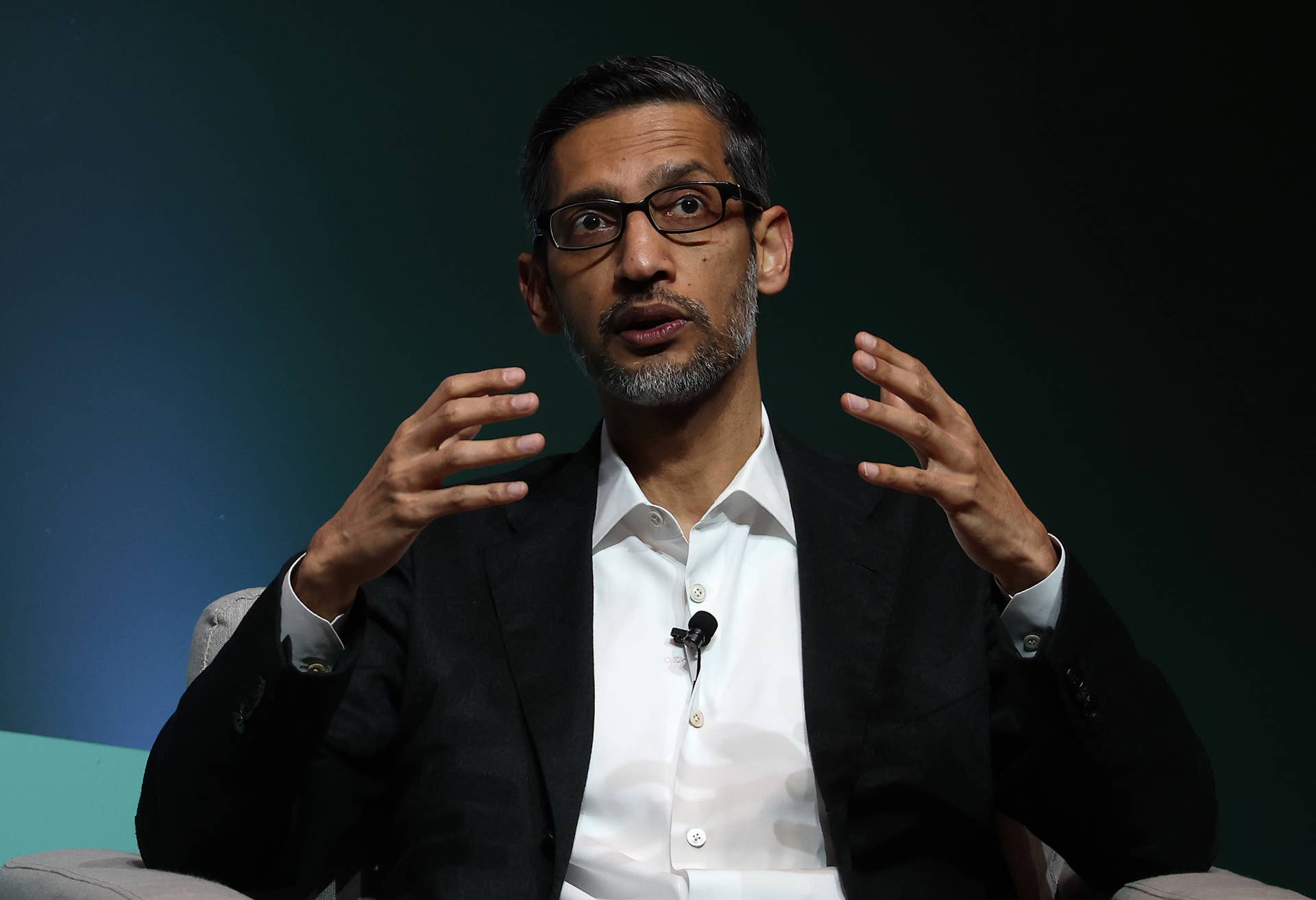
Google CEO Sundar Pichai had a lot to say during the company’s Q2 earnings call, with major implications for investors.
Pichai’s comments suggested that Alphabet is deliberately accepting near-term cash flow and margin pressure to secure longer-duration customer economics.
He said that he was “more bullish on the opportunities ahead” over the past year, describing AI as a secular shift in which enterprises are still “barely scratching the early stages of what’s possible.”
He elaborated on that long-term theme in a discussion on renting third-party capacity.
Pichai acknowledged that serving major Cloud customers could carry a “very high” short-term cost, but framed it as accepting a six-month expense to capture a multiyear contract with “very, very attractive” returns.
That means Alphabet is looking to optimize for customer lifetime value rather than just quarterly Cloud margins, although investors must trust that internal capacity will eventually replace those expensive leases.
Additionally, Pichai also offered a more nuanced view of Google’s AI moat.
He said, “The model is just an ingredient” inside larger cybersecurity, data, infrastructure, and agentic workflow solutions. However, Google’s real moat rests on Gemini, TPUs, proprietary infrastructure, enterprise data controls, and distribution into one integrated system.
Put simply, investors should expect a lot more quarter-to-quarter shocks in CapEx, free cash flow, and cloud margins as Google races to secure AI capacity.
Related: Bank of America targets Nvidia’s next $170 billion growth engine