Every great franchise eventually confronts the awkward second act.
The founder leaves, the crowd shows up out of habit, and for a while the rituals still feel familiar.
Then the numbers start to wobble.
Investors usually blame the macro, the rates, or the latest market obsession. They tell themselves the brand is too strong, the moat too wide. Patience, they say, will be rewarded.
For 60 years, that was the Berkshire Hathaway (BRK.A, BRK.B) story. Buy the stock, leave it alone, let Warren Buffett do his thing, and ride the curve of one of the greatest compounding records in American finance.
It became a quiet default in millions of 401(k)s and IRAs, the boring, dependable, never-blow-up corner of the portfolio.
The boring part is no longer behaving.
Berkshire’s Class B shares have trailed the S&P 500 by more than 37 percentage points over the past twelve months, the worst one-year stretch since 2000, according to Bloomberg. That is about $139 billion of relative market value vanished into the gap between the index and the trillion-dollar icon.
Why Berkshire’s slide hurts Main Street investors
For decades, owning Berkshire was the financial equivalent of buying a Volvo. You did not need to follow Wall Street twitter. You bought, you held, and the stock did its job.
That tidy story is fraying.
Related: Berkshire Hathaway’s new CEO just made a move Buffett never did
Berkshire shares are down about 6% so far in 2026 while the S&P 500 has climbed 5.6%, putting the conglomerate on track for its first losing year since 2015, CNBC reported. Class A and B shares are sitting roughly 13% below their all-time closing highs from a year ago.
If you hold Berkshire as a “core” position alongside index funds, that divergence lands in the most painful place possible. Your annual statement.
A retiree who treated Berkshire as a defensive sleeve has effectively swapped out the safest part of the portfolio for the laggard. The premium that came with owning the Buffett name has flipped into a discount.
I ran the math on a 60/40 portfolio with a 10% Berkshire tilt against a clean S&P 500 mix. The Berkshire-flavored version trailed by roughly three percentage points over the past 12 months. For someone five years from retirement, that is real money quietly leaking out of the plan.
On a $500,000 nest egg, the gap is roughly $15,000 the saver did not bank. Multiplied across a couple of compounding years, the missed return starts looking like a missing trip, a kitchen renovation, or a year of a kid’s tuition.
The discount is no longer a Buffett premium waiting to be unlocked. It is the market starting to price in life after Buffett.
Fund manager buys and sells
- Cathie Wood buys $2.5 million of tumbling megacap stock
- Warren Buffett dumped 77% of Amazon to buy surging media stock
- Cathie Wood buys $11 million of tumbling megacap tech stock
How Greg Abel inherited the Buffett shadow
Abel was not handed a turnaround. He was handed a legacy.
The 63-year-old Canadian executive has been at Berkshire since 2000, ran the company’s sprawling energy and non-insurance operations for years, and was anointed by Buffett as far back as 2021. The handoff itself was orderly. The reaction has not been.
The 2025 numbers tell the deeper story. Operating profits overall declined 6% last year, and a combined $8.3 billion in impairments hit Berkshire’s investments in Kraft Heinz (KHC) and Occidental Petroleum (OXY), Advisor Perspectives reported.
Insurance underwriting earnings, the engine that powers Buffett’s famous “float,” slumped more than 54% in the fourth quarter, while peers managed to beat expectations.
The equity portfolio has its own messes. Reports in late April hinted Abel may exit Berkshire’s longtime Bank of America (BAC) position, with shares trading at a notable premium to book value, according to the Motley Fool. Trimming it would mark Abel’s most visible early break with the Buffett playbook, and signal to the market that the new CEO is ready to act on price even when the brand name is sacred.
The bruises are not Abel’s fault, but the calendar gives him no relief. Every chart now starts with his face on it. Every miss reads like an indictment of the new boss rather than a hangover from the old one.
Where Wall Street’s verdict on Greg Abel really starts
I went back through the past 12 months of numbers looking for a friendly way to frame them. There is not one.
Stack the relative-performance gap against the company’s own scars and the picture comes into focus.
Berkshire’s tough stretch by the numbers
- Class B shares have lagged the S&P 500 by more than 37 percentage points over the past 12 months, the worst stretch since 2000, according to Bloomberg.
- Roughly $139 billion in relative market value has evaporated over that span, per Bloomberg.
- 2025 operating profit fell about 6%, with $8.3 billion in impairments on Kraft Heinz and Occidental Petroleum, according to Advisor Perspectives.
- First-quarter 2026 buybacks totaled just $235 million against a $397 billion cash pile, CNBC reported.
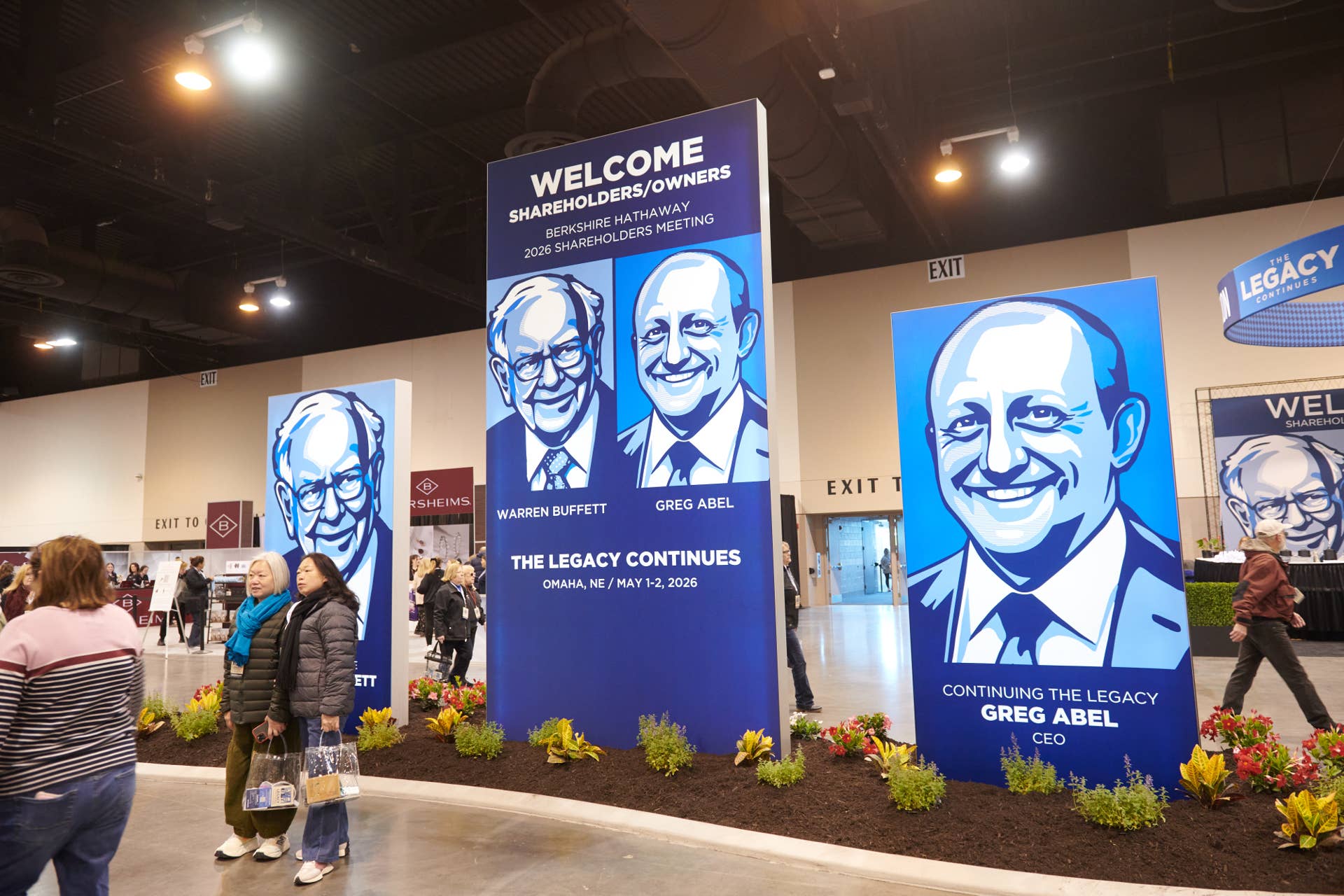
That last bullet is the one that actually rattled analysts at the May 2 annual meeting in Omaha.
UBS analyst Brian Meredith kept his buy rating but flagged the cautious pace, writing that Abel “performed well in his first Annual Meeting as CEO,” according to CNBC.
CFRA’s Catherine Seifert was less generous, saying clients “were hoping for a more aggressive buyback stance” given how cheap the stock looks against intrinsic value.
Abel, for his part, refused to budge on the structural questions. Asked whether Berkshire might break itself up to unlock value, he answered “Absolutely not”, telling shareholders the conglomerate model still works “without the bureaucracy and bloated costs,” per CNBC.
Buffett, watching from the front row, gave his successor the kind of cover only he can. “Greg is doing everything I did and then some, and he’s doing it better in all cases,” the 95-year-old chairman told the crowd, per CNBC.
That endorsement carries weight. It is not yet worth a market-beating stock.
What Greg Abel’s audition means for the rest of 2026
What I keep returning to is the math underneath the noise.
Berkshire posted an 18% jump in first-quarter operating profit and a 28.5% surge in insurance underwriting earnings, the company said. Cash and Treasury bills sit near $397 billion, an arsenal that grows more dangerous every time the broader market sells off. As Goldman Sachs unveiled in its stock market forecast through 2035, the next decade is expected to favor disciplined capital allocators over momentum chasers, which is theoretically Berkshire’s lane.
For long-term holders, especially personal finance readers using Berkshire as a stabilizer, the question is not whether Abel can match Buffett’s mythology. It is whether he can deploy that cash into something Wall Street loves before retail investors lose patience and rotate out.
If he does, this stretch becomes a footnote in a 70-year compounding story. If he does not, the trillion-dollar icon could keep loosening its quiet grip on the average American’s nest egg.
The 2026 meeting was Abel’s introduction. The next four quarters are his audition.
Related: Warren Buffett has message for investors on Berkshire’s new CEO