You learn early in life which voices are worth pricing. The friend who says 7 o’clock and shows up at 7. The contractor who quotes three weeks and hands you the keys in three weeks. You stop double-checking those people, and the trust saves you real money.
You learn the reverse just as fast. Someone tells you the same thing enough times without it landing, and you quietly stop rearranging your week around it. There is no argument and no falling out. You simply stop believing hard enough to act on it.
Markets run that same calculation, only faster and with money on the line. Oil is the purest version of it, because a barrel of crude is mostly a wager on what happens next in places where almost nothing is settled.
When a credible official signals that the risk is easing, traders unwind positions, and prices drop long before a single extra barrel reaches a refinery.
Which brings us to a Treasury secretary who has now told you three times in four weeks that oil is about to get cheaper.
Why oil traders price what a Treasury secretary says
Crude is not priced off what is in the ground. It is priced off what people expect to be available six months from now, and expectations move on information.
The Strait of Hormuz has been the whole ballgame since the war with Iran began in late February. Roughly one in five barrels of the world’s oil normally passes through that 21-mile channel, and the market has spent months adding and subtracting a risk premium based on how open it looks that week.
Related: Bessent just escalated his financial war on Iran
A Treasury secretary occupies an unusual seat in that calculation. He is not a forecaster with a spreadsheet. He is inside the negotiations, which means his words carry information nobody else has, and traders pay for information.
That is why the Aug. 4 “Squawk Box” episode mattered. Bessent went on CNBC and said a deal to reopen the Strait could come within a day or two.
Brent settled at $79.36, down 5.3%. West Texas Intermediate settled at $75.77, down 5.7%, according to CNBC. The market moved before he finished the interview.
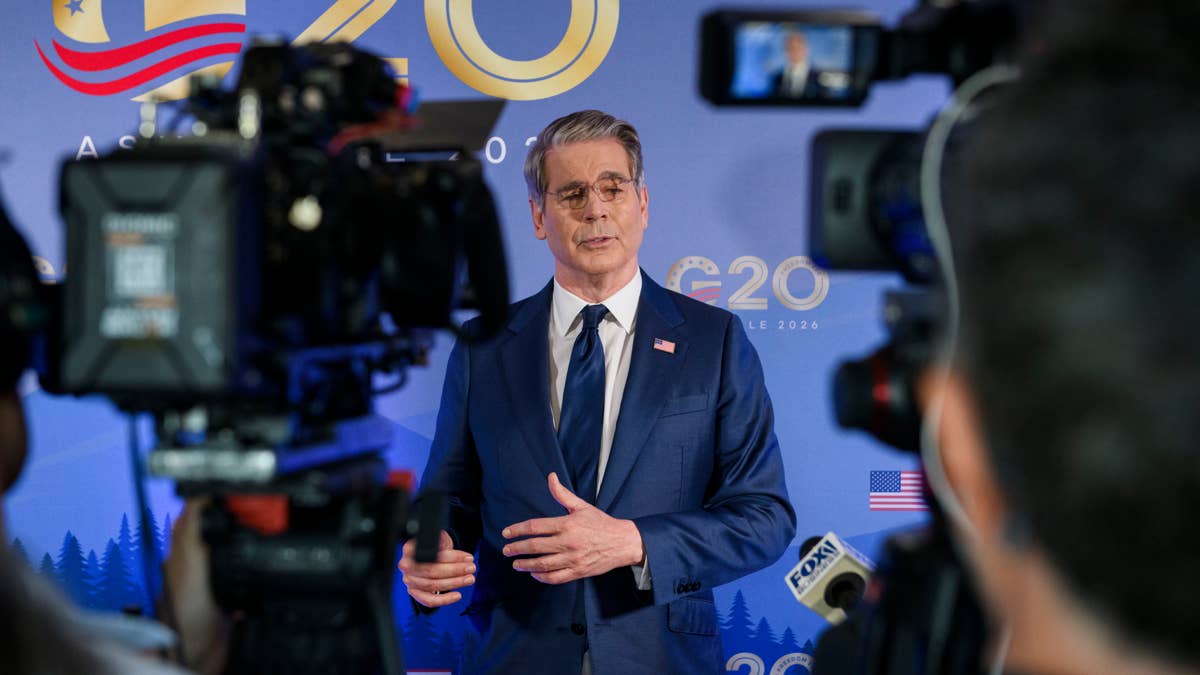
What Bessent said about oil prices on Aug. 31
Bessent sat down with CNBC’s Sara Eisen on Aug. 31, hosting Group of 20 finance ministers in Asheville, N.C. Asked to tie together growth, trade, and the conflict, he said “the oil prices are going to come down,” according to CNBC.
He layered other signals on top. He said the sanctions campaign against Tehran is designed to force Iran to the table, and that he expects Japan’s government and central bank to act in ways that strengthen the yen.
More Oil & Gas:
- The Red Sea just got more dangerous for Saudi oil
- Oil markets look calm on top, but underneath shows a big toll
- Is Trump’s big, splashy Venezuela oil deal real?
On monetary policy, Bessent said, “Traditionally, you don’t raise rates into a supply shock,” FXStreet reported.
That last line is the tell. It is a Treasury secretary telling the Federal Reserve, in public and without saying so, that an oil-driven price spike is not the kind of inflation you fight with rate hikes.
The call itself was not new. On Aug. 20, he told the same network that Washington was confident everyone wanted “energy prices to come back down,” according to CNBC.
Eisen pointed out in that same conversation that oil was marching higher again. Back on May 28, at a Cabinet meeting, he had described elevated oil costs as transitory and pledged that oil would end up below pre-conflict levels.
3 calls in 4 weeks and a fading market response
Here is where I stopped taking the statement at face value and lined up what the market actually did each time. The forecast has been consistent. The reaction has not.
- Aug. 4: Bessent signaled a Hormuz deal within days. Brent fell 5.3% to $79.36 and WTI fell 5.7% to $75.77, according to CNBC.
- Aug. 20: Bessent said all parties wanted energy prices lower. Eisen noted on air that crude was climbing again, CNBC noted.
- Aug. 31: Bessent said oil prices were going to come down. Brent pushed above $90 the same day as U.S. forces struck Iranian positions on Larak Island, according to Trading Economics.
Read that sequence as a price chart rather than a news cycle, and the shape is obvious. The first call was worth more than five percentage points of crude in a single session. The third arrived while barrels were moving the other way.
Brent was at about $96 on Sept. 2, according to Fortune, and WTI was at about $90, according to Trading Economics.
The market is not calling the Treasury secretary dishonest. It has simply repriced how much a forecast is worth when the thing being forecast keeps failing to happen.
Refinery strikes in Russia have tightened global refining capacity, and a supertanker caught fire in the Strait after striking naval mines. Words do not clear mines.
What the cheaper oil promise means for your gas budget
The national average for regular gasoline sat at roughly $4.10 a gallon on Sept. 2, according to AAA. A year ago, you were paying meaningfully less for the same tank.
Run that against your own driving. If you cover 13,000 miles a year in a vehicle averaging 25 miles per gallon, you burn about 520 gallons. Every 10 cents on the national average is roughly $52 a year out of your pocket. The dollar-plus move since the war began is closer to $550 annually, and that is before you count what the pump has actually done to household budgets.
What I would take from the past four weeks is narrow and useful. Do not build a household budget around a forecast from a podium, however well informed the person at the podium is. Build it around what physically moves.
The observable signals are tanker traffic through Hormuz, refinery capacity, and the risk premium sitting in Brent. Those are the things that show up on your receipt. A televised prediction shows up on your receipt only if it turns into cargo.
There is a second consequence sitting underneath all of this. The supply-shock argument Bessent made about interest rates is the case for the Fed cutting, despite hot headline inflation.
If crude cooperates, that argument gets easier, and your mortgage and car loan eventually get cheaper. If crude does not, the Fed stays frozen, and you pay for the same barrel twice, once at the pump and once on your credit card statement.
That is the real stake in whether this third call lands. Not whether a Treasury secretary is right, but whether the market ever starts believing him again before the barrels arrive on their own.
Related: Oil prices tumble as Oman and Iran make an unexpected move