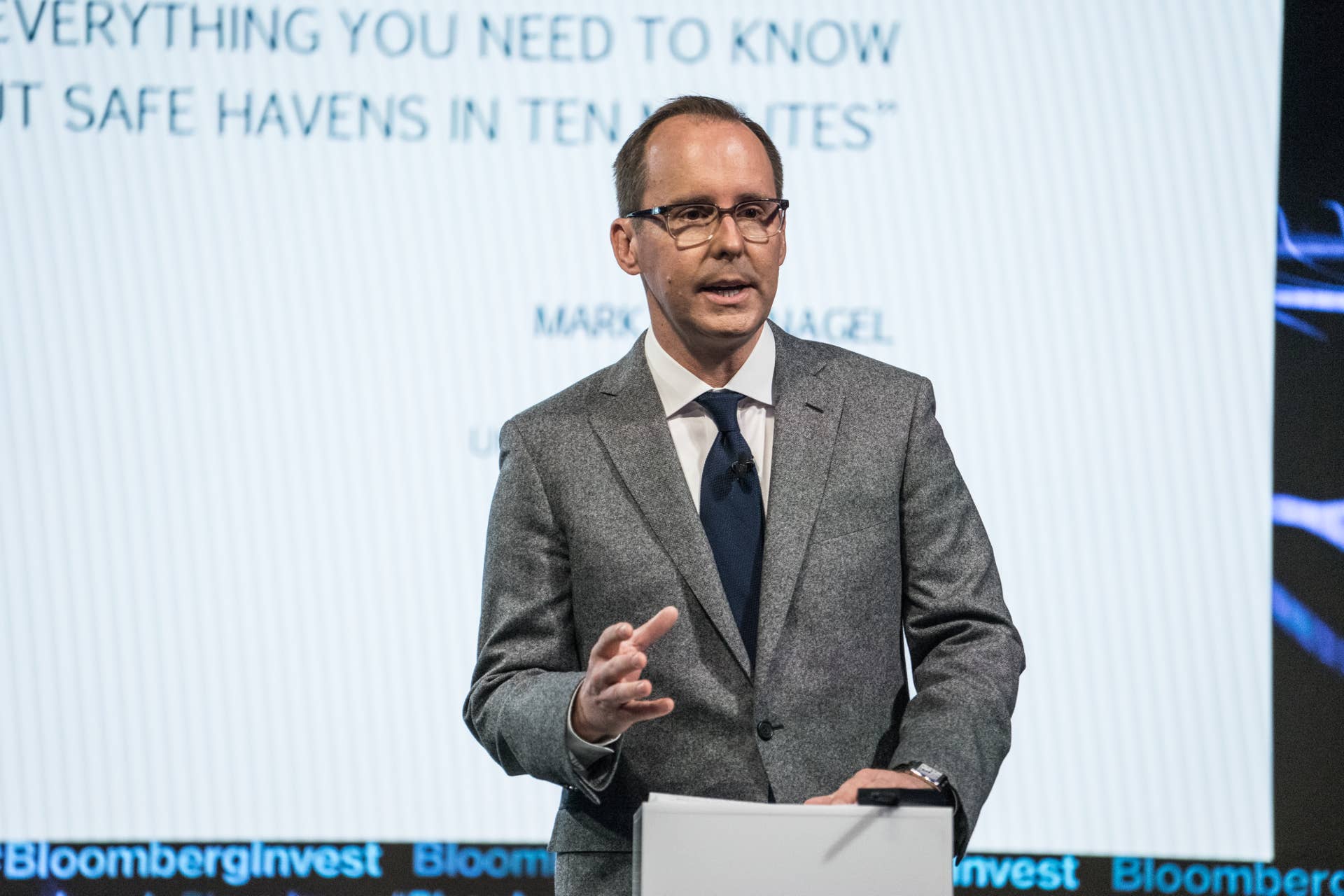
Mark Spitznagel has built his career preparing for disasters most investors hope never arrive.
Right now, however, he doesn’t want investors to panic.
The Universa Investments founder expects risk assets to experience another powerful “euphoric rally” before a potentially historic market collapse.
That is a curious message from somebody whose organization profits from dramatic market disasters.
“I will be the biggest bear that you’ll hear from in the months ahead,” Spitznagel told Business Insider. “I’m just not right now.”
And the timing counts. The S&P 500 is up over 13% year-to-date in 2026, with excitement in artificial intelligence continuing to buoy technology firms. HSBC on Sept. 8 raised its year-end S&P 500 target to 8,100, citing strong corporate earnings and continued AI infrastructure spending.
Spitznagel sees something very different after the rally ends. He believes the next collapse could be bigger than any he has experienced.
Mark Spitznagel expects one more massive rally
Spitznagel’s warning contains an important distinction.
He recognizes market excesses, such as leverage and more aggressive wagers, but doesn’t see an evident reason for an imminent disaster.
Instead, he expects “one more really big, risk-on, insane, euphoric rally” across risk assets before conditions reverse.
It’s hardly the first time Spitznagel has made that case.
He told Reuters in September 2025 that stocks could rise 20%, pushing the S&P 500 above 8,000, before collapsing. He predicted an 80% crash after a historic blow-off rally.
A year later, the first portion of that argument seems a lot less radical.
Related: Michael Burry sends a strong warning to Palantir stock investors
The S&P 500 recently traded at 7,700, bringing the 8,000 level within reach. This is also the way many of the big Wall Street investment banks are heading: HSBC now has its year-end objective at 8,100, while Reuters reports Goldman Sachs, Morgan Stanley and Citigroup are all looking for the index to hit or surpass 8,000.
The rub is that achieving that level wouldn’t make Spitznagel any more bullish.
It might make him a lot more bearish.
Michael Burry and Spitznagel see the same AI danger
Spitznagel’s worry is about artificial intelligence.
He agrees with “The Big Short” investor Michael Burry that the massive expenditure by AI hyperscalers on chips and data centers, circular financing and hidden liabilities are worth investigating.
What sets the two investors apart is the time.
Spitznagel believes Burry is “going to get the timing wrong.”
That difference is important because investing against a bubble too early may be monumentally costly.
Some segments of the IT business are still seeing real growth from AI investment. Snowflake upped its full-year product-revenue guidance as AI demand lifted growth. Nvidia agreed to pay $12.93 billion for Hugging Face, as it extends beyond processors into the wider AI ecosystem.
Meanwhile, another pressure is growing.
Equity valuations and borrowing costs are threatened by the approaching 5% 10-year Treasury yield. Forward price-to-earnings for the S&P 500 was 19.7, above its long-term average.
Spitznagel also thinks the economy is “rolling over” as the lagged effects of past interest-rate hikes continue to work their way through the system.
A 4,144% return explains Spitznagel’s unusual strategy
This figure helps better understand Spitznagel’s present bullishness, says Universa.
The business is a specialist in tail-risk protection, using severely out-of-the-money options that are supposed to provide tremendous rewards in the event of major market dislocations.
Those positions lose money most of the time.
And then something snaps.
In the pandemic-driven collapse of early 2020, Universa posted a 4,144% return in the first quarter on funds committed to their hedging strategy. That result was not a 4,144% return on an investor’s whole portfolio, a crucial difference, but it did show how substantially tail protection may pay off during a crisis.
More Wall Street:
- Wall Street’s AI trade faces its biggest valuation test
- The next Wall Street shift is already underway
- Wall Street sends strong 4-word verdict on the stock market
Spitznagel says that investors may leave the bulk of their portfolio exposed to equities while putting a modest percentage into such protection.
And thus we have the seeming contradiction at the core of his perspective.
His hedging might be quite negative, but the rest of the portfolio can still be optimistic.
Spitznagel’s warning gives investors a difficult choice
Spitznagel isn’t saying stocks have to fall tomorrow.
Which is what makes his warning intriguing.
He believes the market could become even more euphoric first.
Wall Street now has proof on both sides of that argument. Investment in AI is still powering growth, and corporate profits are still healthy enough for HSBC to lift its S&P 500 projection. But Treasury rates are approaching levels that might threaten high valuations in equities.
Spitznagel’s thesis is that the final rally and the eventual crash are not contradictory.
One might assist in generating the other.
If investors gain more confidence that AI expenditure, profit growth, and market momentum can be sustained forever, valuations and risk-taking might rise higher.
That would make the ultimate turnaround more difficult.
The eventual turnaround would be more painful. That’s exactly the sort of thing that Spitznagel has spent his career preparing for. But for the time being, one of Wall Street’s most famous bears isn’t telling investors the rally is over. He thinks the most euphoric part may still be ahead. And that may be the most unsettling part of his warning.
Related: Michael Burry sends a strong warning to Palantir stock investors