Carvana just posted one of its strongest quarters ever with record sales and record operating income.
But buried inside an otherwise upbeat earnings call, CEO Ernie Garcia pointed to a problem that’s easy to overlook: gas prices are quietly squeezing profit per vehicle.
For a company built on delivering cars nationwide, fuel costs are a line item that can move the numbers.
What Carvana stock investors should know
Carvana (CVNA) sold almost 200,000 cars in the second quarter of 2026, a 38% jump from a year earlier, allowing it to increase revenue by 52% to $7.4 billion.
It reported a net income of $513 million, up from $208 million in the year-ago period.
Its adjusted EBITDA rose to a record $769 million, pushing the annualized run rate above $3 billion for the first time.
Yet Garcia’s commentary made clear the ride wasn’t smooth underneath the hood.
Garcia was blunt when analysts pressed him on why profit per unit came in lower than a year ago, stating:
“Gas prices moved up pretty dramatically throughout the quarter. That probably cost us something on the order of $75 across the entirety of the income statement.”
Related: Carvana CEO sends strong message on profitability
In addition to online sales, Carvana also ships cars across the country to buyers’ driveways. Higher fuel costs raise inbound transport expenses and squeeze the delivery side of the business.
Chief Financial Officer Mark Jenkins confirmed the pressure showed up directly in the numbers, noting that non-vehicle costs were higher largely due to inbound transport fuel prices.
Garcia also pointed to other pressures stacking on top of fuel. Benchmark interest rates moved higher during the quarter, and the company chose to pass savings back to customers rather than to let it flow to the bottom line.
“During that same period, we passed back over 100 basis points of rate to our customers,” Garcia said.
He estimated that decision alone should have pulled other profit metrics down by close to $500 per vehicle.
Instead, the drop was only around $200, thanks to what he called “fundamental gains” in the business.
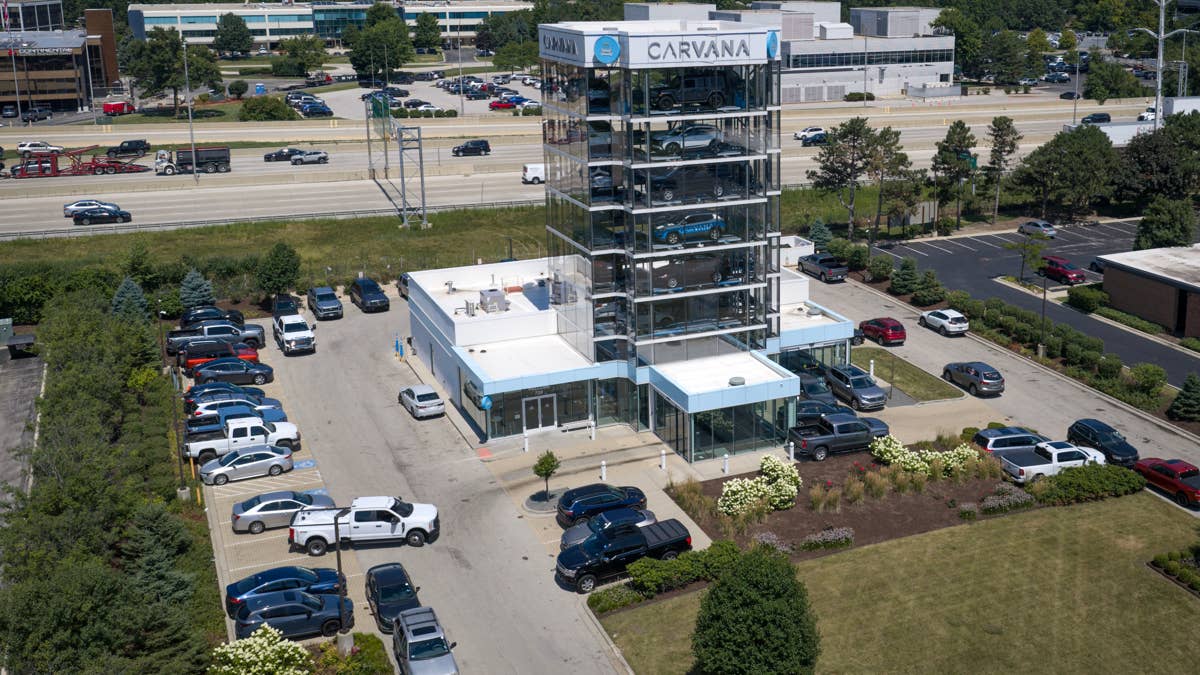
Carvana balances growth with tighter margins
Despite the fuel and rate headwinds, Garcia framed the results as a sign of strength.
“I think this quarter gave a great example of the flexibility of that machine,” he said, referring to Carvana’s operating model of buying, reconditioning and selling used vehicles at scale.
Jenkins echoed that confidence, calling out the scale of the growth given a tough backdrop for the broader auto market.
More Automotive:
- Toyota doubles down on EVs while rivals retreat
- Mazda just made a big change under tariff pressure
- Key auto parts maker closes factory, lays off 325 workers
“That is against an industry backdrop where the industry is down, call it, on the order of four points year over year,” Jenkins said. “So I think the 38% growth is a notch more impressive in light of that industry backdrop.”
Still, the company acknowledged inventory hasn’t kept pace with demand in every region, which adds its own pressure on margins.
Garcia said the team is working to catch up but hasn’t fully closed that gap yet.
Carvana’s strong 2026 guidance
Looking ahead, Carvana expects retail unit sales to rise sequentially in Q3.
For the full year, the company guided to adjusted EBITDA between $2.7 billion and $3.0 billion, up from $2.24 billion in 2025.
Jenkins also flagged that advertising spending will increase in the third quarter as Carvana leans on marketing to help offset tighter inventory in some regions.
Garcia was careful not to promise a quick rebound in per-unit profitability, tying future results to execution rather than a single input like gas prices.
“If we build the machine to generate kind of the maximum demand and maximum conversion, then we get to decide how to express it,” Garcia said.
The bottom line for CVNA stock
Carvana’s growth story remains intact.
Sales are climbing, margins are still well above where they were a few years ago, and the balance sheet keeps improving, with net debt to adjusted EBITDA now at 1.0x.
Consensus data from TIKR.com states:
- Analysts tracking CVNA stock forecast revenue to increase from $20.3 billion in 2025 to $50 billion in 2030.
- In this period, adjusted earnings per share are projected to expand from $1.69 to $3.42.
- The EBITDA is projected to improve from $2.24 billion to $5.77 billion.
Down almost 30% from all-time highs, CVNA stock is valued at a market cap of $47 billion.
Out of the 17 analysts covering Carvana stock, 13 recommend “Buy,” and four recommend “Hold.” The average CVNA stock price target is $86.20, which is 30% above current prices.
Garcia’s comments are a reminder that even a fast-growing, highly profitable company isn’t immune to everyday costs like gas prices.
For CVNA stockholders, the next few quarters will show whether Carvana can keep growing at this pace while absorbing those pressures without a bigger hit to margins.
Related: Morgan Stanley updates jaw-dropping Carvana stock price target