Chick-fil-A is closing the last remaining restaurant of its kind as it continues to refine its strategy for rapid expansion.
The concept was designed to give customers something beyond the chain’s traditional menu, while allowing the company to test new products and a different way of serving guests.
However, after several years of experimentation, the company is preparing to bring the concept to an end.
The move comes as the restaurant chain continues to expand its footprint and experiment with new formats.
Chick-fil-A is closing its last Little Blue Menu
Chick-fil-A is closing its final Little Blue Menu location at 7242 Baltimore Ave in College Park, Maryland, in January 2027, ending the five-year experimental concept.
Little Blue Menu debuted as a test in Nashville in 2021 before Chick-fil-A expanded the concept to a standalone location in College Park in 2023. The concept allowed Chick-fil-A to serve its traditional menu alongside experimental offerings such as burgers, wings, pizza, and other items not typically available at standard restaurants.
The Nashville location closed in 2023, while the College Park restaurant continued operating as the concept’s last location. Chick-fil-A will now convert the College Park restaurant into a traditional Chick-fil-A location in January 2027, Streetcar Suburbs reported.
“Since its inception five years ago, Little Blue Menu was designed as a test-and-learn concept,” Chick-fil-A told Nation’s Restaurant News.
“After several successful years exploring new ways to serve guests, the location in College Park will transition to a traditional Chick-fil-A restaurant in 2027. We are grateful to remain part of the College Park community and look forward to sharing more soon.”
Chick-fil-A’s expansion strategy
Since its founding in 1946, Chick-fil-A has taken a more deliberate approach to expansion than many of its fast-food competitors.
The company remains family-owned and operates under a local owner-operator model, with individual restaurants managed by independent operators who oversee day-to-day operations in their communities.
The model gives individual responsibility for daily operations while allowing Chick-fil-A to maintain its broader approach to customer service and local engagement as it expands into new markets and formats.
The company continues to grow both domestically and internationally, opening its first restaurants in the UK and Singapore in 2025, following its entry into Puerto Rico in 2022.
The company’s expansion has also included a growing number of experiments aimed at reaching customers outside its traditional restaurant model.
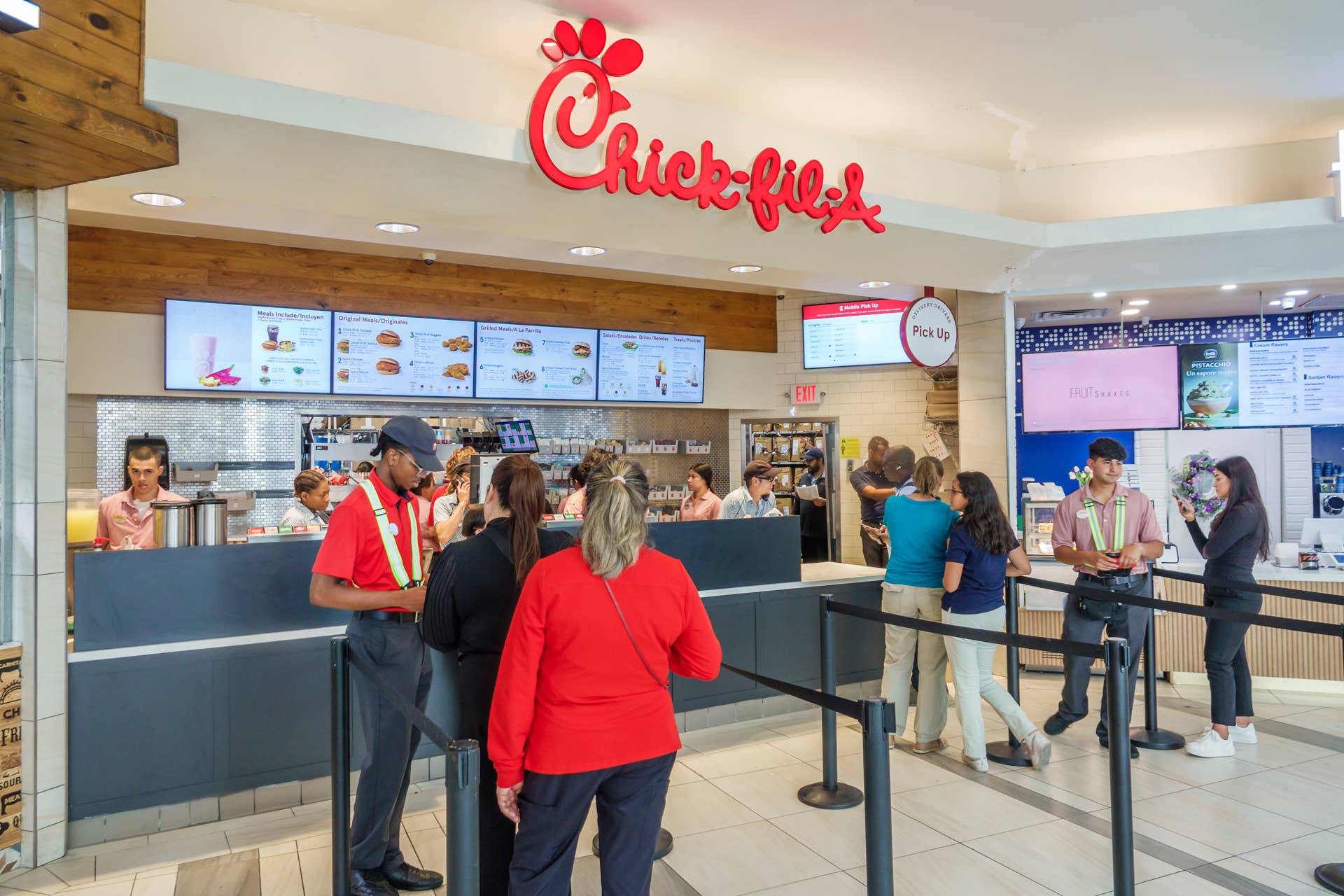
Chick-fil-A’s experimental concepts
Chick-fil-A has continued to experiment with different restaurant formats and ways of reaching customers.
The company launched its first delivery and carryout locations in Nashville, Tennessee, and Louisville, Kentucky, in 2018, according to Nation’s Restaurant News. Those units were designed to support demand for catering, takeout, and delivery without relying on traditional dining rooms.
In 2019, Chick-fil-A expanded its delivery strategy by operating from a shared kitchen facility in Northern California in partnership with DoorDash.
Here’s some of my previous coverage on Chick-fil-A’s expansion strategy and experimental concepts:
- In 2025, Chick-fil-A opened a ghost kitchen with CloudKitchens in Boston and expanded to Miami in 2026 as part of an ongoing effort to expand delivery capabilities.
- In fall 2025, Chick-fil-A opened Daybright, a beverage-focused concept, in Hiram, Georgia, through its subsidiary, Red Wagon Ventures LLC.
- At the same time, Chick-fil-A launched its first-ever vending machine, a temperature-controlled fridge that allows customers to access menu items through a touchscreen.
- In late 2025, the company also began converting its licensed locations, including restaurants on college campuses, in hospitals, and at theme parks, excluding airports, to its owner-operator model. The change is designed to create a more consistent experience across its restaurants.
What this means for Chick-fil-A
Today, Chick-fil-A operates more than 3,000 restaurants across the U.S., Canada, Puerto Rico, the UK, and Singapore, according to its website.
While that footprint remains smaller than competitors such as McDonald’s, which operates more than 45,000 restaurants worldwide, and Subway, with over 35,000 locations, Chick-fil-A has become the third-largest quick-service restaurant company in the U.S. by system-wide sales.
Chick-fil-A generated more than $9 billion in company revenue in 2025, while its restaurants recorded nearly $24 billion in system-wide sales, according to data gathered by QSR Magazine.
The company’s continued growth means Little Blue Menu is only one part of a broader strategy that has seen Chick-fil-A test new restaurant formats, menu items, and service models while expanding its traditional locations.
The end of the Little Blue Menu experiment does not signal a retreat from innovation. Instead, it illustrates how Chick-fil-A has used experimental concepts to test new ideas and determine which formats may fit into its larger restaurant strategy.