Ask most investors who makes AI chips, and they will name Nvidia (NVDA), which designs them but does not build them. Ask who makes the machines that build them, and the room usually goes quiet.
That blind spot matters now. In my last piece, I covered Wells Fargo’s view that a possible 2nm expansion at Taiwan Semiconductor Manufacturing Co. (TSM) could lift chip equipment makers.
The four names investors tend to lump together are ASML Holding (ASML), Applied Materials (AMAT), Lam Research (LRCX), and KLA (KLAC). Each leads a different step in turning a blank wafer into a working chip, which shapes its business.
Global chip equipment sales are forecast to hit a record $229.5 billion in 2028, according to SEMI, the industry’s trade group. Most of it goes to wafer fab machines like the ones these four sell. It all starts with light.
ALSO READ: TSMC’s next move could ripple far beyond Apple, Nvidia
ASML prints the pattern every advanced chip starts with
ASML makes lithography machines, which project circuit patterns onto silicon wafers. CNBC said it is the only company that makes extreme ultraviolet, or EUV, machines used for the most advanced chips. Think of it as the printer that decides how small circuits can get.
That monopoly earns ASML a big slice of every fab budget. About a quarter of chipmaker capital spending goes to lithography, analysts estimate, largely to ASML, Reuters reported in January.
ASML shares hit a record $1,999.96 within the past year and traded as low as $935.41, according to Stock Analysis. The site’s data put the stock about 9% below that peak, the smallest gap of the four, at roughly 33 times forward earnings.
The 42 analysts tracked ASML a Strong Buy, with an average target of $2,115.91. ASML draws the blueprint, but someone still has to build it.
Applied Materials and Lam build and carve the layers
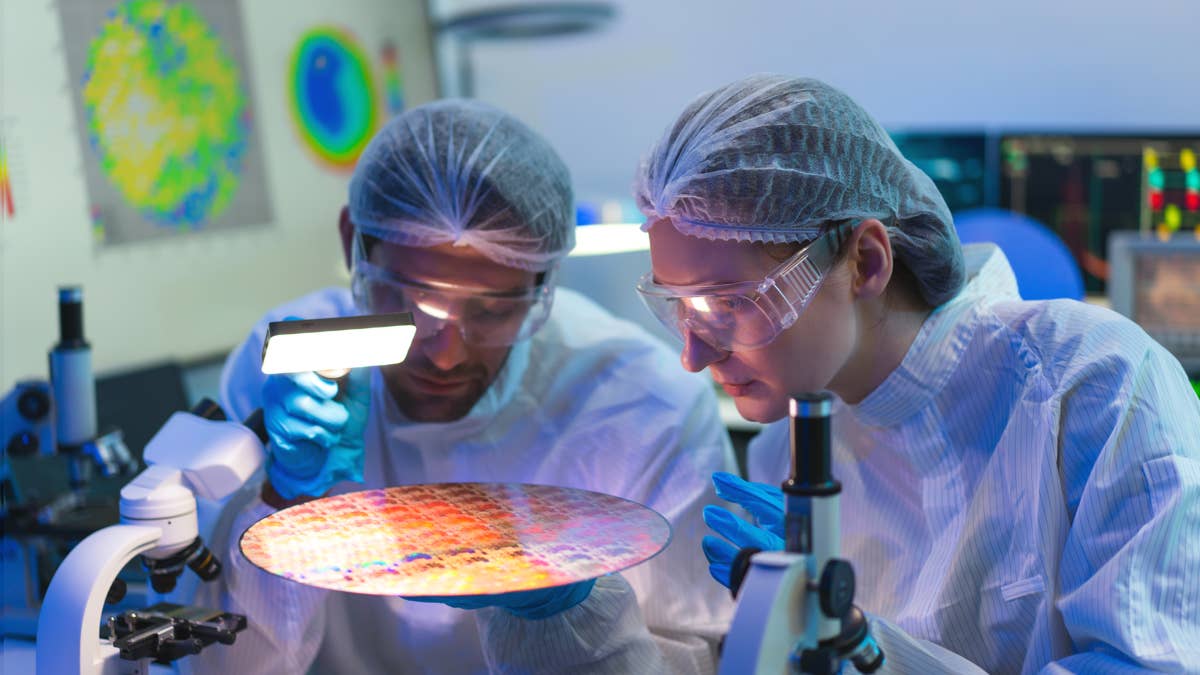
A chip is built up layer by layer. Applied Materials and Lam sell the machines that deposit very thin films, then carve away whatever is not needed.
That job gets bigger at 2nm. Lam CFO Doug Bettinger told a Citi conference on Wednesday, Sept. 9, 2026, that the transistor design used at 2nm needs more etch and deposition. Every 100,000 wafer starts of that capacity adds about $1 billion to the market Lam can sell into, according to a transcript.
The two are still not twins. Applied Materials sells a wider range of tools and brought in about $6.6 billion in the past year from its services arm, Stock Analysis data show. That cushions it when orders slow.
Lam, meanwhile, just posted its highest gross margin in 20 years, Bettinger said. Lam’s market value now edges out Applied’s, even though Applied brings in about a third more revenue, according to Stock Analysis.
Applied Materials shares have ranged from $202.87 to a record $739.67 over the past year, Stock Analysis noted. The data put it at about 29 times forward earnings, the cheapest of the four. The 40 analysts tracked there rate it a Strong Buy, with a $638.94 average target.
Lam shares have ranged from $130.81 to a record $438.50 over the past year, Stock Analysis confirmed. They trade at about 34 times forward earnings, and the 35 analysts tracked there rate them a Strong Buy. The $373.77 average target implies about 14% upside, the thinnest of the four.
All that building creates one more job: checking the work.
KLA gets paid to find the mistakes
KLA does not build the chip. It inspects and measures wafers to catch defects. CFO Bren Higgins told a Goldman Sachs conference on Friday, Sept. 11, 2026, that yield “translates into printing money,” according to a transcript.
Yield is the share of chips on a wafer that actually work. KLA executive Ahmad Khan put it simply at the same event: on a wafer holding two large chips, one killer defect cuts yield to 50%. Bigger AI chips mean more inspection.
More Chip stocks:
- An AI chip machine so pricey, three rivals had to say yes
- TSMC hikes 2026 guidance as AI demand outpaces capacity
- TSMC’s rivals are losing ground, and the gap is growing
KLA shares have ranged from $98.10 to a record $307.37 over the past year, per Stock Analysis. They now sit about 37% below that peak, the widest gap of the four.
Yet the same data put KLA at about 36 times forward earnings, the priciest of the group. The 29 analysts tracked there rate it only a Buy, the lone holdout from Strong Buy, with a $233.77 average target. To me, that split verdict suggests the market hasn’t decided what inspection is worth in an AI buildout.
4 toolmakers, four different ways to bet on AI
ASML is a bet on how small chips get. Applied and Lam ride how many layers get built. KLA rides how hard they are to get right.
ASML reports on Wednesday, Oct. 14, 2026, and TSMC follows a day later, Stock Analysis noted. Lam and KLA are expected later in October, with Applied on Thursday, Nov. 12, 2026.
Those reports will show which slice of the bill is growing fastest and who really gets paid first.