Stone Brewing, the 30-year-old craft beer company behind Stone IPA and Arrogant Bastard Ale, is shutting down the Southern California brewery.
This brewery helped the company become one of the most recognizable names in American craft beer.
But now, it is permanently closing its entire Escondido, California, operation. This move is expected to eliminate about 220 jobs, according to a Worker Adjustment and Retraining Notification (WARN) filed with the state.
The closure marks another dramatic turn for a brewery that grew from a small San Diego County warehouse into a national brand.
It was valued at roughly $165 million when Japanese beer giant Sapporo Holdings agreed to acquire it in 2022.
Stone’s Escondido operation has been central to that growth for more than two decades. The company moved into its larger brewery there in 2005, giving it substantially more production capacity as demand for beers such as Stone IPA and Arrogant Bastard Ale grew.
Now, all three Stone Brewing facilities in Escondido are being permanently closed.
The shutdown affects locations at 1999 Citracado Parkway, 2865 Executive Place, and 2005 Harmony Grove Road.
Stone said the closures result from an asset sale involving the business and that all positions at the Escondido locations will ultimately be eliminated.
The first 58 employees are expected to lose their jobs on Oct. 19.
Additional layoffs will follow in later phases, although Stone said those separation dates have not yet been finalized.
But the Stone beer brand itself is not disappearing.
Stone Brewing closes longtime California operation
Stone Brewing was founded by Greg Koch and Steve Wagner in San Marcos, California, in 1996.
The company began in a small warehouse with just three employees and produced about 400 barrels during its first year.
Stone IPA followed in 1997, when India pale ales were still largely a niche category, while Arrogant Bastard Ale debuted later that year.
More Layoffs:
- Samsung cuts jobs as it shifts U.S. headquarters
- Another popular soda giant closes warehouse operation, cuts 184 jobs
- Meta layoffs take disturbing turn in new lawsuit
Stone eventually became an influential name in the West Coast IPA movement and says its beers helped fuel the modern craft beer revolution.
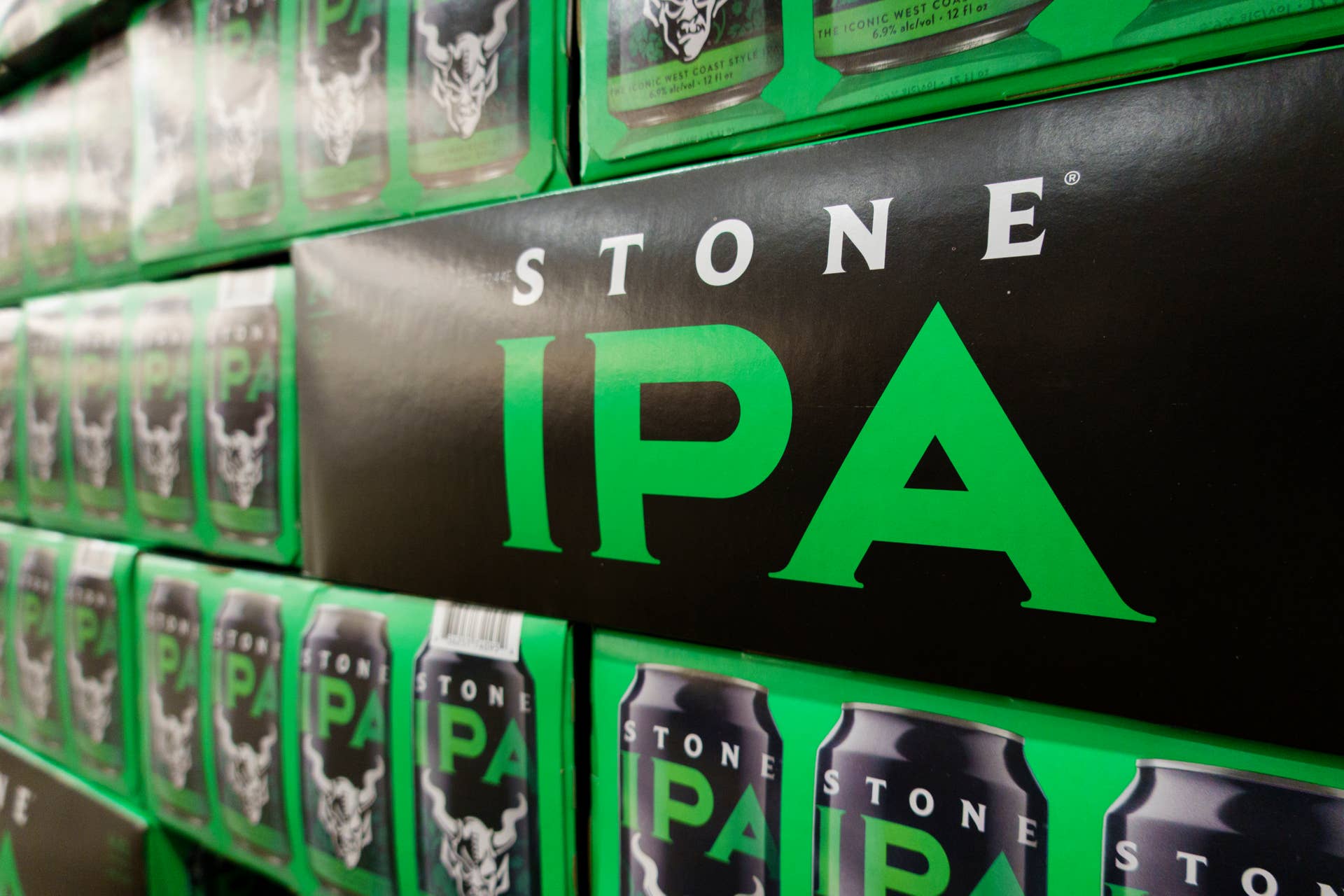
Stone IPA remains its top-selling beer.
Rapid growth eventually pushed Stone beyond its original San Marcos brewery.
The Escondido operation, however, remained closely associated with the company’s identity and housed brewing, packaging, and other operations.
The 58 workers to be affected in October include brewers, packaging technicians, quality-assurance employees, warehouse workers, planners, logistics staff, and an innovation brewer.
The largest groups include 13 Packaging Technician II positions, 8 Brewer I positions, and 4 Packaging Technician I positions. Warehouse and logistics positions at Stone’s other Escondido facilities are also among the initial cuts.
Sapporo bought Stone Brewing for about $165M
The closure follows a complicated four years of ownership changes. Sapporo Holdings agreed to buy Stone Brewing in 2022 as part of an effort to expand its U.S. beer operation.
Sapporo estimated Stone’s equity value at $165 million and advisory fees at another $3 million, bringing the estimated transaction cost to about $168 million before any additional payments tied to Stone’s performance.
Stone’s breweries were a major part of the rationale for the deal.
Sapporo said acquiring Stone’s West Coast and East Coast production facilities would give it U.S. manufacturing bases for the Sapporo brand. It would also reduce logistics costs and allow more beer to be produced closer to American consumers.
Related: Popular brewery stops making beer, files Chapter 11 bankruptcy
Sapporo also expected production of Sapporo Premium Beer at Stone’s plants to increase facility utilization.
Less than four years later, Sapporo changed course.
In April 2026, the company announced plans to sell assets related to the Stone brand and hospitality business to Firestone Walker and another U.S. subsidiary of Belgian brewer Duvel Moortgat.
The transferred assets included Stone’s trademarks, know-how, and hospitality operations. But the Escondido manufacturing operation was not part of that sale.
Sapporo instead said it would stop producing both Stone and Sapporo beer at Escondido by the end of 2026 while concentrating U.S. production at its Richmond brewery.
The company said consolidating production would improve manufacturing efficiency, reduce fixed costs, and improve the profitability of its U.S. operation.
Sapporo estimated the Stone asset transfer would generate a gain of about $23 million, while impairment losses and other costs related to its U.S. restructuring are expected to total about $80 million.
Stone beer will continue under new owners
The ownership structure means the closing of the Escondido brewery does not mean Stone IPA or Arrogant Bastard Ale are disappearing from shelves.
Firestone Walker and Duvel Moortgat’s U.S. operations acquired the Stone brand earlier this year.
Production is transitioning away from Escondido, with Stone beer expected to be produced primarily at Firestone Walker’s Paso Robles, California, brewery and at Duvel Moortgat USA’s Kansas City facilities.
Sapporo said this week that it had been supporting the transition following the brand sale but had been unable to find a viable long-term solution for the Escondido site.
Dominick Miserandino, CEO of RTMNexus.com, said moving production to existing facilities should not necessarily be viewed as a failure of the Stone brand. Instead, he said the shift reflects a broader industry effort to reduce overhead and adapt to a contracting craft beer market.
Craft beer industry shrinks as breweries close
Stone’s shutdown comes during a prolonged contraction across the U.S. beer industry.
Craft beer production fell 4% in 2025 to about 22 million barrels, according to Brewers Association data. Sixty percent of breweries reported lower production for the year.
The broader U.S. beer category performed even worse, with overall beer production and imports declining 5.7% in 2025.
The number of operating craft breweries also fell 2.9% to 9,578.
Only 300 new breweries opened during 2025, down from 518 a year earlier, while 481 breweries closed.
“The old model—massive regional breweries, nationwide distribution and heavy IPAs shipped across the country—no longer works like it once did,” Miserandino said.
TheStreet has tracked several of those shutdowns.
Southern Star Brewing, an 18-year-old Texas brewer known as an early adopter of canned craft beer, recently announced that it would cease brewing operations and close permanently, TheStreet reported.
Other breweries have entered bankruptcy or closed locations as operators contend with weaker beer demand, rising costs, and an increasingly competitive market.
The pressure is not limited to small craft breweries. TheStreet has also tracked restructuring and workforce reductions across the broader alcohol industry.
Diageo, the global alcohol company behind Guinness, Johnnie Walker, and Smirnoff, recently reported that its average workforce declined by 1,922 employees as the company undertakes a roughly $1.2 billion restructuring program.
Diageo also pointed to softer demand in North America, its largest market.
The distribution side of the alcohol industry has also undergone major upheaval.
Republic National Distributing Co., one of the country’s largest wine and spirits wholesalers, filed for Chapter 11 bankruptcy in July after selling operations across multiple markets.
That included an 11-market deal with Reyes Beverage Group that transferred roughly 5,200 employees.
Miserandino said shrinking craft production, distributor consolidation, tighter shelf space, and high freight costs are all putting pressure on brewers to rethink how and where they produce beer.
Stone’s Escondido shutdown adds another major name to that shift.
The brand will continue under the U.S. operations of Firestone Walker and Duvel Moortgat, but production is moving away from the Southern California brewery Stone called home for more than two decades.
Related: Sportswear giant closes 113 stores as shares plunge