There is an investor I know who has a simple rule. Chris never buys a stock that makes headlines for falling, and never sells one that makes headlines for surging.
The crowd is usually late in both directions. Now, by that logic, Netflix deserves a serious look.
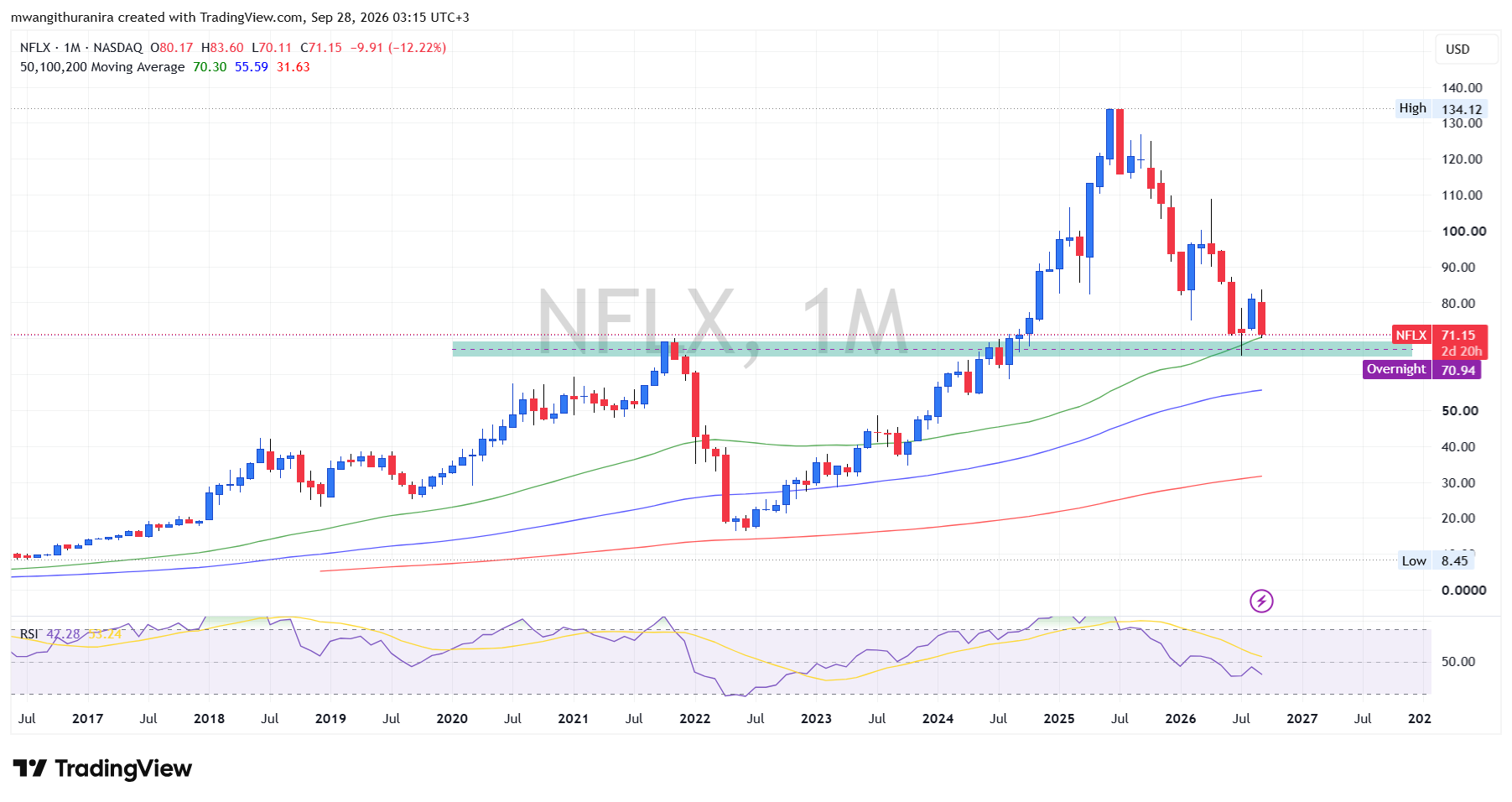
Netflix (NFLX) hit an all-time high of $134.12 on June 30, 2025. As of the week ending Sept. 25, it trades at $71.15. That’s a 46% decline from that peak. The 52-week low of $65.08 was tested in July 2026 and held, according to Yahoo Finance data.
Two major downgrades landed this September, too. Wells Fargo cut to Underweight with a $57 target on Sept. 18, and HSBC reset to Hold with a $76 target on Sept. 22. The stock’s P/E has compressed to 22x from a valuation that once stretched into triple digits 10 years ago.
That compression is the opportunity case. The question is whether the compression is finished or still in progress.
Also Read: Netflix Inc. Latest News and Stories
Here is why Netflix stock has been bleeding
The honest starting point for any Netflix analysis in 2026 is acknowledging what the data shows.
Average daily YouTube viewing globally overtook Netflix for the first time in 2025, according to Digital i’s “The YouTube Era: 2025 in Review” report.
Daily YouTube usage rose from 87.2 minutes in 2024 to 99.1 minutes in 2025. Netflix declined from 100.5 minutes to 93.4 minutes over the same period, according to the same report.
On U.S. living-room TVs, YouTube captured a record 14.2% share of viewing in July 2026, while Netflix fell to a multiyear low of 7.8%, nearly doubling the gap between the two, according to TheStreet.
More Netflix:
- Bill Ackman’s surprising $934 million bet after dumping Alphabet
- Bill Ackman does U-turn on Netflix, makes bold claim
- Netflix stock has a strange stock price target problem
As Yahoo Finance reported, Wells Fargo analyst Steven Cahall noted that Netflix viewing time averaged 1.6 hours per subscriber daily in the first half of 2026, down 8% from 2023 levels.
The concern is that Netflix’s subscribers are watching less, which limits the platform’s pricing power and advertising revenue potential.
The content pipeline has also disappointed. Netflix has not produced breakout original series at the pace that once drove subscription growth. Its push into video podcasts, games, and live events has added engagement around the edges, but has not replaced the viewing hours lost in traditional long-form content.
Netflix noted improvements on its most recent earnings call
Management pushed back on the most bearish interpretation during the Q2 2026 earnings call. Total view hours grew 2% in the first half of 2026, representing an incremental 1.5 billion hours year over year. It is a slight acceleration from the 1.5% growth seen in 2025.
Management also addressed concerns about season-over-season dropoff, stating that second-season retention actually improved slightly in 2026 compared to 2025. The company measures engagement across quality, variety, and quantity rather than relying solely on raw viewing hours.
Related: HSBC sends blunt message to Netflix stock investors
Netflix referenced a competitive strategy in the Q2 earnings call transcript, saying it is open to launching a free, ad-supported tier in certain international markets over the longer term. The streamer did cite concerns about cannibalizing paid tiers before its ad business reaches the scale necessary to support a free offering economically.
The TF1 integration in France, four weeks in at the time of the earnings call, was showing strong local engagement.
None of this is a knockout argument for buying the stock today. But it is evidence that the business is not in free fall. It is competing in a more challenging environment than investors priced in a year ago.

Netflix’s technical picture and why the current level matters
The chart sets up a clear decision point. Netflix is sitting at a $65 to $71 support level that first acted as resistance in late 2021, rejected price, then broke to the upside and flipped to support in Aug. 2024.
The same level also coincides with the 50-day moving average at $70.30. The key condition before any buy signal is validated is to wait for a clear rejection at the level on a higher timeframe, with bullish price confirmation.
If the support breaks and the stock closes below $65 on meaningful volume, the next major level is lower, and the technical case for a near-term entry collapses.
Twenty-five of 33 analysts covering Netflix still rate it a buy, according to TheStreet’s aggregated ratings over the past three months. Seven rated it a hold, and one rated it a sell. Evercore ISI raised its target to $110 on Sept. 14. The analyst community broadly believes the stock has overshot to the downside.
Whether it has depends on whether the shift toward YouTube represents a permanent structural problem Netflix cannot solve, or simply a cyclical trough in its content cycle that improves as its 2026 and 2027 slate strengthens.
The 22 times earnings multiple at a 52-week low suggests the market has priced in significant doubt.
Rejection and recovery from this level is the buy. A breakdown below $65 is not. There is no reason to try to catch a falling knife.
Related: Netflix stock has a strange stock price target problem