The American economy is changing faster than most people expected. Jobs that seemed secure a few years ago are now under pressure. And the people feeling that pressure are looking for answers that the current policy conversation has not yet delivered.
Elon Musk just offered one. It is bold, it is controversial, and it has already generated more than 68 million views on X, the former Twitter. More importantly, it raises a question every working American should be thinking about right now.
What Musk says will solve unemployment
“Universal HIGH INCOME via checks issued by the Federal government is the best way to deal with unemployment caused by AI,” Musk wrote in a post on X, according to Moneywise.
That is not a universal basic income proposal. Musk is describing something more ambitious: a high level of income distributed broadly across society. This would not be just a floor to cover basic needs, but a meaningful check that allows people to participate in an economy increasingly run by machines.
MoreEconomy:
- Ernst & Young drops stunning take on economy as oil jumps
- Treasure secretary delivers surprise take on the economy
- Powell sends message on U.S. economy and AI-related job loss fear
His reasoning addresses the inflation concern head-on. “AI/robotics will produce goods and services far in excess of the increase in the money supply, so there will not be inflation,” he wrote, Moneywise noted.
In Musk’s view, automation dramatically expands the supply of goods and services, which means more money in circulation does not necessarily chase the same amount of output.
Why Musk’s universal income proposal is different
This is not abstract futurism. The job losses tied to AI are already showing up in real data. In 2025, AI was linked to nearly 55,000 job cuts in the United States, according to consulting firm Challenger, Gray, & Christmas. Major companies, including Amazon, Salesforce, and Oracle, cut thousands of roles, citing AI as a contributing factor.
The pace has not slowed. Challenger estimates that roughly 30,000 additional jobs were lost to AI in just the first months of 2026, Moneywise reported. And those numbers may understate the full picture, since many companies do not publicly attribute layoffs to automation.
Anthropic CEO Dario Amodei offered an even starker warning. He has said that AI could eliminate up to half of all entry-level white-collar jobs within five years, potentially pushing U.S. unemployment as high as 20%.
The economic vision Musk is describing
When a commenter pushed back on Musk’s post, questioning whether abundance would make money meaningless, Musk doubled down.
“AI/Robotics will mean everyone can have a penthouse if they want. The output of goods and services will be several orders of magnitude higher than today’s economy,” he wrote, according to Moneywise. “What is the future you want? Amazing abundance seems the best to me.”
That framing is important. Musk is not talking about a safety net. He is talking about a structural redesign of how prosperity is distributed in an economy where human labor becomes less central to production. The premise is that machines generate enough wealth for everyone to share meaningfully in the gains.
Key numbers behind the AI jobs debate:
- AI is linked to nearly 55,000 U.S. job cuts in 2025, according to Challenger, Gray, & Christmas.
- Roughly 30,000 additional AI-linked job losses are estimated in early 2026, Moneywise reported.
- Musk’s X post on universal high income generated more than 68 million views and 195,000 likes, Moneywise noted.
- Anthropic CEO Dario Amodei warned that AI could eliminate up to 50% of entry-level white-collar jobs within five years.
- Amodei projected U.S. unemployment could reach as high as 20% as a result.
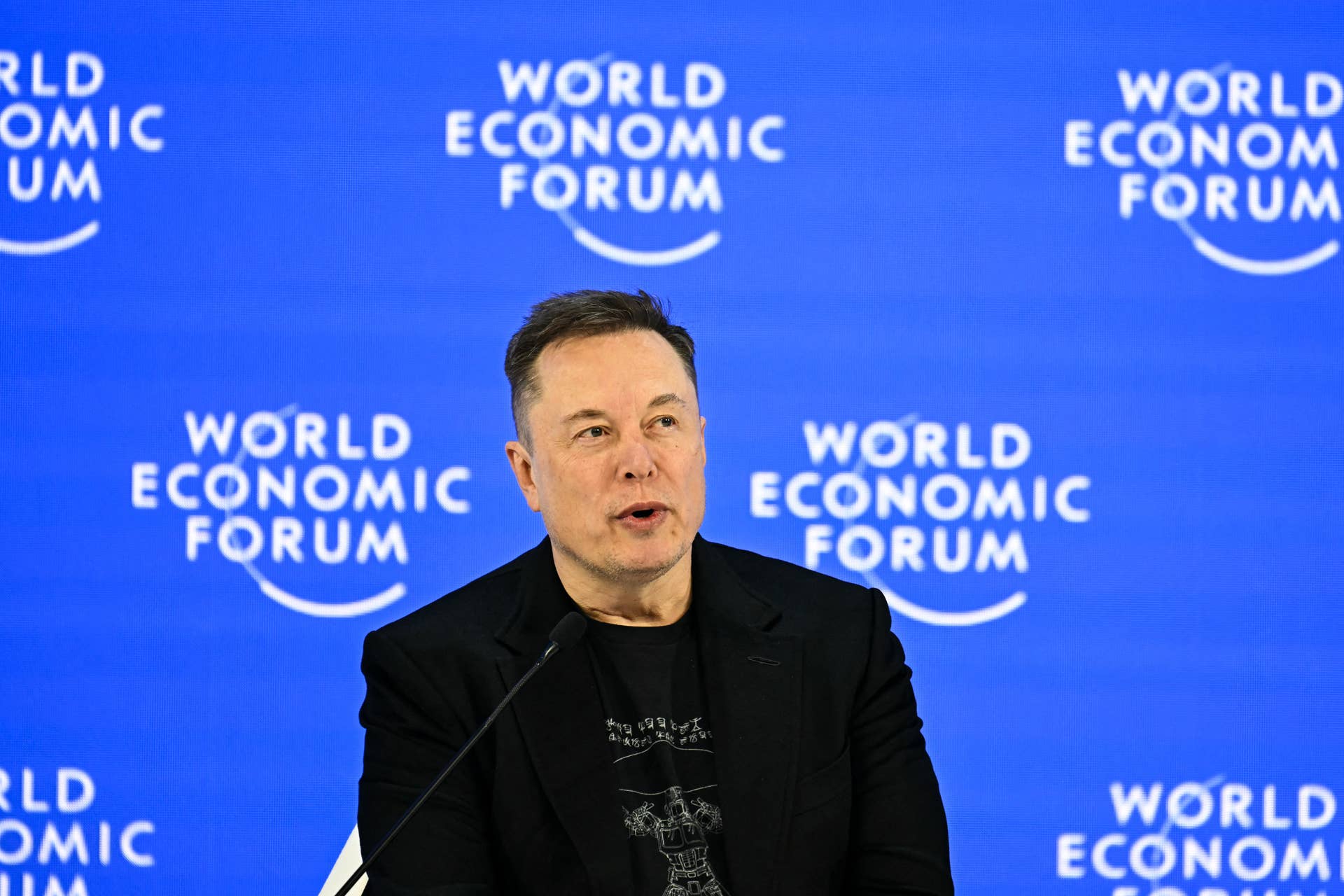
Coffrini/Getty Images
Why the universal income proposal is so controversial
The biggest objection to universal income proposals has always been inflation. Critics argue that putting more money in people’s hands without a corresponding increase in production pushes prices up. Musk’s answer to this is that AI and robotics solve the production side of the equation so thoroughly that the usual inflation math does not apply.
But that argument depends on assumptions that are not yet proven. AI productivity gains are real, but they are also uneven. Not every sector is automating at the same pace, and the political and fiscal mechanics of distributing federal checks at scale remain deeply complicated, regardless of what the economy produces.
The funding question alone is enormous. Even if the economic logic holds, a program of this scale would require sustained political consensus on how to pay for it, which is precisely the kind of agreement Washington has failed to reach on far simpler programs.
Critics also point out that automation-driven wealth tends to accumulate on the balance sheets of technology companies, not in government coffers.
Structural questions also arise about who benefits from automation-driven gains. If productivity rises sharply but wealth concentrates among the companies that own the technology, a government check may still be necessary, but it would not automatically follow from abundance alone.
What Musk’s economic vision means for everyday Americans
For most Americans, Musk’s proposal lands somewhere between hopeful and unsettling. It suggests a future where income is less tightly tied to employment, which sounds reassuring if you are worried about your job. But it also implies a transition period that could be chaotic, uneven, and politically contentious.
The workers most at risk are those in roles that are easiest to automate: data entry, customer service, basic analysis, content moderation, and other white-collar tasks that AI is already performing at scale. For those workers, a universal income program would need to arrive before the displacement does, not after.
That is the core tension in Musk’s vision. The economics may eventually support what he is describing. But the policy, the funding, and the timing would all need to align in ways that governments have historically struggled to coordinate.
Whether abundance arrives fast enough to support the people it displaces is the question that no one, including Musk, has fully answered yet.
Related: Elon Musk makes a stunning claim about Tesla’s chip future