The Iran war could push U.S. inflation and unemployment higher than the Federal Reserve expected this year, according to a new survey of former central bank officials conducted by the Duke University Department of Economics.
The findings arrive just days before the Fed’s March policy meeting, when policymakers will release their “dot plot” forecasts for interest rates, inflation, and employment.
The CME Group FedWatch tool estimates a more than 99% chance the Federal Open Market Committee will hold rates steady at its March 17-18 meeting. The next likely quarter-point cut is predicted for later in the year, perhaps as late as December.
Among the key findings from the Federal Reserve Insights survey released March 16:
- Former Fed insiders projected an inflation rate higher than what the central bank is anticipating and a jobless rate higher than the Fed’s December projections.
- Most respondents said the Fed would likely need to hold policy steady this year.
- The former officials projected slower growth in economic output than previously estimated.
What the Fed’s dual mandate requires for jobs, prices
The Fed’s dual congressional mandate requires it to balance full employment and price stability.
- Lower interest rates support hiring but can fuel inflation.
- Higher rates cool prices but can weaken the job market.
The two goals often conflict, operate on different timelines and are influenced by unpredictable global events such as pandemics and wars.
Federal Reserve Bank of New York via FRED®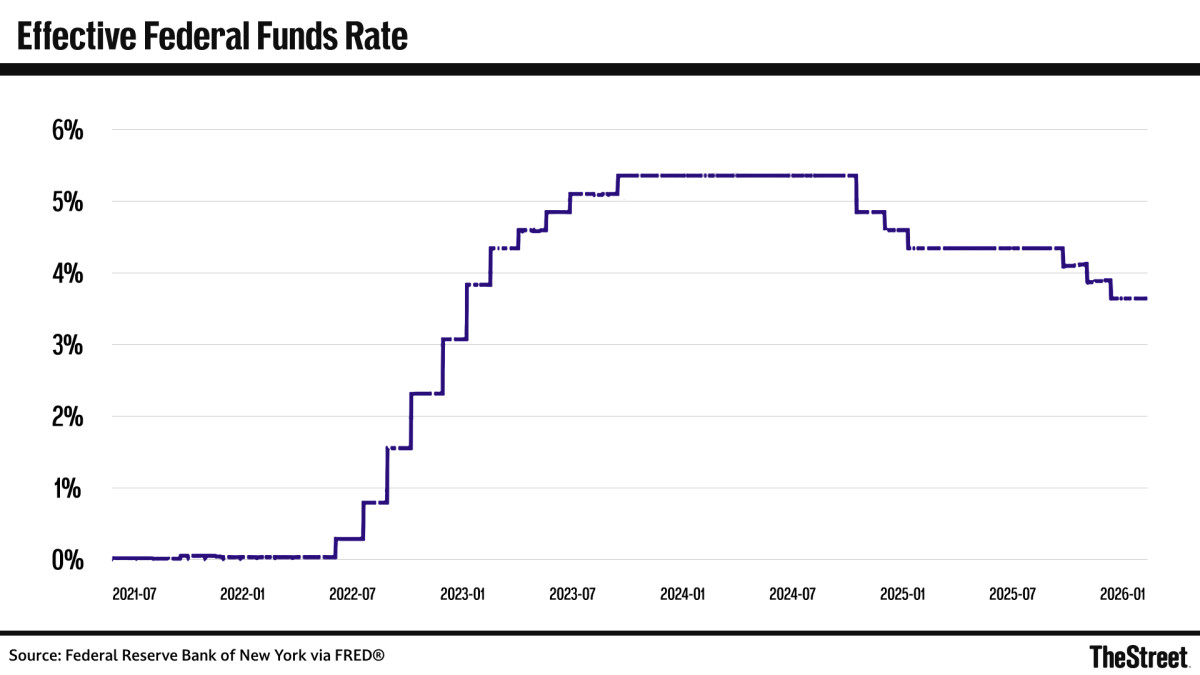
Fed paused rate cuts in January
The FOMC voted 10-2 to hold interest rates steady at 3.50% to 3.75% in January after three consecutive quarter-point cuts in its last three meetings of 2025.
Those cuts were based on data showing increasing weakening in the labor market and cooling inflation, although still sticky and tariff-laced.
More Federal Reserve:
It was the FOMC’s first pause since July 2025.
The Fed uses government and private data sources to drive monetary policy decisions, a rear-view mirror approach often criticized as being too restrictive.
Those critics, including Treasury Secretary Scott Bessent and former Fed Governor Kevin Warsh, Trump’s nominee to be the next Fed chair, advocate use of more advanced models, including AI, to set interest rates.
Fed to release latest “dot plot” this week
The Fed’s “Summary of Economic Projections” provides its estimates of inflation, unemployment, and economic output, in addition to estimates of interest rates that officials see as the most appropriate monetary policy over a three-year horizon.
The interest rate estimates, also known as the Fed’s “dot plot,” are closely watched on Wall Street for insight into the central bank’s thinking and plans.
Background on the Federal Reserve Insights survey
In all, 28 former officials and staff members participated in the survey between March 6 and March 13.
The survey panel included former Fed board governors, former regional bank presidents, and former staff at the Board and Reserve Banks.
Related: Looming Fed meeting shifts bets for 2026 interest-rate cuts
The projections outlined are based on the medians of their estimates.
Some individuals didn’t answer every question.
Survey projects new inflation, jobless rates
Former central bank officials projected 3% inflation this year, higher than the Fed’s official 2% target, and higher than the 2.4% inflation rate that the central bank projected for 2026 back in December.
Former officials also projected a jobless rate of 4.6%, higher than the 4.4% rate that the central bank projected in December and higher than the 4.2% rate that the Fed sees as normal in the long run.
The former officials projected slower growth in economic output than previously estimated.
For now, they agreed the United States is not in recession or heading toward recession, but they said that could change if conflict in the Middle East and disruptions to global oil supplies persist.
Could Fed interest-rate hikes be in the future?
Given the economic backdrop, most respondents said the Fed would likely need to hold policy steady this year.
- Thirteen respondents said appropriate policy in 2026 would likely be no change in rates.
- Six said it would be appropriate to raise rates.
- Seven said it would be appropriate to reduce rates.
Former Fed officials focus on Iran war, oil shock
Many former officials in the Duke survey described the conflict in the Persian Gulf as a global supply shock — a constraint on the production and movement of energy and other products from the Middle East to other parts of the world. Reduced supply pushes up prices and reduces output.
One former official estimated that every $10 per barrel increase in the price of oil adds 0.2 percentage points to the U.S. inflation rate.
- The longer this disruption lasts, this person said, the greater the risks to inflation and output.
- A short-term disruption might wash through the economy without major effects on inflation or output.
- A sustained shock would be more damaging.
A sustained oil price above $100 per barrel would raise recession risk, while sustained oil prices over $120 per barrel would make recession the most likely outcome, this person said.
What the market outlook expects from the Fed
With the Fed meeting this week amid heightened geopolitical tensions and rising oil prices, markets are closely watching what the “dot plot” will reveal.
Ben Sullivan, CIO of AE Wealth Management, said higher energy prices could complicate the inflation outlook, even as markets continue to anticipate rate cuts later in the cycle.
Sullivan expects the possibility of one to two cuts over the remainder of 2026 if inflation moderates and growth slows, but said a major wild card remains the potential leadership transition at the Fed and the uncertainty surrounding Warsh’s confirmation.
Gene Goldman, CIO of Cetera Investment Management, said he is focused on how the Iran War and resulting spike in oil prices could keep market volatility elevated.
While markets historically recover from geopolitical shocks, Goldman said higher energy costs can pressure consumer spending and potentially influence Fed policy.
He said he is also watching the stronger U.S. dollar and elevated market valuations, which may make equities more sensitive to uncertainty.