Hawaii often shows up on lists of the most expensive places to retire.
But a closer look at the tax code tells a more nuanced story, Abel Soares III, CPA/PFS, CFP, CEO of Hui Malama Advisors in Hawai’i, said in a recent interview.
According to Soares, who is also a member of the American Institute of CPA’s PFP Champions task force, the state’s income tax rates – topping out at nearly 11% – are among the highest in the country.
Yet retirees may not feel the full impact. Social Security benefits aren’t taxed. Many pension payments receive favorable treatment. And property taxes are lower than in many mainland states.
Below is a transcript of the interview with Soares, edited for clarity and brevity.
Understanding Hawaii’s tax picture for retirees
Robert Powell: Hawaii isn’t a low-cost retirement destination, but its tax structure does offer meaningful offsets. Joining us to discuss that is Abel Soares III. Abel, welcome.
Abel Soares III: Aloha, and thank you for having me.
Income taxes: high rates, but context matters
Powell: As we’ve done in prior conversations about state tax systems, let’s start with income taxes. What should retirees know?
Soares: Hawaii has a progressive income tax system, ranging from about 1.4% to nearly 11%. That puts it on the higher end nationally. But it’s important to look at total taxes, not just income taxes. That includes sales-type taxes and other factors that can affect your overall burden.
Social Security and pensions
Powell: Retirees may not feel the full impact of those rates. Let’s talk about Social Security.
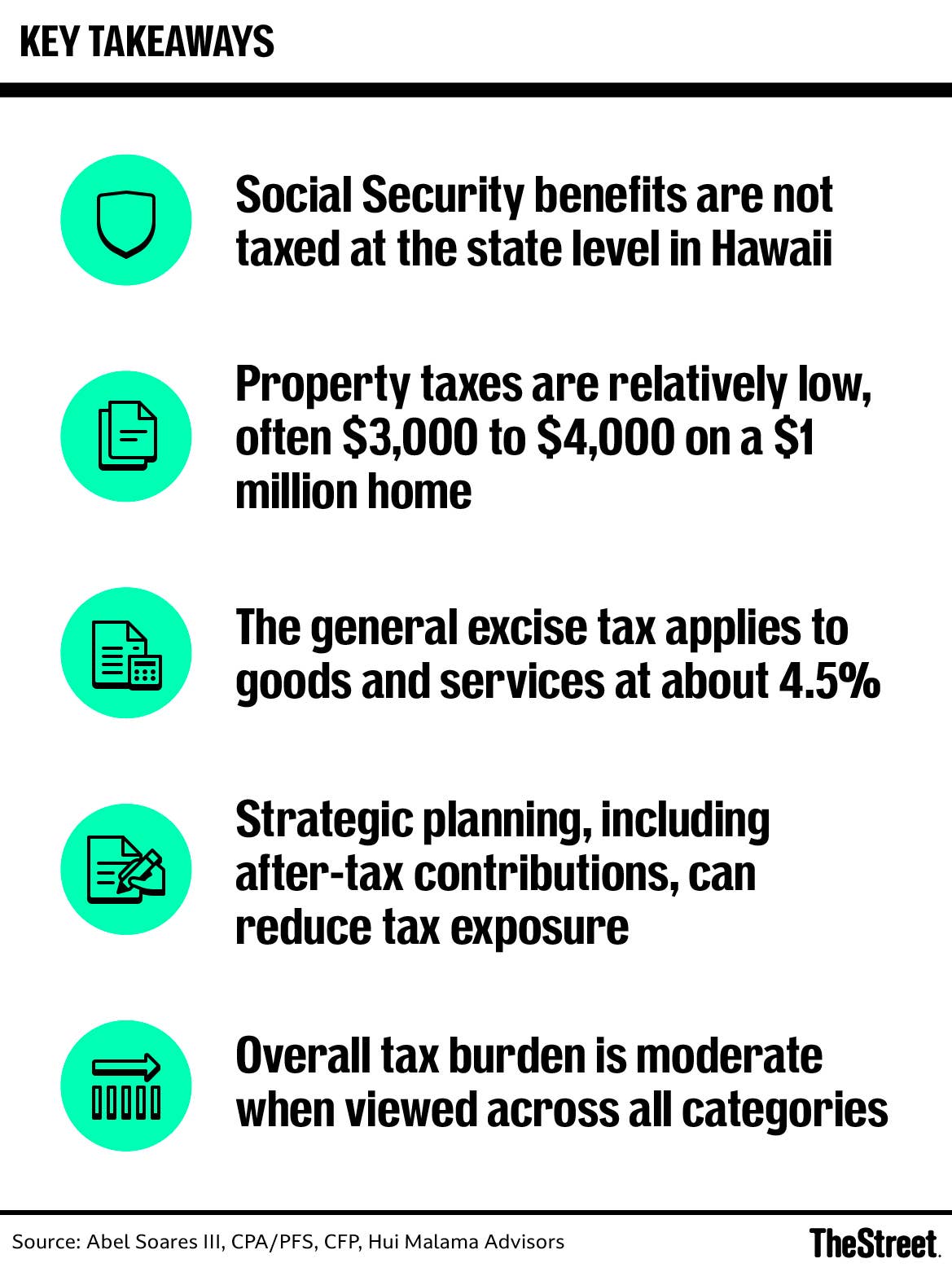
Soares: Social Security benefits are not taxed at the state level in Hawaii. If that’s your only source of income, you likely won’t have a state income tax bill.
That extends, in some cases, to pensions. Certain private pensions may receive favorable treatment. Military pensions are not taxed, and disability benefits are also exempt.
Senior tax breaks and planning opportunities
Powell: There are also exemptions for seniors, correct?
Soares: Yes. Seniors may receive partial exclusions on pension income. The exact amount depends on individual circumstances, so it’s important to work with a tax professional.
You also want to be mindful of income thresholds. As income increases, certain benefits may phase out, similar to the federal system.
Retirement account strategy
Powell: What about planning opportunities before relocating?
Soares: After-tax contributions to retirement accounts can be helpful. If you’ve already paid taxes on those contributions, withdrawals in retirement are generally not taxed.
That applies broadly across IRAs and 401(k)s. It’s also relevant for those pursuing early retirement strategies. Managing cash flow and avoiding sudden increases in taxable income — what we often call “cliff events” – is key.
Housing costs also play a role. Hawaii home prices often range from $900,000 to $1 million or more, especially on Oahu. The mortgage interest deduction cap – currently tied to the Tax Cuts and Jobs Act – may limit deductions for some homeowners.
Property taxes: lower than many states
Powell: Let’s turn to property taxes.
Soares: Hawaii offers a homestead exemption that reduces the taxable value of a primary residence by about $100,000.
For example, a $1 million home may be taxed as if it were worth $900,000. Property tax rates themselves are relatively low. A homeowner might pay $3,000 to $4,000 annually on a $1 million property.
There are additional benefits for military retirees, including full exemptions in some cases for those with 100% disability ratings.
General excise tax: broader than sales tax
Powell: What about sales taxes or similar levies?
Soares: Hawaii uses a general excise tax (GET) instead of a traditional sales tax. It applies to both goods and services.
The base rate is about 4.5%, though it may appear higher – around 4.712% – due to how it’s passed through to consumers. Unlike most states, services like financial advising or tax preparation are subject to this tax.
The big picture: a balanced system
Powell: So when you put it all together, Hawaii may not be as expensive from a tax standpoint as it first appears?
Soares: That’s correct. While income tax rates are higher, other factors offset that. Property taxes are relatively low, and the GET is moderate.
Unlike states such as Pennsylvania, Hawaii does not impose local income taxes. Compared with states like Texas or Florida, which rely heavily on property taxes, Hawaii’s overall system can be considered moderate when viewed holistically.
Focus on your situation
Powell: Anything retirees should keep in mind?
Soares: Focus on your individual situation. If you still have income – from a business or other sources – your tax picture changes.
There are also exemptions, such as not applying the GET to certain out-of-state income. Because rules vary widely, working with a financial planner or tax professional is essential.