J.R. Simplot never dealt with small potatoes.
This is a man who dropped out of school in the eighth grade and went on to found the Boise, Idaho-based J.R. Simplot Company, one of the world’s largest potato businesses.
His wealth soared during World War II when he secured military contracts to supply dehydrated onions and potatoes to the U.S. Armed Forces. After the war, his company pioneered the first commercially viable frozen French fry.
Simplot, who liked to say, “when the time is right, you just got to do it,” struck a handshake deal with McDonald’s (MCD) founder Ray Kroc in 1967 to supply the fast-food chain with frozen fries, so workers would no longer have to peel, cut, and blanch potatoes by hand.
In 1980, the legendary risk-taker saw potential in a company called Micron Technology (MU), which had been founded in 1978 in the basement of a Boise dental office by Ward Parkinson, Joe Parkinson (Ward’s twin brother), Dennis Wilson, and Doug Pitman as a semiconductor design consulting company.
When Micron lost its only customer after semiconductor manufacturer Mostek was acquired, the founders decided to pivot into chip manufacturing. But they were going to need money.
“Boys, it’s a gamble, and we’re going to take it,” Simplot said, as he signed the initial $1 million check to fund Micron’s first manufacturing plant and keep the fledgling company afloat.
That gamble paid off — big time.
Here’s a closer look at how Micron became the memory behemoth it is today — and one of the most widely popular stocks on the market.
Micron: one of the ‘Big Three’ memory companies
Simplot’s original $1 million investment grew to an estimated $4 billion by the mid-1990s, as Micron became one of the “Big Three” memory companies in the world, along with South Korea’s Samsung Electronics and SK hynix (SKHY).
The company, whose customer base includes such heavy tech hitters as Apple (AAPL), Nvidia (NVDA), AMD (AMD), Dell (DELL), Microsoft (MSFT), and Ford (F), reached a $1 trillion market cap on May 26, 2026.
Simplot, who drove a white Lincoln Town Car with a vanity license plate reading MR SPUD, insisted on keeping Micron rooted in Boise rather than spending tons of dough on California real estate like the Silicon Valley firms.
Related: 3M: The history behind the massive global conglomerate
He believed Idaho’s inexpensive land, abundant water, and affordable electricity would give the company a competitive advantage by lowering manufacturing costs.
Simplot also used his political capital to protect his investments from foreign competition. In the 1980s, cheap Japanese memory chips were flooding the U.S. market, threatening to crush Micron.
He was already packing a serious grudge against Japan for placing high tariffs on his Idaho potatoes, and he personally lobbied President Ronald Reagan for trade protections while American semiconductor companies pushed back against what they argued was unfair competition.
Simplot’s efforts helped secure the landmark 1986 U.S.-Japan Semiconductor Trade Agreement, which penalized Japan for dumping microchips below fair market value globally.
He served on Micron’s board of directors for 22 years before retiring in 1999. He died of natural causes at the age of 99 on May 25, 2008.
Microngoes public: Its IPO & stock splits explained
Micron went public on June 1, 1984, with shares priced at $13.
The stock has since undergone a 5-for-2 split in 1994 and two 2-for-1 splits in 1995 and 2000, reducing its split-adjusted IPO price to about $1.35 per share.
The company transferred its stock listing from the New York Stock Exchange to the Nasdaq on Dec. 30, 2009.
“With many of the technology companies in our industry already traded on the NASDAQ, Micron believes as an innovative semiconductor company that the NASDAQ represents the best fit for the company and our shareholders,” said Steve Appleton, then-Chairman and CEO.
Micron in the modern day: Acquisitions and government funding
Today, Micron designs and manufactures DRAM, NAND flash memory, solid-state drives, and high-bandwidth memory chips used in AI servers, smartphones, PCs, automobiles, and industrial equipment.
In 2013, Micron acquired the bankrupt Japanese memory manufacturer Elpida Memory in a deal valued at roughly $2.5 billion.
The acquisition transformed Micron into a global memory powerhouse, instantly boosting the company’s DRAM manufacturing capacity by roughly 50% and propelling it to the number two spot in worldwide DRAM market share behind Samsung.
“They have bought ability for increased flexibility on how they expand future capacity,” Doug Freedman, an analyst with RBC Capital Markets, told the BBC at the time.
Related: Goldman Sachs: The History Behind Wall Street’s Most Influential Investment Bank
In 2024, Micron secured up to $6.1 billion in direct federal funding under the CHIPS and Science Act to build and expand domestic memory chip fabrication plants in Idaho, New York, and Virginia.
Micron is also accelerating its long-term U.S. expansion. In July 2026, the company announced new investments to strengthen the domestic semiconductor supply chain and said it would accelerate its U.S. spending through 2035.
Micron, which employs roughly 53,000 people globally, pays dividends quarterly.
The growth of artificial intelligence transformed Micron from a cyclical memory supplier into a high-growth AI juggernaut, driven by skyrocketing demand for high-bandwidth memory (HBM) and AI-optimized DRAM.
Heather Ainsworth/Bloomberg via Getty Images
Micron’s record revenue
In a bid to support AI-driven demand, Micron is implementing a massive global expansion in Japan, Taiwan, Singapore, and India.
Wall Street analysts have generally maintained bullish ratings on Micron, citing robust AI data-center demand, expanding gross margins, and growing use of multi-year supply agreements.
Related: History of Honeywell: Company timeline, milestones & facts
For fiscal 2025, Micron reported record revenue of $37.38 billion, up 49% year over year.
Net income surged to $8.54 billion from $778 million a year earlier as booming demand for HBM and AI memory products fueled one of the strongest years in the company’s history.
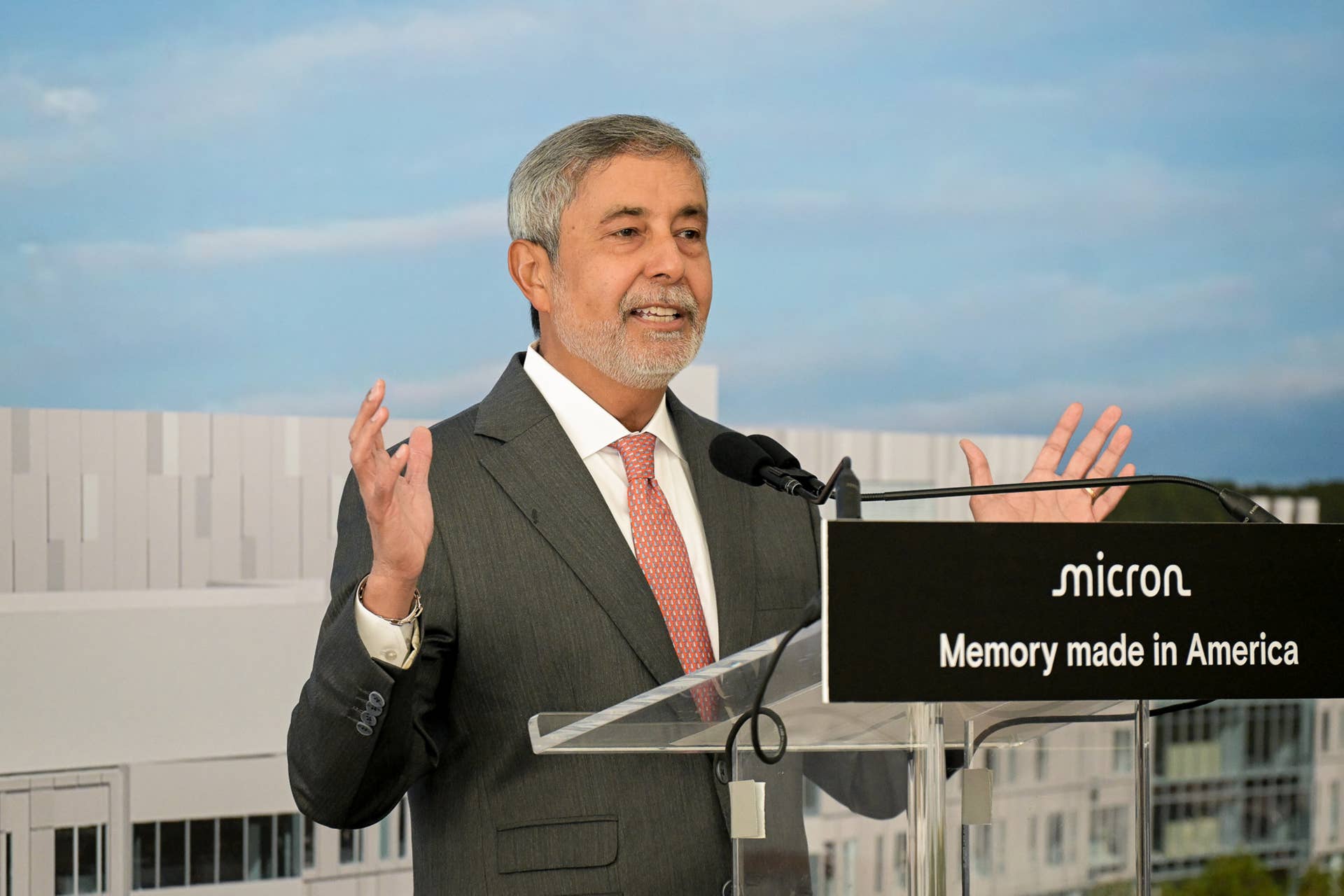
Sanjay Mehrotra has served as Micron’s president and CEO since 2017. The SanDisk (SDNK) co-founder has overseen the company’s transformation into one of the biggest winners of the AI memory boom.
“The memory industry has been structurally transformed by the proliferation of AI,” Mehrotra said during the company’s third-quarter earnings call on June 24. “We are only in the early innings of the significant innovation and productivity that can be unleashed in every part of the global economy over time.”
He noted that data center-driven growth will be increasingly complemented by AI-enabled features in smartphones, high-end PCs, and new consumer devices, as well as in automotive, industrial applications, and robotics.
“Exciting possibilities enabled by robotics and humanoids, as well as fully autonomous vehicles, portend a robust long-term demand environment for memory and storage,” Mehrotra said.
More on Micron & its stock:
- Does Micron pay dividends? Its yield and payouts explained
- Micron Technology’s stock buybacks explained
- Is Micron Technology a good long-term investment? What buy-and-hold investors should know
- Who owns Micron Technology? A look at its top investors
- How many employees does Micron have in 2026? Its workforce, locations, and layoffs explained
- Where is Micron Technology’s headquarters? All about its Boise, Idaho base
And what would J.R. Simplot say about that gamble he took all those years ago?
“I started Micron Technology,” he once declared. “I put the first million dollars in it and owned 40 % of it. And it’s been a howling success. We cover the world now. We will build the memory for the world, period.”
A timeline of key events and milestones in Micron’s history
Oct. 5, 1978: Micron Technology is founded as a four-person semiconductor-design firm in the basement of a dental office in Boise, Idaho.
July 1980: Micron breaks ground on its first Boise fabrication facility (Fab 1).
June 1, 1984: Micron holds its Initial Public Offering (IPO) with shares priced at $13 per share. This same year, Micron introduces the world’s smallest 256K DRAM.
Sept. 2, 1986: The 1986 U.S.-Japan Semiconductor Trade Agreement is signed, requiring Japan to stop “dumping” chips below fair market value globally.
April 18, 1994: Micron enters the Fortune 500.
Jan. 9, 2006: Micron and Intel (INTC) form IM Flash Technologies to pioneer advanced NAND flash and, later, 3D XPoint memory.
May 29, 2008: Micron and Intel jointly introduced the industry’s first sub-40nm NAND flash memory device.
May 8, 2017: Sanjay Mehrotra becomes the president and CEO of Micron.
Sept. 12, 2022: Micron officially breaks ground on its memory manufacturing fabrication site in Boise.
Dec. 10, 2024: Micron secures up to $6.1 billion in direct federal funding under the CHIPS and Science Act to build and expand domestic memory chip fabrication plants in Idaho, New York, and Virginia.
Sept. 23, 2025: Micron posts fiscal full-year 2025 revenue of $37.38 billion, up 49% year-over-year.
May 26, 2026: Micron reaches a $1 trillion market capitalization for the first time in its history.
Related: History of IBM: Company timeline, milestones & facts