Fuel shortages rarely announce themselves. They show up as a line at the pump, then a handwritten sign taped to a nozzle, then a government map of your own country with holes punched in it.
Wealthy countries assume they are insulated from that sequence. They hold strategic reserves, they subsidize when politics demand it, and they carry enough diplomatic weight to keep tankers pointed in their direction.
For most of the past seven months, that assumption held across Western Europe. The Strait of Hormuz closed at the end of February, when the war with Iran began, taking roughly a fifth of the world’s seaborne oil trade with it.
Crude spiked. Governments wrote checks. Nobody in Paris waited two hours for a tank of diesel.
Europe covered the gap two ways. It bought refined fuel from other regions, mostly the U.S. Gulf Coast, and it leaned on a Saudi pipeline built specifically to move crude around Hormuz.
Then one of those workarounds burned.
On Friday, Sept. 18, 11% of French service stations had run out of petrol or diesel, up from 9% two days earlier, according to The Connexion.
President Emmanuel Macron called an emergency meeting at the Élysée Palace that morning with the main 2027 presidential candidates.
Why Europe stopped refining its own diesel
France is not short of fuel because of a strike or a hurricane. It is short because the continent spent 15 years dismantling the machinery that would have protected it.
Roughly 30 refineries closed across the European Union between 2009 and 2024, with another 400,000 barrels per day of capacity slated to shut in 2025 under tightening emissions rules, according to OilPrice.com.
More Oil & Gas:
- The Hormuz crisis just did what climate summits couldn’t
- Exxon Mobil CFO warns of hidden risks behind oil supply shock
- Chevron CEO sounds the alarm on global oil supplies
That left Europe structurally short of diesel, the fuel that moves its freight, its farm equipment and most of its passenger cars. It replaced domestic production with imports, first from Russia, then, after the 2022 embargo, from the Middle East and the United States.
The war closed the Middle Eastern door. Ukrainian drone strikes on Russian refineries closed most of the other one, and Moscow has extended its diesel export ban through Oct. 31.
That leaves American barrels, which is where the arithmetic starts to pinch.
“Gulf Coast refiners can’t keep exporting diesel to Northwest Europe indefinitely,” Kpler’s head of clean petroleum products, Zameer Yusof, told Bloomberg, as reported by OilPrice.com.
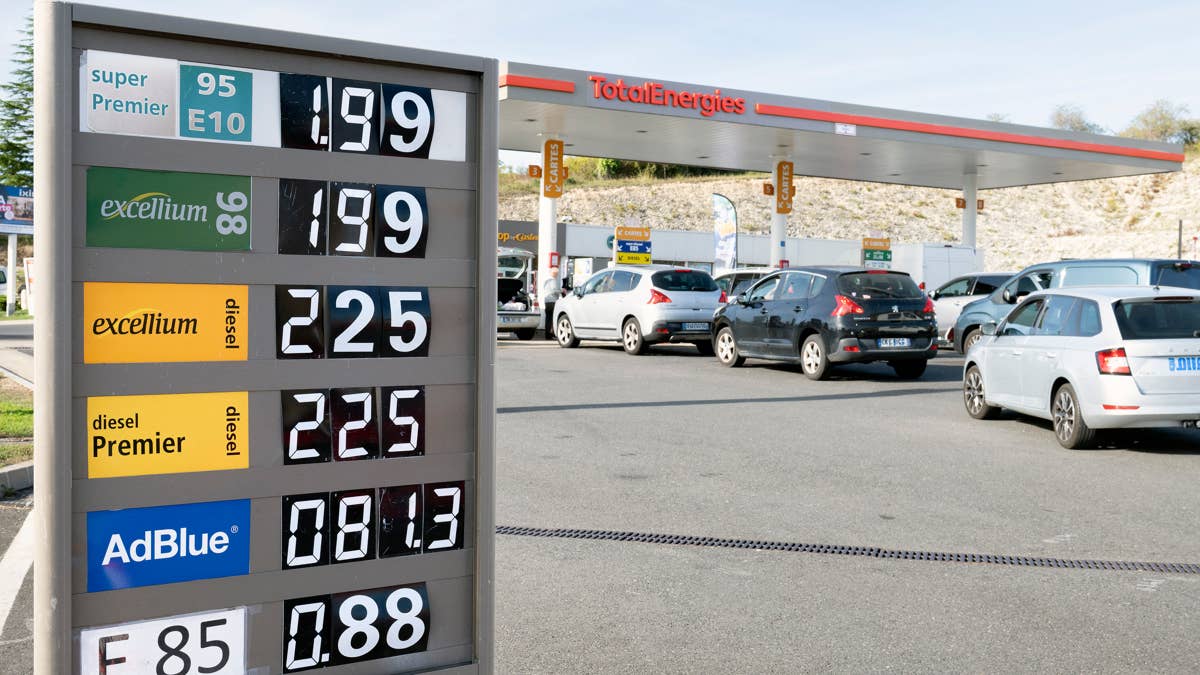
What empty pumps look like across France
The shortage is not spread evenly. Grand Est reported 16% of its stations dry and Occitanie 14%, while Île-de-France sat at 7%, as of the morning of Friday, Sept. 18, according to the French Economy Ministry.
Those numbers also flatter the situation. A station counts as out of stock only if it has no petrol at all or no diesel at all, so a site that has burned through one grade and still sells another is recorded as fine.
Retail pricing tells the cleaner story. French diesel averaged €2.378 per liter on Sept. 18, within two cents of the record set in April and up nearly 7% in a month.
Related: JPMorgan sends stark warning on $100 oil
I converted that figure at Friday’s euro rate of $1.1486, and it works out to roughly $10.34 a gallon. American drivers cursing $6 diesel are paying about 40% less than a French trucker.
Macron’s government is preparing a new support scheme starting Oct. 1 aimed at “the most vulnerable French workers,” Energy Minister Maud Bregeon said, according to The Connexion.
Marine Le Pen’s National Rally wants fuel VAT cut from 20% to 5.5%, a proposal the government rejected at a cost of €15 billion. Drivers can check live shortages on the government’s prix-carburants site.
How a Saudi pipeline attack deepened the crunch
The trigger this week was a drone strike on Sept. 10 that closed Saudi Arabia’s East West pipeline, the line carrying crude from the eastern oil fields to Yanbu on the Red Sea without touching Hormuz.
Aramco has now told European refining customers they will receive no crude at all in October under long-term contracts, reported Bloomberg. The decision applies to every European buyer.
Asia is getting those barrels instead, routed through Hormuz and transferred ship-to-ship off Oman. Europe is the customer left holding the cancellation notice.
Where diesel stands right now
- French diesel averaged €2.378 per liter on Sept. 18, roughly two cents below April’s record, according to The Connexion.
- The U.S. national average hit a record $6.4776 per gallon on Sept. 18, up 79% this year, according to AAA.
- Global diesel exports averaged 5.85 million barrels per day in August, down 25% from a year earlier, according to S&P Global Energy, as reported by Oil & Gas Journal.
- Brent crude settled near $104 on Sept. 18 after touching $108 on Monday, Sept. 21, according to Trading Economics.
What French diesel prices mean for American wallets
Here is the part that travels. Europe’s shortfall does not stay in Europe, because the barrels that fill it come off the same U.S. Gulf Coast docks that supply Atlanta and Chicago.
U.S. refinery utilization has run near 97% this summer while global diesel exports have fallen 25% year over year, according to Rigzone. “Winter is coming for diesel markets,” S&P Global Energy executive director Karim Fawaz said in that analysis.
Diesel sets the price of every physical thing you buy. It moves the container off the ship, the pallet into the warehouse and the box to your door, and the cost rides along at each step. It is also why $5 gasoline is already reshaping holiday spending plans.
That is why the Federal Reserve raised its benchmark rate a quarter point to a range of 3.75% to 4% on Sept. 16, its first increase since July 2023, blaming energy-driven inflation. Chair Kevin Warsh said inflation is “too high and has been for too long,” according to Fox Business.
So the French fuel crisis reaches you twice. Once at the pump, where the national average for regular sits near $4.47, and again on your mortgage quote and your credit card statement, because the 10 year Treasury yield has pushed above 5%.
What to watch as winter oil demand arrives
Saudi Arabia expects partial pipeline service within days and full capacity within six weeks. Both estimates come from people who have been wrong about repair timelines since March.
The harder deadline is temperature. Northern Hemisphere heating season starts pulling barrels in October, and European diesel inventories were already sliding toward multi-year lows before Aramco canceled the October program.
When I lined the French shortage map up against the U.S. export numbers, the uncomfortable read was that the two markets are now bidding for the same scarce cargoes. Europe will win most of those auctions, because Europe has no choice.
Watch three things from here. Whether Yanbu resumes loading, whether Washington taps what is left of the Strategic Petroleum Reserve, and whether TotalEnergies (TTE) and other European majors begin rationing supply to their own branded stations.
France ran out first because it had the thinnest margin. It will not be the only one.
Related: The IRS just rewrote a fuel tax credit as diesel hit $5.94