IBM (IBM) unveiled the first mainframe processor built to run two rival computing architectures on a single core, disclosing the design at the Hot Chips conference on Monday, August 24, according to a press release.
Any enterprise architect who has ever been told a piece of software will not run on the mainframe knows the usual workaround: pay a vendor to port it, or route the workload somewhere else entirely. IBM just spent two years building a chip designed to remove that excuse for one of the fastest-growing software ecosystems in computing.
Why mainframes couldn’t talk to modern AI
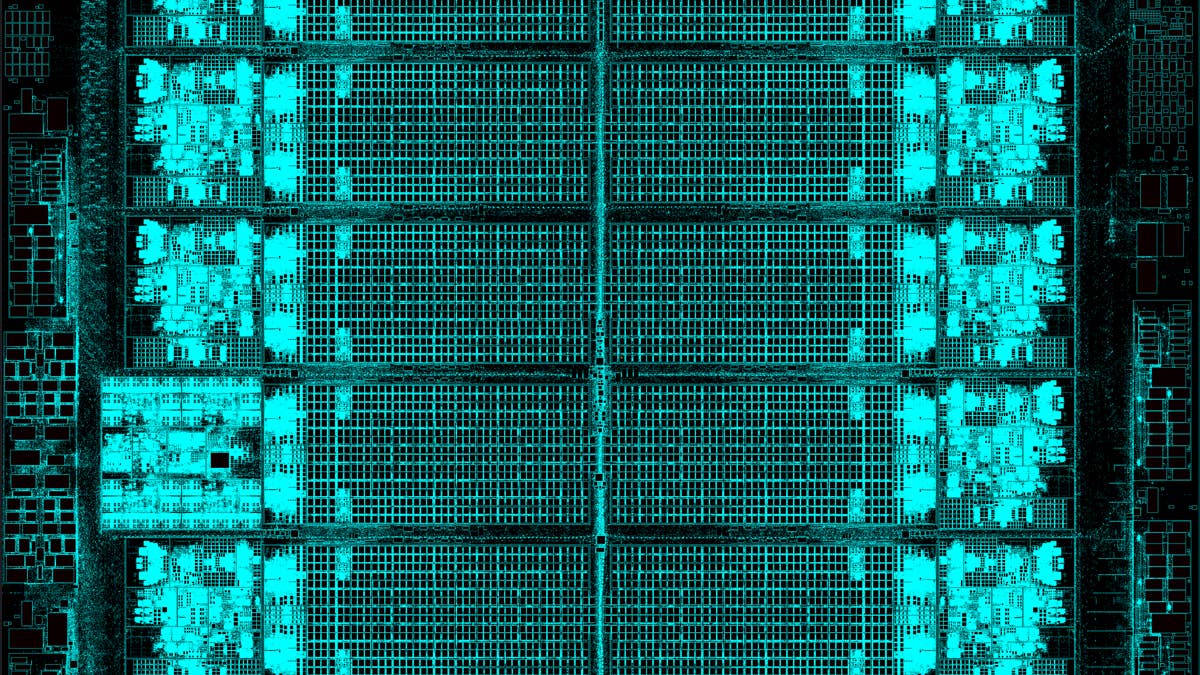
For three decades, IBM Z has run on z/Architecture, an instruction set almost no software outside mainframe shops has ever targeted. The new chip’s 11 cores execute both z/Architecture and Arm instructions natively, without an emulation layer or a separate block of Arm-only cores bolted onto the die, the firm found.
That distinction matters because the mainframe now inherits software already built for Arm, including AI servers, smart virtual assistants, and instant search tools that power modern AI, instead of waiting for someone to build a mainframe-specific version first.
Related: IBM CEO sends blunt message on quantum computing
Without an emulation layer, the chip avoids the slowdowns that happen when hardware constantly translates foreign code. Think of it like a speaker fluent in two languages instead of relying on a middleman interpreter.
It allows real-time AI tools to run natively at full speed without stalling mission-critical operations.
Built on a 2 nanometer process, the chip packs 11 cores running above 5.7 GHz continuously, according to IBM’s announcement. It also includes AI inference accelerators aimed at catching fraudulent transactions in real time, a capability banks lean on for split-second decisions during a live payment.
The mainframe coder shortage
The Arm partnership has as much to do with staffing as silicon, according to Rachita Rao, a senior analyst at Everest Group, in comments to Network World.
Banks and insurers resist changing core architecture because of the risk to their ledgers, Rao said, but they also face a dwindling pool of specialists who know how to run z/Architecture systems.
Native Arm support lets those firms modernize without retraining an entire workforce or ripping out systems that still process the bulk of global financial transactions.
Rao also framed the move as IBM targeting sovereign and air-gapped computing, the regulated workloads that cannot move to public cloud infrastructure. That is a narrower market than the hyperscale data centers where Arm has already won, but it is one where IBM faces little direct competition.
IBM leadership framed the move as a direct response to that modernization push.
By bringing Arm natively to our platform, we’re combining access to one of the industry’s fastest-growing software ecosystems with the qualities that have made IBM systems the foundation for how businesses run today.
Why was Wall Street quiet?
IBM shares were fractionally lower and Arm slipped 2.4% in premarket trading following the announcement. That muted reaction fits how early the product still is. IBM gave no shipping date, no pricing, and no name for the chip, so any financial impact sits years out.
The announcement lands amid a broader buildout of IBM’s AI infrastructure bets, including an expanded Nvidia partnership to bring Blackwell Ultra GPUs to IBM Cloud, an $11 billion acquisition of data-streaming company Confluent, and a partnership with OpenAI.
IBM’s parallel Nvidia expansion signals the company is not treating Arm compatibility as its primary answer to AI at scale, since large models still run on GPU-heavy infrastructure. Arm’s role is narrower: pulling the software that surrounds those models closer to the data that already lives on the mainframe.
IBM also cleared a pricing obstacle that had discouraged this kind of consolidation. Red Hat moved to per-socket-pair pricing with cost parity across x86, IBM Z, LinuxONE, and Power shortly after Arm partnership was announced in April, per Moor Insights & Strategy, removing a structural penalty that made mainframe deployments more expensive per core regardless of how efficiently that core ran.
More IBM:
- IBM CEO sends blunt message on quantum computing
- IBM quietly cleared a quantum computing hurdle experts doubted
- IBM CEO makes bold AI strategy claim
Arm’s last holdout is starting to open up
Arm chips already power roughly half of the new compute capacity added by the largest hyperscalers, with Amazon, Google, and Microsoft each building custom Arm silicon for their own clouds.
The mainframe was the one corner of enterprise computing that shift never reached, walled off by decades of software written for a single instruction set.
IBM’s chip does not tear that wall down immediately. Pricing for non-IBM software, distribution certification, and vendor support on Arm workloads remain undefined, and the earliest systems are not expected before 2027.
What changes is the assumption underneath it. The architecture now dominating cloud and AI infrastructure is no longer locked out of the systems that still run much of the world’s banking and insurance backbone.
That shift will shape enterprise computing decisions for longer than any single quarter’s stock reaction suggests.
Related: IBM quietly cleared a quantum computing hurdle experts doubted