Amazon is the world’s largest online retailer, with a market capitalization exceeding $2.5 trillion as of June 2026. The company started in the early years of the internet, survived the dot-com bust, and grew into a worldwide tech powerhouse. At the same time, Amazon expanded its digital footprint, with Kindle books and Prime Video.
Now it’s investing heavily in artificial intelligence, not wanting to miss out as rivals nip at its businesses. Here’s an overview of whether Amazon is a good long-term investment in 2026.
Is Amazon a good long-term investment?
Amazon’s current market capitalization reflects its performance. Its stock reached a record high in May 2026 and has increased in value by massive multiples since it went public in 1997, minting millionaires among its early investors.
For 2025, Amazon posted a profit of $77.7 billion on sales of $717 billion — both of which were the highest since the company went public in 1997. Sales alone were almost double their 2020 record of $386 billion.
Related: How many employees does Amazon have in 2026? Its workforce explained
How much has Amazon’s stock gained?
Amazon’s shares have risen significantly since the company’s IPO. The stock rose more than 2,400 times from its first day of trading on May 15, 1997, meaning that a $10,000 investment then would be valued at over $24 million as of early June 2026. For comparison, the S&P 500 index gained nearly eightfold in the same time period.
In the past decade alone, the stock has risen from about $35 in June 2016 to a record of nearly $245 in early June 2026.
Google Sheets via Google Finance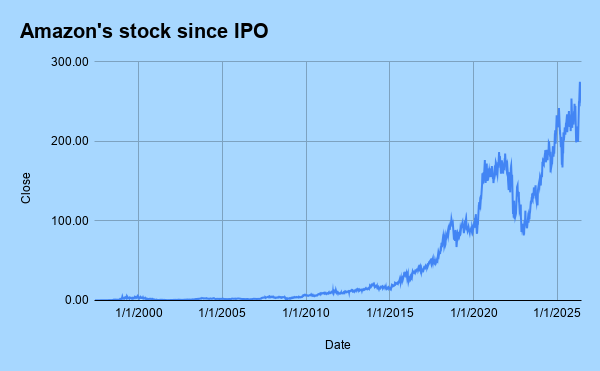
How is Amazon’s stock rated by analysts?
Amazon’s stock is rated a hold, or number 3 rank, by Zacks Investment Research, a Chicago-based investment research firm that compiles analyst ratings and earnings estimates. That suggests a neutral position on the stock.
For investors who own Amazon shares, that means there’s no recommendation to either buy more stock or sell any shares at the moment. “Stocks in this camp can still provide excellent upside potential. But one needs to keep a careful eye on these stocks,” according to Zacks.
Zacks recommends investors focus on stocks ranked 1, or strong buy, and to an extent, those ranked 2, while stocks rated 4 or 5 should typically be avoided.
More on Amazon:
- Amazon’s dividends and stock splits: What you need to know
- Where are Amazon’s headquarters? Seattle and beyond
- History of Amazon: From garage startup to tech titan
What contributes to Amazon’s top-line growth?
Product sales, mainly through its online platforms, generate the overwhelming majority of its revenue, although margins in this business are quite thin.
Amazon Web Services (AWS), its cloud computing unit, continues to grow in contributing to the top line, and the company continues to focus on expanding its web services operations. In 2025, AWS accounted for almost a fifth of the $716.9 billion in total revenue.
AWS is also the company’s most profitable segment, accounting for more than half of its operating income.
How is Amazon spending its money?
Amazon has never paid a dividend, though it has bought back shares, which could signify that the retailer is optimistic about its future prospects. Its most recent — and only — stock repurchase program was a $10 billion buyback introduced in 2022. As of 2025, it said it had $6.1 billion remaining.
Most of the cash Amazon generates is reinvested into what the company says are its “rapidly evolving and intensely competitive” businesses. In 2025, its free cash flow decreased to $11 billion from $38 billion in 2024, driven primarily by a year-over-year increase of $50.7 billion in purchases of property and equipment, net of proceeds from sales and incentives, the company said in its 2025 annual report.
That change in free cash flow, it said, was particularly a result of its capital expenditure investment in artificial intelligence — the latest trend in tech.
Most likely, the company was spending heavily on data centers and logistics. By one measure, the total footage on property it leased and owned — which covers office space, physical stores, fulfillment centers, and data centers — surged by almost three quarters to 819,676 square footage in 2025 from 474,516 square footage in 2020.