How do you value the assets of about 8.3 billion people and a livable planet that is 4.54 billion years old – give or take 50 million years? The question came up in an Elon Musk tweet on July 9:
“SpaceX will be worth more than the rest of Earth if we accomplish our goals.” – Elon Musk
The key here is the little word “if” attached to his “goals.” That sure is a big “if,” the biggest “if” of any company trying to talk about the future. I like the fact that SpaceX wants to turn humanity into an interplanetary species. I like the fact he’s taking the fiction out of “science fiction.” Among his goals, they want to build a city on the Moon and later on Mars.
That is fine and dandy, but I think it will take a few years, maybe decades, and share prices are about discounting future cash flows.
Those cities on the Moon and Mars are hard to discount, to put it mildly, as they certainly won’t happen within the next year or two.
Related: Louis Navellier sees uncommon August rebound after Palantir blowout
The leveraged ETF community has noticed keen investor interest in SpaceX and has listed five 2X leveraged bullish single-stock ETFs on the company, and one bearish-inverse ETF.
I find the idea of single-stock 2X exchange-traded funds absurd.
What type of “fund” would hold only one stock? And piling this 2X leverage on top of an already volatile security is only going to make it more volatile.
Musk wants to generate $1 trillion in revenue by 2030. If anyone can do it, Elon Musk can. He divulged more of his plans for how he will achieve that goal in SpaceX’s first earnings call. And yet, the stock did not rally.
Will SpaceX follow Tesla’s trajectory?
Many point out Tesla’s (TSLA) spectacular growth after it became public in 2010, but few bothered to look up Tesla’s market cap at its IPO price – it was only $1.7 billion, while SpaceX’s debut price was 1,000+ times higher, at $1.75 trillion.
Tesla grew dramatically since 2010, while SpaceX is already at a huge market cap.
SpaceX’s lockup expired on August 6, and investors will get a better grip on what SpaceX is worth after the August-December period, and after we get even more details on Musk’s interplanetary exploration plans. But right now, SpaceX has declined about 50% from its highs and is not expected to be profitable until late 2027 or 2028.
I am not anti-Elon Musk and realize that he made a lot of people, including himself, rich. However, Tesla has never scored well in my 8-factor fundamental model.
My stock grading system rates Tesla as a D.
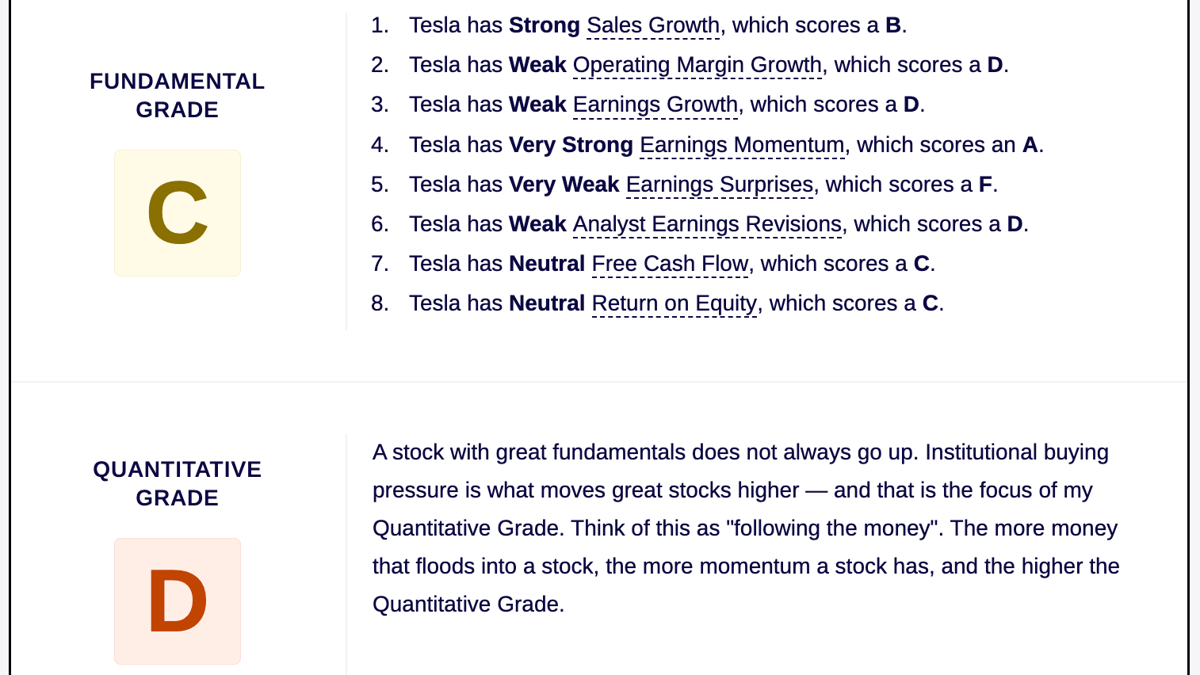
For more information about my grading system, click here.
SpaceX will not be in Stock Grader until it has traded for 52 weeks, but I can tell you already that SpaceX already scores poorly in my 8-factor fundamental model.
All the fuss on the SpaceX initial public offering (IPO) was about 21 Wall Street underwriters collecting record investment banking fees and not about a good investment.
Whether SpaceX will be worth more than the rest of Earth is anyone’s guess, but for now, its valuation is pricing in a future that remains a very big “if.”
Related: Bank of America doubles down on SpaceX after earnings