AI CapEx fatigue continues to sour investors as hyperscalers shell out billions on data centers, chips, and power infrastructure without a clear timetable for returns.
Wall Street’s been bracing for evidence of the spending boom being a drag on margins, free cash flows, and earnings.
Some of the recent Big Tech results added to those fears.
I covered Alphabet (GOOGL), which spent $44.9 billion on capital expenditures in Q2, exceeding its $39.1 billion in operating cash flows and pushing quarterly free cash flow to negative $5.9 billion.
At the same time, as I covered, Amazon’s (AMZN) trailing-12-month free cash flow swung from an $18.2 billion inflow to a $7.6 billion outflow, as property-and-equipment spending shot up by $66.1 billion, mainly due to AI investments.
Nevertheless, AI stocks such as Nvidia (NVDA) have had investors laughing all the way to the bank in recent years.
For context, according to Seeking Alpha, Nvidia generated a gain of more than 390% over the past three years, meaning a $10,000 investment would now be worth roughly $49,000, including about $39,000 in profit.
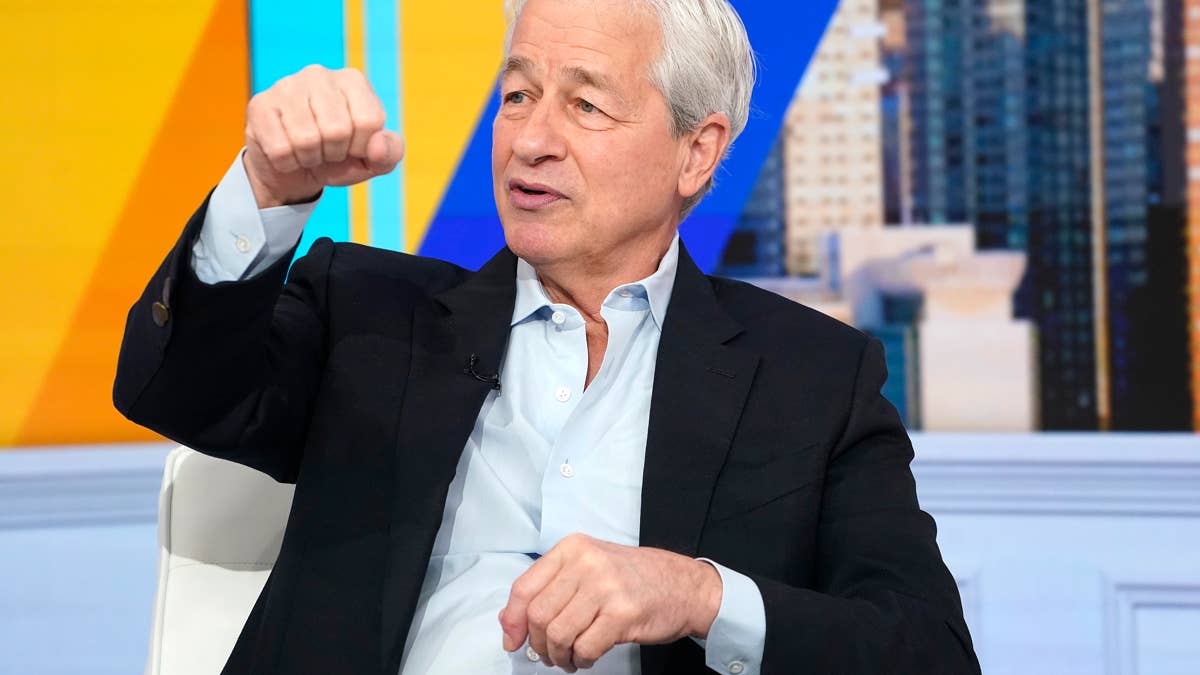
Surprisingly, JPMorgan CEO Jamie Dimon offered a contrasting take on the matter, arguing that the AI buildout could be far more economically consequential than skeptics assume.
In many ways, his comments recast the near-term debate, raising the question of whether AI spending is eroding shareholder value or quietly becoming a major engine of U.S. growth.
Jamie Dimon sees AI spending powering the economy
Dimon is looking past the immediate pressures AI spending exerts on corporate cash flows.
The veteran banker and JPMorgan CEO believes the AI buildout needs to be viewed as a broader investment cycle that’s feeding through the U.S. economy.
Speaking to CNBC, as cited by Business Insider, Dimon acknowledged that his prediction might go wrong, but the spending surge will ultimately “play out and pay out.”
More AI:
- Nvidia just made a move Wall Street wasn’t ready for
- Microsoft just took sides in AI policy fight
- OpenAI just disclosed something genuinely alarming
According to him, these companies aren’t committing hundreds of billions of dollars blindly. In fact, he believes there is a method to the apparent madness in raising the cost of developing frontier models, running those models for customers, and meeting growing computing demand.
The advanced training model is one piece of the puzzle and incurs a massive upfront investment. However, inference (operating cost of AI systems) creates an ongoing need for more advanced chips, servers, networking equipment, and energy.
“The need is going up dramatically,” Dimon said, which means the infrastructure race reflects rising usage rather than enthusiasm alone.
On the economy, he estimates that AI-related spending will increase by roughly 1% of GDP this year, with another comparable increase expected next year. That makes the AI buildout more than an insular Silicon Valley story.
Specifically, he pointed to the tremendous demand for steel and cement, highlighting how AI CapEx needs can flow into industrial companies, utilities, engineering firms, and local labor markets.
The spillover is already backed by the numbers. For context, the U.S. private data-center construction spending jumped to an annualized $68.3 billion in June, up 45.8% year over year.
Moreover, Dimon said he wasn’t concerned about investors cooling on AI stocks, saying it was “not high on the list” of risks worrying him.
John Lamparski/Getty Images
JPMorgan is playing both sides of the AI boom
Dimon’s view is not a big surprise, though, considering the bank’s skin in the game.
Over the past couple of years, the bank’s been automating operations with AI while earning fees from companies financing the buildout.
According to a recent company update, JPMorgan said it was allocating about $20 billion to tech this year across 6,000 applications.
Moreover, its internal large-language-model platform is used by 150,000 employees weekly, with users estimating it saves each person 4 hours. Additionally, Dimon added that the bank has roughly 1,000 AI use cases, including 50 high-priority applications across fraud, risk, marketing, hedging, and document analysis.
On top of that, the bank’s been raking in a ton of money, monetizing AI through capital markets.
JPMorgan serves over 11,000 startups with more than 550 specialized bankers. For perspective, in Q2, investment banking fees jumped 30% to $3.3 billion, driven by stronger equity underwriting. Moreover, JPMorgan’s investment-banking revenue surged 45% year over year to $3.9 billion.
Also, JPMorgan was a bookrunner on SpaceX’s IPO, which sold 638.9 million shares and raised about $85.7 billion.
The biggest risk may be capex concentration
Dimon’s AI optimism is backed by real demand, but the spending cycle remains unusually dependent on a small group of businesses.
For some color, Amazon, Alphabet, Microsoft (MSFT), and Meta Platforms (META) are collectively expected to spend $735 billion to $760 billion on capital expenditures during 2026, according to Statista.
Amazon alone plans roughly $220 billion, and Alphabet recently bumped its range to $195 billion to $205 billion.
So essentially, a handful of balance sheets are creating demand for AI chips, electricity, construction, and whatnot, and they are big enough to affect national investment.
Nevertheless, there’s evidence, especially based on recent tech results, that the spending is generating commercial returns.
Alphabet’s cloud sales surged 82% to $24.8 billion, while its backlog reached $514 billion, with just over 50% expected to convert into sales within two years. In addition, Microsoft reported 40% Azure growth and a $627 billion commercial backlog, Bloomberg reported.
However, these numbers are far from sufficient to eliminate the concentration problem.
For instance, looking at Q3 figures, Microsoft’s backlog grew 99% overall, including OpenAI commitments, but only 26% excluding OpenAI, underscoring the tremendous impact of a single major customer.
Additionally, the Federal Reserve offered another important qualification.
According to Fed research, AI-related investment contributed meaningfully to recent growth, but imported servers and computing equipment offset part of the domestic GDP benefit.
Also, its researchers found that even though corporate AI adoption is rising, usage remains mostly shallow at many firms.
It means that even if a couple of hyperscalers slow their expansion in protecting cash flows, suppliers might face weaker orders before today’s massive backlogs are recognized.
Dimon could be right about the eventual AI payoff, yet the durability of that support depends a ton on a handful of businesses shelling out money at historically exceptional levels.
As the Joker or Michael Burry might say, the end is nigh…