For millions of Americans, the idea of supporting a family on less work sounds almost impossible.
Housing, groceries, insurance, and child care already consume so much of household income that many households depend on two paychecks just to stay comfortable.
Backing that pressure up with some data, in 2025, both spouses were employed in 49.1% of U.S. married-couple families, according to U.S. Bureau of Labor Statistics data.
That said, Jeff Bezos thinks artificial intelligence could eventually turn that equation on its head.
The Amazon (AMZN) founder recently argued that AI-driven productivity gains could make it possible for people to support their families while working just three days a week.
That seems like a highly optimistic vision at a time when workers are hearing far more about layoffs, automation, and whether AI will make some jobs disappear.
That contrast is what makes Bezos’ prediction especially interesting, and perhaps the real question is not whether AI can make companies dramatically more productive.
Instead, I think it’s who ultimately benefits from that productivity: workers gaining more time and income or employers gaining more output with fewer people?
Bezos says AI could make the 3-day workweek possible
Bezos believes AI could eventually produce double-digit productivity gains across the U.S. economy, enough to fundamentally change how much Americans need to work.
During an interview with Fox News’ Bret Baier at Blue Origin’s Cape Canaveral complex, Bezos argued that those gains could give workers choices that sound almost foreign today.
“I can support my family by working three days a week,” he said.
More Layoffs:
- Disney cuts 300 jobs and major overhaul puts hundreds more at risk
- Microsoft cuts hundreds more jobs as restructuring deepens
- Oracle layoffs top 2,500 workers as AI spending surges
His prediction goes further than a shorter workweek.
Bezos believes some households could return to relying on a single income because AI makes the economy substantially more productive. In his telling, the resulting abundance could eventually make workers scarcer, not more disposable, because fewer people would feel compelled to work as much.
Baier challenged him by pointing to the nearly 30,000 corporate roles Amazon has eliminated since late 2025. Bezos responded that Amazon had been in an unusual position after dramatically expanding its workforce during the pandemic, an explanation he has made separately for the company’s recent restructuring.
At the same time, Amazon is betting extraordinary sums on the technology behind Bezos’ forecast. The company said in February that it expected roughly $200 billion of capital expenditures in 2026, with CEO Andy Jassy describing AI as a major driver of that investment, as reported by CNBC.
After reporting its Q2 results on July 30, Amazon raised its plan by about 10% to $220 billion.
In essence, Bezos is arguing that enormous corporate spending on AI can eventually translate into more leisure and greater financial freedom for workers.
SpaceX CEO Elon Musk made a similarly sweeping argument about abundance when he spoke at the Saudi-U.S. Investment Forum in May 2025.
“I think it’s actually going to be universal high income, where anyone can have any goods or services that they want,” Musk said, according to Fox Business.
Whether productivity actually gets distributed that way, however, is a much harder question.
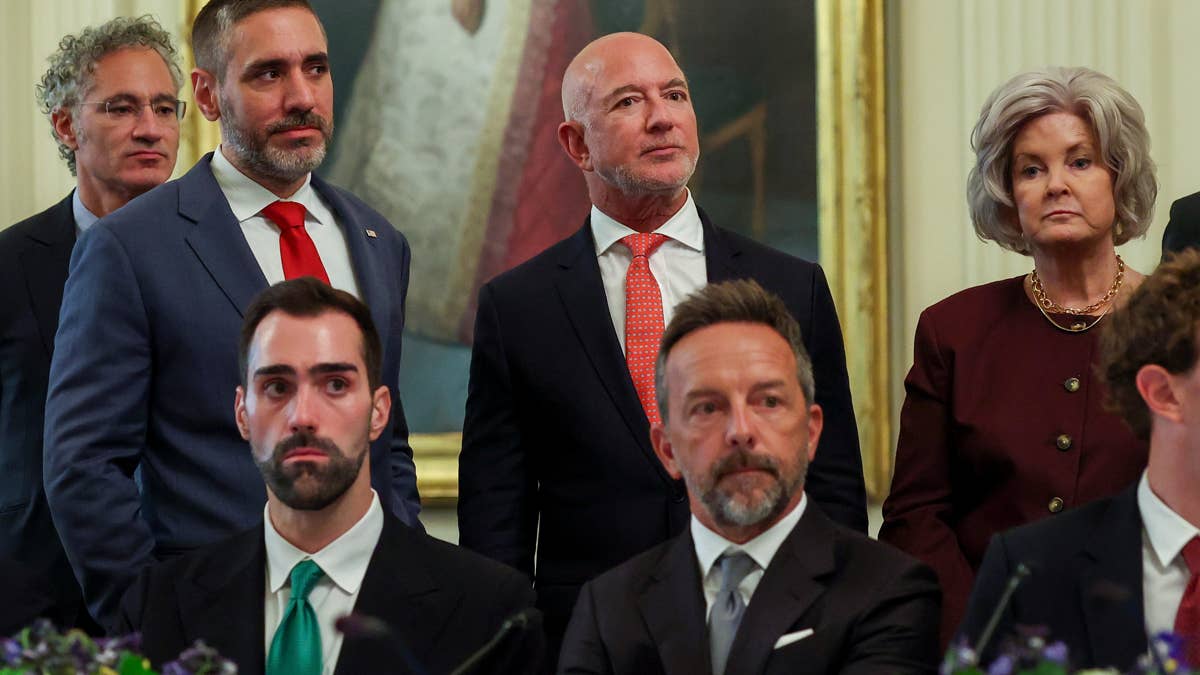
The AI-fueled productivity boom only matters if workers share in it
Bezos’ argument is already yielding evidence, at least in part, since the productivity side of that equation is improving, according to the latest data.
U.S. nonfarm business productivity rose 2.2% year over year in the second quarter of 2026, according to the Bureau of Labor Statistics.
Since late 2019, productivity has grown at a 2.1% annualized rate, faster than during the previous business cycle.
But I think the harder part of Bezos’s thesis is distribution.
In that same quarter, real hourly compensation fell 0.1% from a year earlier, while labor’s share of economic output dropped to 52.8%, the lowest level since the BLS series began in 1947.
Meanwhile, unit profits at nonfinancial corporations jumped 17.8% year over year.
That contrast is pretty huge. Higher productivity can lead to higher wages, shorter working hours, bigger corporate profits, or some combination of the three. A three-day workweek only becomes realistic for ordinary households if workers capture enough of the gains to maintain their living standards while working less.
The labor-market evidence also argues against assuming AI has already transformed employment. Yale’s Budget Lab, using data updated through August 2026, said it still found no clear evidence of broad labor-market disruption associated with AI.
There is, however, evidence that shorter weeks can work under the right conditions. A 2025 six-country study involving 2,896 workers across 141 organizations found that moving to a four-day workweek without reducing pay improved burnout, job satisfaction, and physical and mental health.
To me, that suggests the technical possibility is real. The unresolved issue is whether AI’s productivity dividend ultimately shows up in workers’ paychecks and free time, or mainly on corporate income statements.
The real test for Bezos’ AI vision is who gets the gains
The next test of Bezos’s argument will come from the gap between productivity, wages, and corporate profits.
The first checkpoint arrives on Nov. 5, when the Bureau of Labor Statistics releases preliminary third-quarter productivity data.
If productivity continues to accelerate while real compensation and labor’s share of output remain weak, I would argue that Bezos’ three-day-workweek thesis still has a missing link: Companies are becoming more efficient, but workers are not yet capturing enough of that benefit.
Amazon itself offers another useful test. For the third quarter, the company guided to $197 billion to $202 billion in sales, or 9% to 12% growth. When Amazon next reports results, investors should watch AWS growth, returns on its enormous AI infrastructure spending, and any new commentary about how automation is changing headcount.
AI-related companies are expected to drive roughly two-thirds of S&P 500 earnings growth this quarter, putting enormous pressure on Big Tech to convert AI spending into profits.
For me, the simplest framework is this, which is to watch whether productivity rises faster than hours worked without workers losing income. If that begins happening broadly, Bezos’ abundance argument gains credibility.
If productivity instead flows mainly into margins and fewer jobs, AI may create abundance without delivering the extra free time he envisions.
Related: Cathie Wood sells $4.7 million in surging tech stock after rally