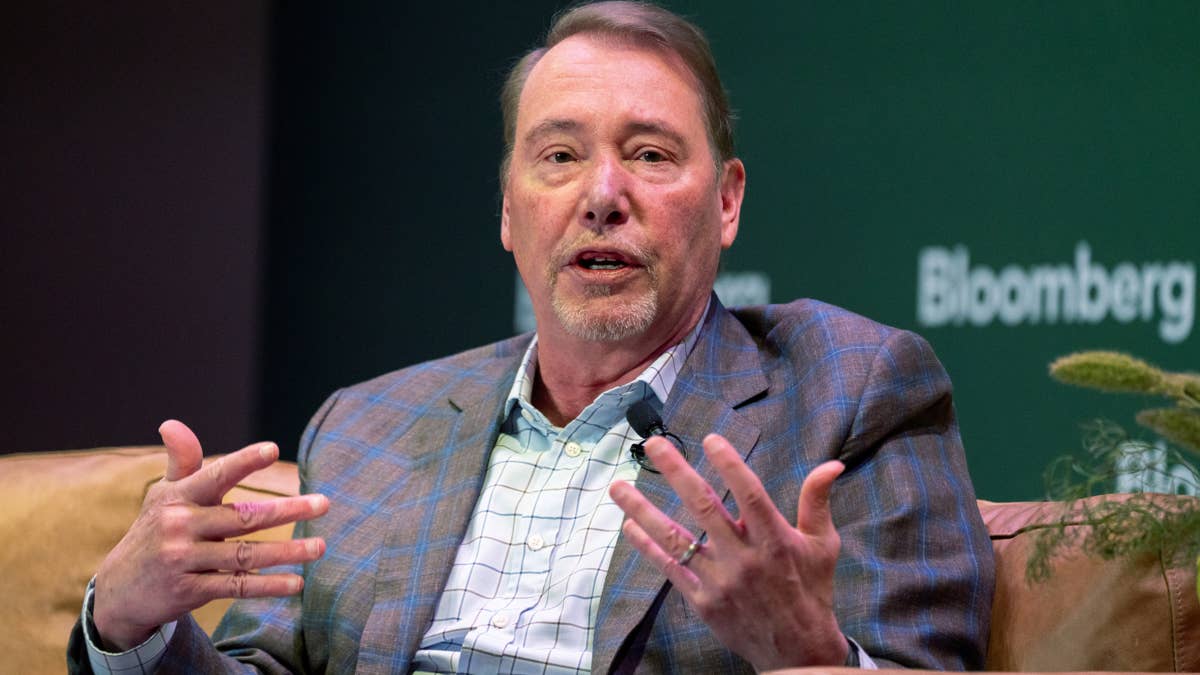
Jeffrey Gundlach thinks the stock market looks much healthier than it really is.
Despite seeing the S&P 500 stay close to record highs, the CEO and chief investment officer of DoubleLine Capital likened the market to a “hollow tree,” with weakness lurking beneath those peak highs.
His evidence is striking. MarketWatch calculated that 80% of S&P 500 companies were at least 10% below their 52-week highs at the start of October, while 39% had fallen at least 20%. In other words, much of the index was already experiencing correction- or bear-market-sized declines even though the benchmark itself remained close to a record.
Even for investors who never choose particular equities, that is important. Due to the S&P 500 fund’s weighting toward the largest firms in the market, a few massive technology corporations may maintain the index’s strength while hundreds of smaller participants suffer.
And Gundlach’s warning has gained relevance since he made it. More than four in ten S&P 500 stocks were down for 2026 as of Oct. 12, while stress has started appearing in the debt financing the artificial intelligence boom.
The S&P 500’s ability to continue climbing is no longer the only issue.
It is the amount of weakness the index can conceal before investors become aware of it.
Gundlach says the S&P 500 is weaker than it looks
Gundlach used a real tree as the inspiration for his metaphor.
During an interview with Rosenberg Research founder David Rosenberg, Gundlach described a roughly 100-year-old silver maple at his Buffalo, N.Y., home. The tree had appeared healthy until a large limb suddenly broke away. Only afterward did it become clear how badly the tree had deteriorated internally.
Because the S&P 500 is based on market capitalization, it may stay close to a record. Gains from the biggest firms have a much bigger impact on the index than decreases from smaller members.
Such conditions may lead to a discrepancy between what is happening to the average stock and the index that investors see on television.
“You’ve got to wait for the branch to fall off,” said Gundlach.
A Reuters analysis published Oct. 12 seems to support Gundlach’s view of underlying weakness in the stock market. It found that the S&P 500 was up roughly 14% in 2026, even though more than 200 of its members were down for the year. A quarter of the index had fallen at least 11%, while the median S&P 500 stock was up only about 4%.
When investors discuss poor market breadth, they are referring to the fact that fewer equities are taking part in the headline gain.
When the firms doing the majority of the lifting have the same catalyst, the concentration becomes very significant.
Spending, profit expectations, and market gains have all increased dramatically as a result of artificial intelligence. There could be fewer companies underneath it that can sustain the overall index’s upward movement if that transaction falters.
Gundlach’s warning reaches beyond the stock market
Gundlach is concerned about more than just the breadth of the equities market. Additionally, he sees warning indicators emerging in the finance industry, especially in relation to private markets and artificial intelligence.
At a September DoubleLine event, Gundlach said he sees AI-related bonds widening significantly compared with the rest of the credit market. He also questioned private-credit valuations and argued that equity concentration leaves investors with little margin for error, according to DoubleLine.
More Wall Street:
- Nvidia and Micron are about to lord their successes all over Wall Street
- Nvidia, Palantir, and Alphabet send waves through Wall Street
- Wall Street elites will pocket windfall from record $46 billion profits
In public markets, the issue is becoming more apparent.
CoreWeave (CRWV), one of the largest borrowers connected to the AI infrastructure buildout, has about $50 billion in debt, according to LSEG data cited by Reuters. The cost of insuring its debt against default climbed to roughly 1,200 basis points this week, while yields on some CoreWeave bonds reached around 15% to 16%.
This does not imply that the market for AI funding as a whole is collapsing.
It does indicate that lenders are beginning to expect much more remuneration for assuming certain risks.
Because assets do not move as often as public equities and bonds do, private credit complicates the situation. As a result, valuations may change more slowly, giving investors less timely insight into how much an asset has declined.
For this reason, Gundlach’s “hollow tree” metaphor also applies to private credit, not just equities.
Even after the underlying structure has begun to deteriorate, the outside may still appear stable.
And there is a huge amount of capital involved. According to Carlyle’s estimates, private lending may eventually fund up to $1 trillion worth of AI infrastructure, according to Reuters.
The credit market may serve as a crucial gauge of how long-lasting the boom is if borrowing prices continue to rise and investors start to doubt AI returns.
Gundlach’s warning gives investors two signals to watch
Investors are not receiving a date for the next stock market meltdown from Gundlach.
That difference is important.
A narrow market may stay that way for a very long period, especially if its biggest businesses continue to generate outstanding profits. While weaker companies underperform, Nvidia (NVDA) and other leaders in artificial intelligence might continue to expand fast enough to sustain the indices.
However, concentration changes the risk.
Investors may think they control a wide-ranging portion of corporate America if they buy an S&P 500 index fund. In theory, they do. However, in reality, returns may grow more and more reliant on the fate of a tiny number of mega-cap firms.
Thus, breadth is the first indicator to look for.
Gundlach’s hollow-tree theory loses credibility if more S&P 500 members start rising above longer-term norms and taking part in market gains. It becomes increasingly difficult to overlook the structural mismatch if the index increases while more individual equities lag behind.
Credit is the second signal.
I find it noteworthy that the tales about stocks and bonds are starting to overlap. Higher interest rates make every new data center, chip purchase, and loan refinancing more costly, and the AI revolution requires unusual amounts of cash.
The International Monetary Fund also warned this month that an AI investment slowdown and rising government bond yields represent meaningful risks to global financial stability, Reuters reported.
That does not prove Gundlach is right that the market is about to snap.
It does explain why investors should look beyond the S&P 500’s headline level.
The most useful question may not be whether the index is making another record.
It is whether the rest of the market is becoming strong enough to hold it up.