For most of the last century, the heart of a car was the part you could hear.
You judged a vehicle by its engine growl, its horsepower and the solid thud of the door. The badge on the grille told you who built the best motor, the best transmission and the smoothest ride.
Chips were an afterthought. Automakers bought them by the million as cheap parts, much like bolts or wiring, and leaned on suppliers to shave pennies off each one.
That playbook ran Detroit, Stuttgart and Toyota City for generations. Success meant units shipped, plants humming and dealer lots full.
Then the screen started to matter more than the drivetrain. Software updates began arriving overnight, and features showed up that weren’t there when you drove off the lot.
You’ve probably felt the shift without naming it. Many newer cars now ask you to accept terms of service before you can use them.
Now one of the most powerful people in tech has put a name on who forced that change, and it points to the most polarizing CEO in the car business.
Nvidia (NVDA) CEO Jensen Huang says Elon Musk helped transform the auto industry into a computing industry.
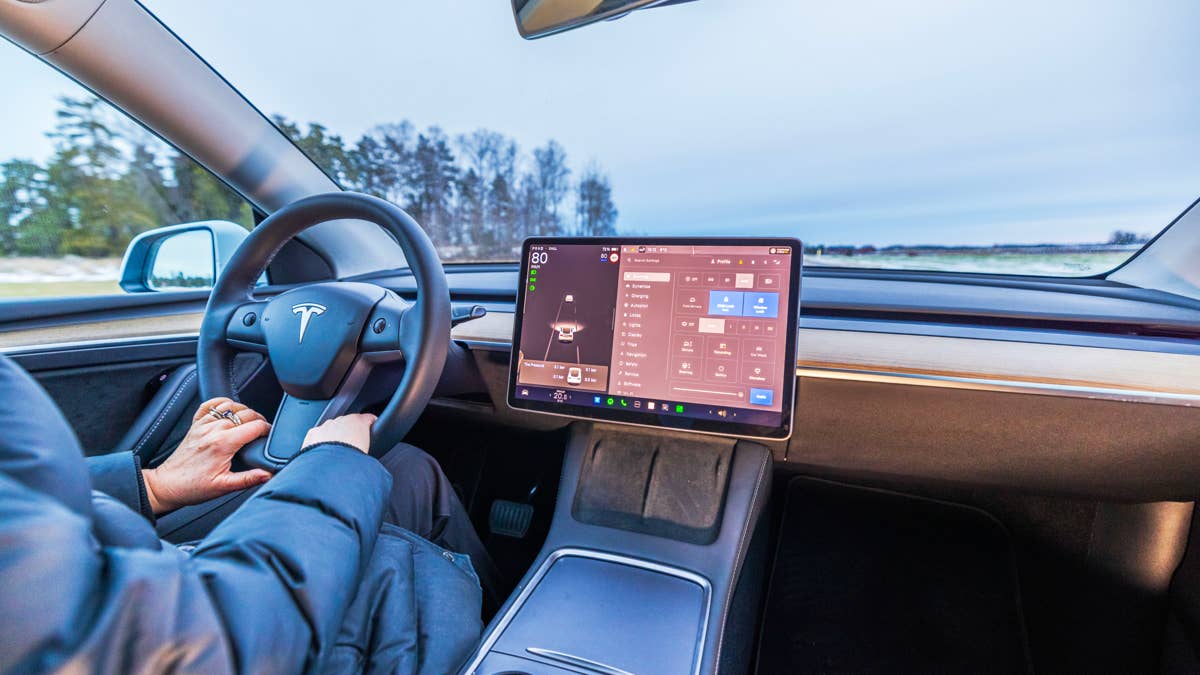
Jensen Huang hands Elon Musk the credit for a new auto industry
Huang also predicted that every car and logistics company will eventually become a technology company. The remarks come from Huang’s third conversation with the BG2 Pod, posted on Oct. 15.
The timing matters. U.S. semiconductor stocks lost roughly $1.64 trillion in market value over six sessions, according to Reuters.
Related: Waymo drives on freeways: what’s next
Huang spent much of the episode pushing back on fears that artificial intelligence (AI) spending has outrun revenue. New chip orders keep coming in “almost weekly and daily,” he told the hosts.
Before you take the praise at face value, remember who is talking. Musk’s companies are among Nvidia’s biggest customers, and Huang once called Musk “the ultimate GPU,” a nod to Nvidia’s graphics processing unit chips, reported Business Insider.
Self-driving money mostly lands in data centers
Here’s the part most coverage skips. The computer inside your car is the cheap one.
More Automotive:
- Citroën is bringing back the 2CV as a $17,000 electric car
- GM wants drivers to be able to text and drive
- Volkswagen’s newest EV runs Chinese chips and starts near $19,000
Nvidia builds three types of computers for the auto industry: one to train driving models, one to simulate roads, and one that rides in the vehicle, according to Fortune. Two of those three live in a data center.
So I lined that up against Nvidia’s latest quarterly report. Data center revenue hit $89 billion in the quarter ended July 26, out of $96.2 billion in total sales, according to Nvidia. Its separate Edge Computing line generated $7.2 billion in revenue.
By my math, the data center business made up about 92.5% of sales. Edge Computing was about 7.5%.
That changes how Huang’s prediction reads. When every carmaker becomes a technology company, every carmaker also becomes a data center customer.
How the Nvidia, Tesla and xAI partnership grew
The relationship between Huang and Musk runs deeper than one podcast compliment. Here is how it has built up, based on public records.
- Huang said he helped Musk build the first computer for the Tesla (TSLA) Model S and Model 3, according to IBTimes, recounting his appearance on “The Joe Rogan Experience.”
- Musk is building xAI’s Colossus II training cluster near Memphis using Nvidia chips, reported Business Insider.
- Nvidia expanded its work with General Motors (GM) at its 2025 GPU Technology Conference, reported Fortune.
- The Mercedes-Benz CLA became the first car powered by Nvidia’s Alpamayo driving model, according to Tom’s Hardware coverage of CES 2026.
- Starmind, a computer SpaceX (SPCX) and Nvidia are building for data centers in orbit, should reach volume production in 2027, Musk said, according to Benzinga.
Why trucking and logistics firms are next in line
Huang’s broader claim extends beyond sedans and SUVs. Fleets that move freight run on routing, timing and fuel math, which is exactly the kind of work AI chips are built to speed up.
He has made a similar case before. “Every industry, every company that has factories will have two factories in the future,” Huang said at the 2025 conference, reported Fortune.
One factory builds the product. The other is an AI factory that trains and runs the software behind it.
Musk is already pushing that idea off the planet. “One particular new market that we’re going to go explore together is putting data centers out in space,” Huang said on the podcast.
Some realism helps here. Starship, the rocket those orbital plans depend on, has lagged Musk’s original targets, Reuters reported.
What a computer on wheels means for your wallet
Your next car purchase is partly a software purchase. Safety features, convenience perks and even resale value will lean more on code than on cylinders.
Before you sign, ask the dealer three things. How long does the automaker promise free updates, which features turn into subscriptions after a trial and what happens to those features when you sell the car?
Your portfolio is already in this story. If you own an S&P 500 index fund, you own both Nvidia and Tesla, so Huang’s thesis is riding along in your retirement account whether you picked it or not.
My analysis cuts both ways. If Huang is right, the stakes behind Tesla’s autonomy push grow higher, and so does the data center bill tied to it.
If he is wrong, that $1.64 trillion chip selloff is a preview of how fast the mood can turn.
The next car fight happens far from the showroom
The automakers that win the next decade may be the ones that buy the most computing power, not the ones with the best engines.
On the next earnings calls from Nvidia, Tesla and GM, listen for how much each says about training and simulation spending. That will tell you who is serious about Huang’s future.
The most important computer in your life may soon sit in your driveway. The money behind it will sit in a data center you will never see.
Related: Nvidia CEO Jensen Huang doubles down on his big 2030 market bet