Some people build the loudest thing in the world and never say a word in public about it.
That silence is a choice. It usually holds right up until the moment the rules being drafted in someone else’s building start to matter more than the product being built in yours.
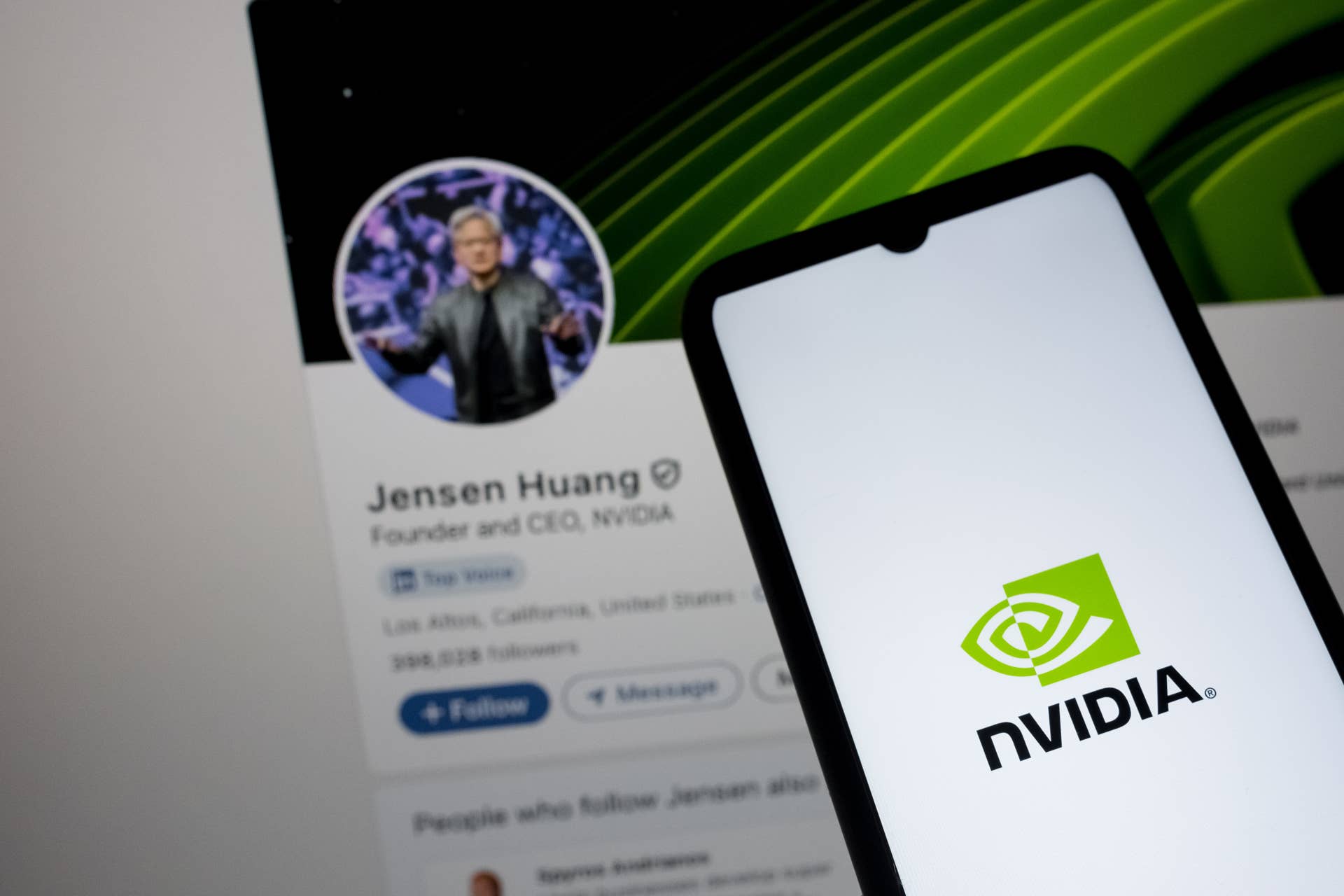
Jensen Huang has run Nvidia (NVDA) since 1993. He gives interviews, fills arenas in a black leather jacket, and has spent three years as the most quoted executive in technology. He has also never once posted on social media.
Washington, meanwhile, has spent recent weeks arguing over whether Americans should be allowed to download artificial intelligence (AI) models built in China. The argument sharpened on July 16, when a Beijing startup called Moonshot AI released a free model that independent testers ranked near the very top of the field.
On July 24, Huang finally posted something. He used it to hand Washington a letter.
Why open-weight AI models turned into a Washington fight
Open-weight models are the part of AI most people never see. The weights are the billions of numbers that decide how a model answers you, and when a developer publishes them, anyone can download that model, inspect it, modify it, and run it on hardware they own.
That is the opposite of how ChatGPT or Claude reach you. Those run inside a company’s own systems, through a paid app or interface, according to Decrypt.
More Artificial Intelligence:
- Workers over 55 in Al-exposed jobs face new reality
- Visa hands banks an edge against their rivals with Al tool
- Nvidia CEO doubles down on Al and stock market verdict
The distinction stopped being academic this year. Chinese labs kept publishing their weights for free while American leaders kept theirs locked up, and the free versions got good.
Moonshot’s Kimi K3 ranked third on one widely tracked capability index and first in a blind coding arena, according to Unite.AI. It also costs a fraction of what American frontier models charge.
Washington noticed. The administration has weighed restricting the use of Chinese open models, and Treasury Secretary Scott Bessent said it is examining them for evidence of stolen American intellectual property, reported Quartz.
The concern runs on two tracks. One is security, the worry that a downloaded Chinese model could function as a backdoor. The other is commercial, the fear that free Chinese models undercut American labs spending tens of billions to train their own.
I have covered the demand side of this fight for months, and what keeps striking me is how one-sided the public argument had been. Policymakers heard from a small number of closed-model labs. The companies selling the chips, servers and cloud capacity underneath all of them stayed quiet.
Related: Nvidia, Micron just got hit by an AI model from Beijing
What Jensen Huang actually told Washington in his first post
That changed July 24. Huang used his first post on X to share a three-page letter titled “Open Weights and American AI Leadership,” signed by 25 companies and organizations.
The letter opens in the 1980s, when open-source advocates argued that software would only improve if outsiders could read it. That movement now underpins most of the internet and systems used by the U.S. military and federal agencies, the signatories wrote in the letter.
Its central claim is the one Washington will find hardest to wave off. “Openness may be one of the most important paths to AI safety,” the letter argues.
The signers asked policymakers to avoid premature restrictions that would drive innovation overseas, and to stop treating distillation, the practice of training one model on another model’s outputs, as theft.
“Open models strengthen safety and cybersecurity, accelerate innovation and diffusion, and enable sovereignty,” Huang wrote on X.
The signatory list is the part I would put in front of a skeptical editor first. This is not a hobbyist coalition. It is Meta, Microsoft, IBM, Dell Technologies, Palantir, CrowdStrike, Andreessen Horowitz, Mozilla, the Linux Foundation and Y Combinator, among others.
Here is how nine days reshaped the debate.
- Moonshot AI released Kimi K3 on July 16, with full public weights due July 27, according to Tom’s Hardware.
- Huang told Axios on July 21 that the Chinese models are “excellent” and should be used, reported Fortune.
- Bessent told Fox Business that same week that the administration is reviewing Chinese models for stolen U.S. technology, per Quartz.
- Twenty-five companies published the open-weights letter on July 24, and neither OpenAI nor Anthropic signed it, reported CNBC.
Microsoft (MSFT) CEO Satya Nadella backed the same argument the same day. “Open-weight models are essential to a healthy AI ecosystem,” he wrote, reported PYMNTS.
What the open model fight means for Nvidia investors
Here is where all of this lands on your screen.
Nvidia sells the hardware every model runs on, open or closed. A world with 12 credible model families consumes more compute than a world with three, because each one gets fine-tuned, re-run and deployed separately by thousands of companies that would otherwise rent capacity from a single provider.
Huang has said the quiet part out loud. “Free AI should be great for chips,” he told Axios, per Quartz.
That is the commercial logic sitting under the principle, and my analysis is that both things are true at the same time. Huang appears to believe concentration is a genuine security risk, a theme he returned to when he told shareholders that national security comes before commercial opportunity, TheStreet reported. He also runs a company with a market value above $5 trillion, per Quartz, whose growth depends on AI reaching as many hands as possible.
The absence on that letter is just as informative as the presence. OpenAI and Anthropic, each valued near $1 trillion and each having confidentially filed for an initial public offering, sat this one out, CNBC reported. Both sell access to models customers cannot download.
For a retail investor, none of this is abstract policy talk. If Washington restricts Chinese open models, the labs with the most expensive products get a moat. If it does not, cost curves keep falling, adoption keeps widening, and the company selling the shovels keeps selling shovels into a bigger dig.
Neither outcome is priced in with much confidence, which is why the letter reads less like advocacy and more like a hedge against a rule nobody has written yet.
Two dates decide how much of this reaches a portfolio. Moonshot publishes the Kimi K3 weights on July 27. Nvidia reports earnings on Aug. 26.
Huang waited more than 30 years to say anything at all on social media, then picked this fight, in this week. Watch what Washington does with it.
Related: Jensen Huang’s staggering $4 trillion bet shifts Nvidia