While owning a camper and traveling the world is still a dream for my family, many lucky RV owners are staying at home instead of hitting the road.
During the pandemic boom, consumer demand for RVs surged, driving rapid dealership expansion. And now, as the outdoor recreation boom has cooled and consumers are forced to cut their discretionary spending amid rising fuel and food costs, the industry is trying to catch up to that reality.
One of the nation’s largest retailers of RVs, RV accessories, and RV-related services, Camping World Holdings Inc. (CWH) has operated since 1966. It went public in 2016, raising $251 million.
As of mid-2026, the company has a market cap of $672.45 million. Year-to-date and over the last five years, its shares have dropped 32.96% and 83.65%, respectively, to $6.51 per share.
To battle the harsh industry environment, the retailer made operational changes, including store closures and consolidations.
Camping World closes 13 locations in 12 months
Camping World’s store footprint decreased by 10 store locations over the 12 months ended March 31, 2026, the company reported in its Form 10-Q filing with the Securities and Exchange Commission.
The company’s financial statements revealed that Camping World actually consolidated 10 store locations, closed three stores, temporarily closed one location, and opened four new locations.
During the first-quarter earnings call, newly appointed CEO Matt Wagner (since January 2026) attributed the improvement in Selling, General, and Administrative expenses (SG&A) partly to these consolidation efforts.
“On SG&A, I’m very pleased with our progress. The 135 basis point improvement in SG&A to gross profit and the $29 million reduction reflects a fundamentally lower cost basis, not onetime savings. This includes $19 million of compensation reduction in the quarter and the consolidation of 13 store locations over the last year that sharpened the efficiency of our footprint,” Wagner said.
Camping World documents also disclosed that in 2025 alone, the company’s full-time employee count dropped from 12,701 to 11,144.
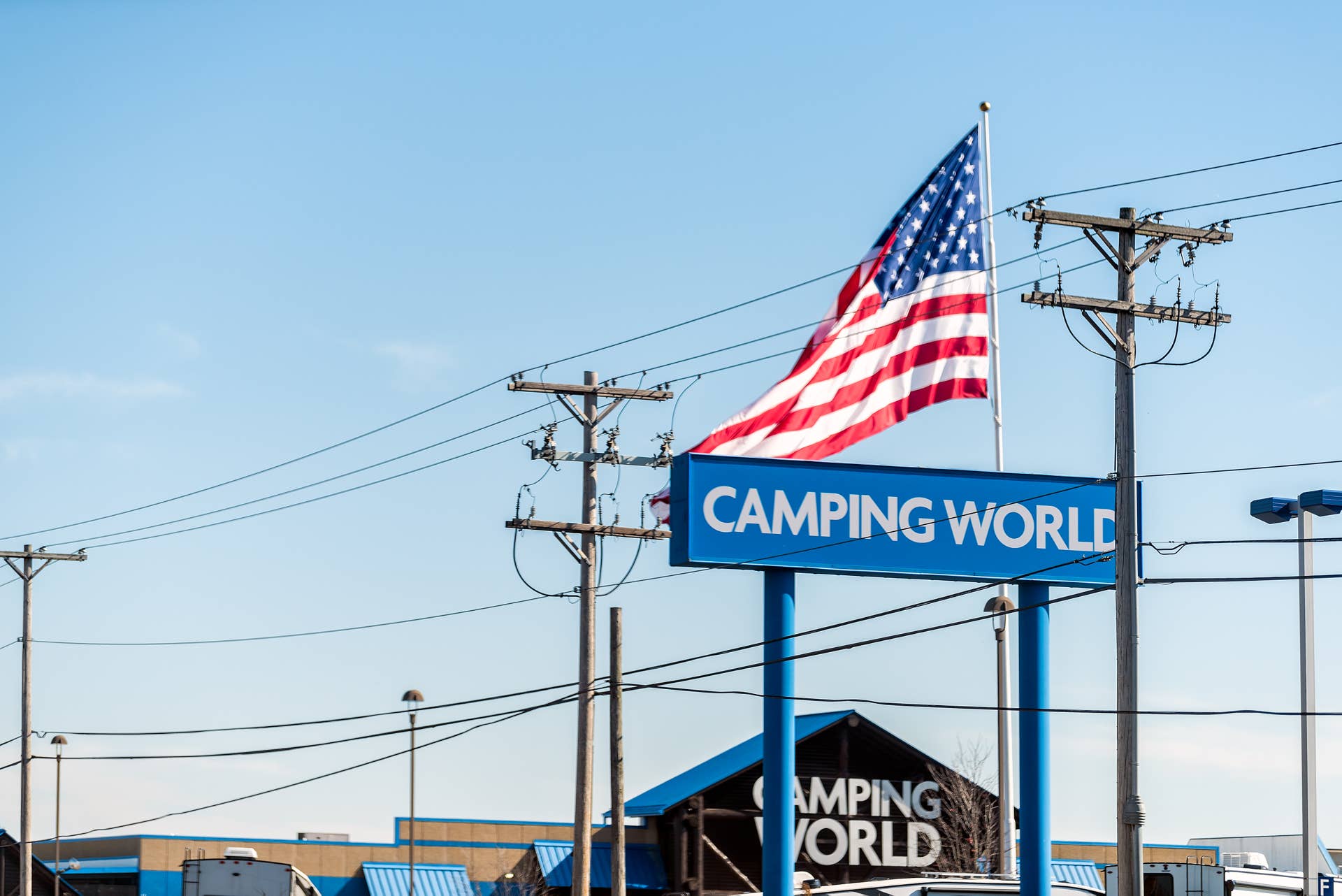
Why Camping World has been closing stores
Camping World has closed select stores over the last few years to improve profitability and raise unit count and margin profile per store.
Based on the company’s filing, for the 12 months ended March 31, 2026, the company consolidated and closed stores “to improve overall cost efficiency of the remaining store locations.
“After enduring several difficult years following the post-pandemic boom, Camping World appears to have reached an important inflection point. Management has aggressively reduced inventory, streamlined operations, cut expenses, improved liquidity, and paid down debt. At the same time, the company has embraced AI to reduce operating costs and improve customer service,” Seeking Alpha analyst Brad Thomas recently wrote.
However, industry pressures recently sparked rumors of the retailer’s potential bankruptcy as it battles the harsh outdoor industry environment.
Camping World was recently rumored to be heading toward bankruptcy
Earlier this year, a viral social media post on X (the former Twitter) claimed that Camping World was facing Chapter 11 bankruptcy due to $3.5 billion in unpayable debt. X user Roger compared Camping World’s case to the recent West Marine bankruptcy.
Former Camping World CEO Marcus Lemonis publicly responded to the post, calling the bankruptcy claims “totally false.”
RV Lifestyle travel writer Mike Wendland pointed out that when the CEO of a publicly traded company feels compelled to respond to a random guy on social media, that raises its own set of questions.
“Either the post struck a nerve because it was dangerously wrong, or because it was uncomfortably close to something that could be true, probably maybe a little of both,” Wendland said.
Wendland further explained that although Camping World is not facing imminent bankruptcy, it faces the same set of challenges that put the biggest boating retailer in restructuring.
In May 2026, I reported on the largest boating retailer’s filing for Chapter 11 bankruptcy protection in the U.S. Bankruptcy Court for the District of Delaware. The company noted several contributing factors:
- Supply chain disruptions
- Extreme weather events
- Shifts in consumer behavior
On the one hand, Camping World is currently under real financial pressure after losing about $105.6 million in 2025, seeing its sales drop further in early 2026, and seeing its stock crash more than 80% from its peak.
Moreover, the company stopped paying dividends to its shareholders earlier this year to better address its debt, Simply Wall St indicated.
On the other hand, Wendland highlights that the company is not facing imminent bankruptcy. It has $200 million in cash on hand, successfully pays long-term debt, and most importantly, captures a larger share of the overall RV market than its competitors.
Earnings amid “the weakest new RV retail environment in over 15 years”
Camping World’s consolidation and other cost-cutting measures come as the retailer battles its most challenging environment in a decade.
“In the weakest new RV retail environment in over 15 years, we executed on the priorities we set for this year, growing new and used unit share, accelerating Good Sam, and driving SG&A efficiency,” Wagner said during the second-quarter 2026 earnings call.
During the second quarter of fiscal 2026, Camping World reported:
- Total revenue amounted to $1.93 billion, compared to $1.98 billion in the same period of 2025.
- Total gross profit declined to $538.38 million, versus $592.26 million in the second quarter of last year.
- Total operating expenses decreased to $446.53 million, from $461.99 million a year ago.
- Net income dropped to $43.71 million, from $57.52 million in the same period of last year.
Camping World also revised its 2026 full year outlook to “reflect what we know today in a highly volatile market.”
The retailer lowered its previous guidance range of Adjusted EBITDA of $275 million to $325 million to a new range of $230 million to $270 million, for full year 2026.
Wagner highlighted that the company is not pleased with what it has achieved during the quarter, despite delivering on three priorities in a difficult market: reducing SG&A expenses, growing RV market share, and accelerating Good Sam.
“Our progress was more than offset by new RV industry trends that weakened during the peak selling season in May and June. Even so, we moved aged used inventory and prior-model-year new inventory as planned. These factors pressured vehicle gross profit and resulted in second-quarter earnings below our expectations. We are not satisfied with the result.”
Outdoor retail industry challenges are real as consumers cut discretionary spending
Camping World’s challenges reflect a broader slowdown across the entire outdoor recreation industry. High interest rates, inflation, elevated fuel prices, and tariffs are forcing everyday consumers to cut back on big-ticket discretionary items such as RVs and boats.
According to a McKinsey & Company consumer study, American families report an immediate intention to “pull back spending across most discretionary categories,” noting that even higher-income consumers are aggressively cutting back on ‘nice to haves.’”
Related: 29-year-old casual dining chain closes 4 locations after acquisition
During the Covid pandemic, however, both the recreational boating market and RV market actually boomed. Americans heavily invested in getting into the outdoors, either on the water or by camper.
Boating market sales reached pre-2008 financial crisis heights, and Bloomberg called RVs “Covid campers” due to their sudden rise in popularity. As lockdowns receded into the past and consumers’ wallets tightened, the outdoor industry started feeling pressure again.
Results from the RV Industry Association’s (RVIA) July 2026 survey of manufacturers found that total RV shipments ended the month with 19,948 units, an 11.9% decrease compared to the 22,633 units shipped in July 2025.
RV owners are staying home: here’s why
Earlier this year, during the 2026 RV Industry Power Breakfast, Toby O’Rourke, CEO of KOA, the largest campground network in North America, sounded the alarm on industry trends.
O’Rourke highlighted that while more people are camping, camping frequency is down.
“Two-thirds of all people who are camping are doing so just once or twice a year compared to 55% in 2019,” she said. “That’s a significant loss in camper nights at campgrounds.”
Data also revealed that 5% to 8% of people who own an RV didn’t use it last year, and that might be a conservative estimate.
“This difference in participation has a big impact at campgrounds, but it also has a big impact at dealers because if people are not using their product, they’re not inclined to upgrade or purchase another one,” O’Rourke explained, as reported by RV Business.
She added that people aren’t dropping out because they’ve lost interest in camping; rather, they can’t afford to do it as often, they can’t find the time, or both.
“We need to make camping multiple times a year feel possible again because that will drive purchases,” she said.
Wendland commented on this in the podcast, adding that one of the things he keeps hearing from RVers is that “between fuel costs and just the general price of everything, people are being a lot more careful about when they hit the road and how far they are going to go.”
Based on current fuel prices, campground fees, and food and activities costs, a long weekend ends up costing more than a week used to cost, argued Wendland.
Related: 125-year-old mall retail anchor closes discount outlet, cuts 101 jobs