For banks, cutting costs increasingly means deciding which businesses are worth keeping.
Truist is the latest major lender to make that choice.
It has decided to exit a longtime auto-finance operation as it narrows its focus on businesses that can generate stronger returns and deeper customer relationships.
And this decision will come with a human cost.
Regional Acceptance Corporation, an auto-finance company affiliated with Truist Bank, plans to permanently close its facility at 1351 East Bardin Road in Arlington, Texas, according to a Worker Adjustment and Retraining Notification (WARN) reviewed by TheStreet.
Approximately 205 full-time employees are expected to lose their jobs as a result of the closure.
The first separations are expected around Nov. 30, with all employment losses completed by Feb. 28, 2027, when the facility is expected to completely cease operations.
The Arlington closure is tied to Truist’s decision to substantially sell all of Regional Acceptance’s near-prime auto-loan portfolio.
This marks another step in the bank’s pullback from parts of consumer lending it considers less attractive.
Truist exits $5.5 billion auto-loan business
Truist said it had agreed to sell $5.5 billion in near-prime auto loans, representing substantially all of Regional Acceptance’s assets.
The company did not disclose the buyer.
Regional Acceptance specializes in financing vehicle purchases for borrowers generally outside the strongest prime-credit segment and has operated in auto lending for more than four decades.
Truist expects the transaction to produce approximately $5.2 billion in net proceeds as well as a $535 million recapture of loan-loss reserves.
The sale was expected to close on Sept. 15.
More Layoffs:
- Samsung cuts jobs as it shifts U.S. headquarters
- Another popular soda giant closes warehouse operation, cuts 184 jobs
- Meta layoffs take disturbing turn in new lawsuit
The Arlington WARN notice confirms that the facility closure is related to the asset sale and that Regional Acceptance will cease operations at the location following the transaction.
For Truist, the move is about more than reducing its workforce.
Regional Acceptance produced approximately break-even pretax earnings during the first six months of 2026, while Truist said exiting the business would improve its credit profile and free up capital.
The transaction is expected to create approximately $945 million of common equity tier 1 capital, while reducing both nonperforming loans and annualized net charge-offs.
Truist intends to use proceeds from the loan sale in part to repay wholesale borrowings.
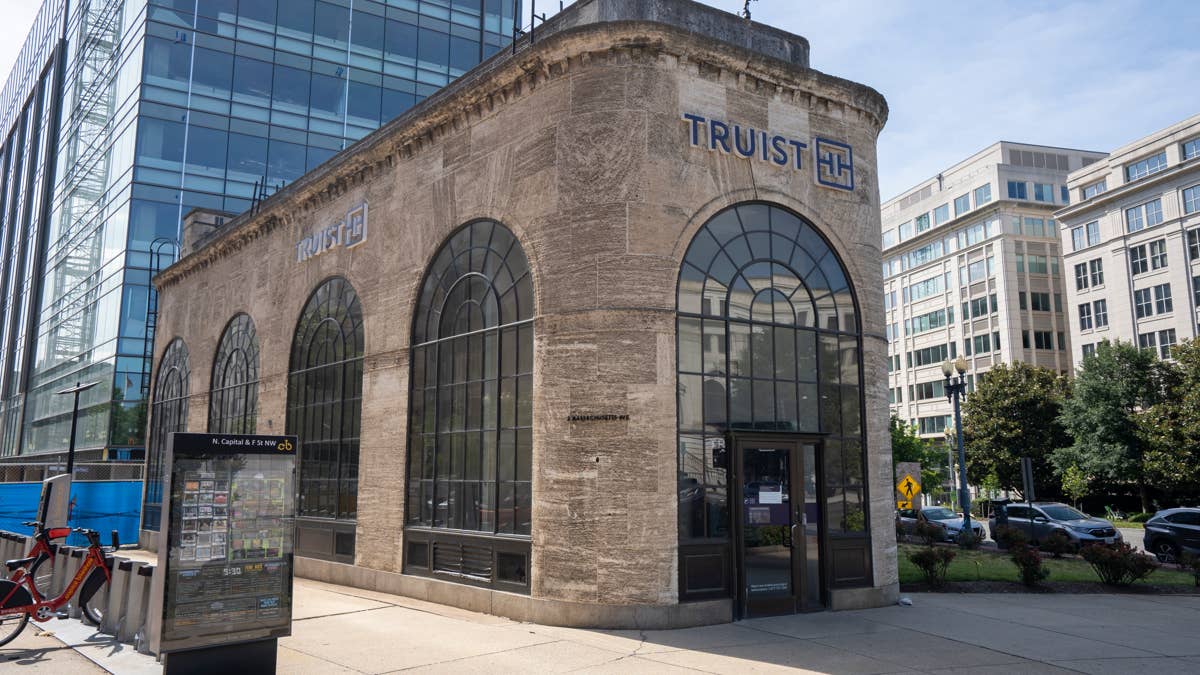
Truist has been pulling back from consumer lending
The Regional Acceptance shutdown follows other moves by Truist to shrink lending operations it considers less profitable or less connected to its core customers.
During the second quarter, Truist stopped originating marine and recreational-vehicle loans and significantly reduced originations in other consumer lending areas, including prime and nonprime auto loans.
The bank said those changes were expected to reduce 2026 loan production across the affected portfolios by roughly 40% compared with 2025.
“We discontinued the origination of certain marine and recreational vehicle loans, and we further reduced originations in less strategic and less profitable consumer lending units such as prime and non-prime auto,” said the company statement.
While those loans can generate interest income, Truist said the businesses offer lower long-term returns and fewer opportunities to develop broader customer relationships.
The changes are part of a wider strategic review that has gained momentum under new Chief Executive Mike Lyons.
Lyons took over as CEO on Sept. 1, succeeding Bill Rogers, after previously leading payments and financial-technology company Fiserv.
Just two weeks into his tenure, Truist unveiled the Regional Acceptance transaction.
Major banks continue cutting jobs
Truist’s layoffs come as several major financial institutions are also reducing staffing, although the reasons behind the cuts vary.
Citigroup began another year of workforce reductions in January, cutting roughly 1,000 jobs as part of a previously announced plan to eliminate 20,000 positions by the end of 2026.
Additional layoffs were expected after employee bonuses were paid.
The reductions are part of CEO Jane Fraser’s multiyear restructuring of Citi aimed at simplifying operations and cutting expenses.
That effort is still underway.
Citi CFO Gonzalo Luchetti said during the bank’s second-quarter earnings call that “productivity efforts had helped reduce headcount to 219,000, while Citi had incurred more than $800 million in severance costs through the first half of 2026.”
Wells Fargo has also steadily reduced its workforce.
CEO Charlie Scharf said in the company’s Q2 earnings call that the bank’s “efficiency initiatives” are visible in its headcount.
It has “declined for 24 consecutive quarters. In the second quarter, our headcount was down 197,000, down 79,000 from six years ago, 15,000 from last year, and 3,500 from last quarter,” said Scharf.
Further adding that these reductions are used to offset broader investments such as new bankers, advisors, managers, and traders to drive the bank’s growth.
Technology is increasingly a part of that equation.
Wells Fargo CFO Mike Santomassimo said this week that the company is using artificial intelligence to automate tasks, including coding and call-center work, and expects the technology to contribute to further reductions in headcount.