Your own head has always felt like the last place no one else can get into. You can lie with your face, edit your words, delete a text before you hit send.
But the half-formed sentence sitting behind your eyes, the one you have not decided to share yet, has stayed yours alone for the entire history of the species.
That privacy has had exactly one serious threat, and it came with a scalpel. For years, the only way a computer could reliably turn brain activity into language was to get inside the skull.
Elon Musk‘s Neuralink drills a coin-sized hole and lays electrodes directly on the brain. Companies like Synchron thread sensors through blood vessels.
The results can be remarkable, and so are the risks: infection, scarring, a device that degrades over months. High accuracy meant surgery, full stop.
I have covered enough Musk brain-implant promises to treat any “mind reading” claim with a raised eyebrow. So when Meta Platforms (META) said on June 29, 2026, that it can now decode the sentences you type straight from your brain signals, with no implant and no incision, I went looking for the catch.
What Meta’s Brain2Qwerty v2 actually decodes
The system is called Brain2Qwerty v2, and the name is a tell. It does not pluck free-floating dreams out of your head. It reconstructs the sentences you are actively trying to type, reading the brain activity that fires while your fingers move.
Here is how it works.
- A volunteer sits inside a magnetoencephalography (MEG) scanner, a machine that picks up the faint magnetic fields thrown off by neurons, and types memorized sentences.
- The AI model reads those raw signals and rebuilds the words as they form. Two things make that work.
The model learns straight from raw brain signals instead of hand-built rules.A fine-tuned language model rides on top, using context to repair the gaps and guess the likeliest word when the neural read comes back noisy. It is the “highest-performing end-to-end pipeline capable of real-time sentence decoding,” according to Meta.
The accuracy is the part that stopped me. When I lined up the new figures against what non-invasive decoding could manage a year ago, the jump was not incremental.
- Older non-invasive methods landed near 8% word accuracy, Meta confirmed.
- Brain2Qwerty v2 averaged 61% word accuracy across nine volunteers, Meta said.
- The best participant reached 78% word accuracy, with more than half of sentences decoded with one word error or less, Digital Trends reported.
- The model was trained on roughly 22,000 sentences gathered over 10-hour scanning sessions, according to Meta.
That 61% figure means the system now “approaches levels of accuracy previously achieved only with techniques requiring brain surgery,” Decrypt explained.
For a method that touches nothing and cuts nothing, that is a real leap. The earlier version, whose findings appeared in the journal Nature Neuroscience, could only spell out characters one at a time, according to Meta.
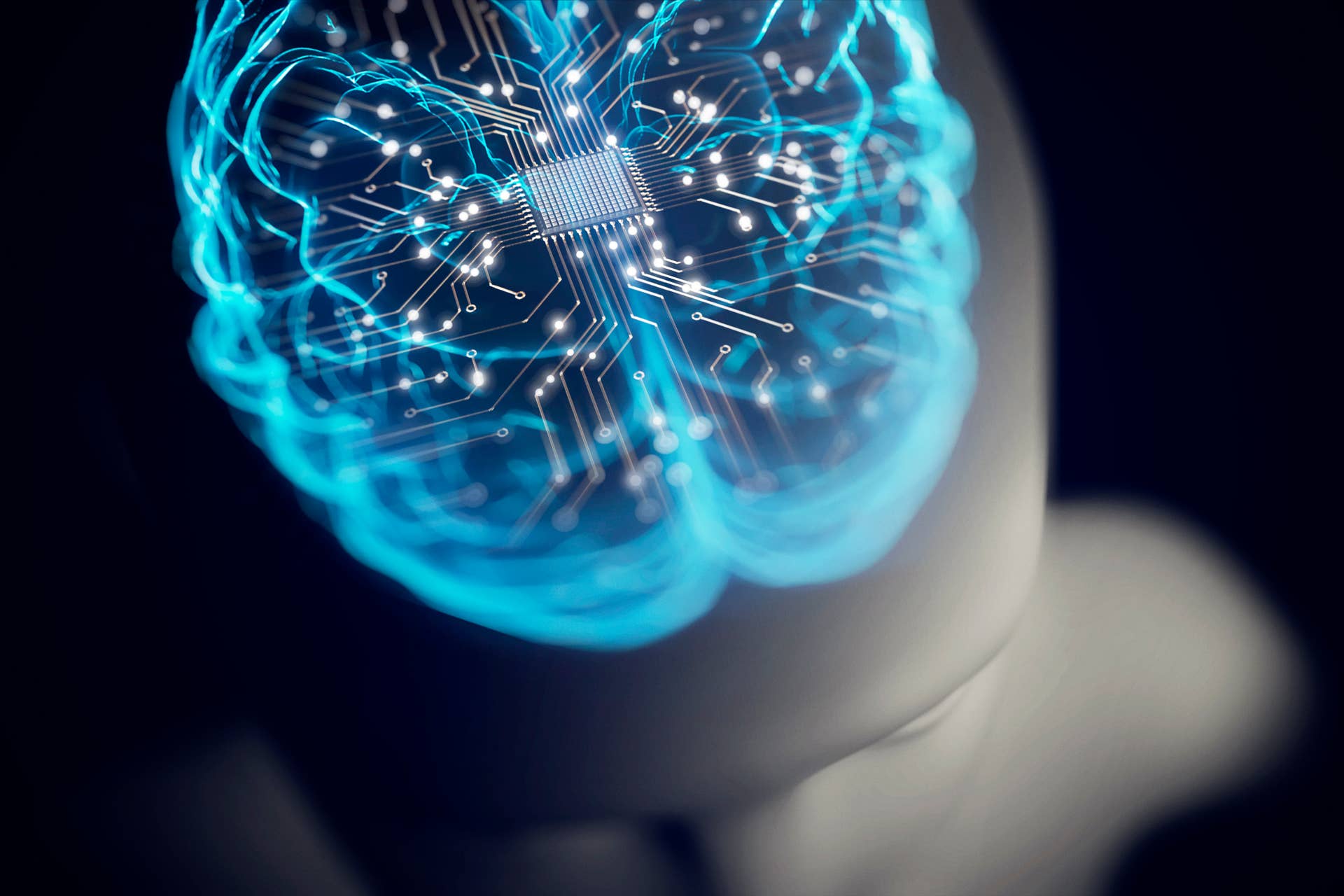
Why this brain-reading milestone still needs a room-sized machine
Before anyone panics about Mark Zuckerberg downloading their inner monologue, look at the hardware.
A MEG scanner is not a headband. It is a multimillion-dollar instrument that sits in a magnetically shielded room and weighs about as much as a small car. Those scanners are “massive, expensive machines that belong in research labs, not living rooms,” according to Digital Trends.
More Artificial Intelligence:
- OpenAl’s $1 trillion ambition could delay its IPO
- Palantir gets powerful Al signal from key ally of U.S.
- Amazon quietly raises price tag on the Al boom
There is a second limit that matters just as much. The system decodes typing, not unspoken thought. It leans on the brain’s motor signals as your hands move, which makes it closer to a very advanced read of your keystrokes than a window into your imagination.
That distinction matters, because every leap in this field gets sold as telepathy long before it earns the word. Meta has announced no product, no timeline, and no plan to put this on a shopper’s head.
The gap between a lab result and a thing you can buy is where most brain-computer breakthroughs go to wait. The invasive route shows why.
Musk’s Neuralink gets clean signals because it lays electrodes on the brain itself, and it has shown a paralyzed patient move a cursor by thinking, as TheStreet covered in 2024. The price of that fidelity is a hole in the skull.
What Meta stock and the brain-computer race signal next
For Meta Platforms shareholders, Brain2Qwerty is not a revenue story. It is a flag planted in a field everyone suddenly wants to own.
For Zuckerberg, that is partly the point. He has spent heavily to recast Meta as a frontier research lab rather than a social network with an ad engine bolted on, and a brain-decoding milestone buys exactly that kind of credibility.
The company open-sourced the training code and is funding open neuroscience data through a new Digital Brain Project carrying a $5 million commitment, according to Meta.
Related: Mark Zuckerberg sends stunning message to Meta employees
The competitive map is filling in fast. Neuralink and Synchron are pushing implants you have to be cut open to receive. Merge Labs, a startup backed by OpenAI chief executive Sam Altman, is chasing the same prize from another direction, Decrypt noted.
Meta’s wager is that it can get most of the way there without the scalpel, and that giving the work away will pull the whole field forward faster than guarding it would.
I keep coming back to the uncomfortable part, the one Meta’s careful framing does not erase. This is the company whose business runs on knowing what you want before you do. The stated goal, restoring a voice to people who have lost the ability to speak, is real and worth cheering.
But the same plumbing that gives someone their words back can, pointed differently, model intent. Anyone who shrugs at one more ad-targeting story should notice that the signal being decoded here is not a click. It is a sentence forming in your head.
Where the brain-to-text race goes from here
The most important number in the research is not the accuracy rate. It is the slope. Accuracy kept climbing as Meta fed the model more data, with no sign of leveling off, according to Meta.
That is the same scaling logic that turned chatbots from novelties into tools, now aimed at the brain.
So the honest forecast is patience, and then, all at once, none. For now, the MEG scanner keeps this locked inside the lab.
The day a wearable version closes even part of that accuracy gap, the question stops being whether a machine can read the words in your head and becomes whether you ever agreed to let it.
I would start deciding your answer now.