Timing is everything, and, if you’re an investor in Meta Platforms (META) and Tesla (TSLA), the week ahead is a week to pay attention to their earnings reports and what company officials have to say about the state of the business.
We say that because there was a big selloff this past week in stocks related to artificial intelligence because of worries everyone involved has done what seems to be inevitable in a boom: Bet too much on a transformative technology, including data centers, and then wait for the reckoning to emerge.
The selloff came in stocks in the Nasdaq Composite Index and, in a more concentrated way, in the Nasdaq-100 stocks. The Nasdaq Composite fell 4.5% last week. The Nasdaq-100 fell 5.5%, its worst weekly loss since the Trump tariff panic in April 2025, when it fell 9.8% in a week.
The 2025 losses were soon recovered, and perhaps this past week’s decline will prove a minor blip.
But it will be on everyone’s minds on Oct. 21 when both Meta Platforms, the parent of Facebook and other projects, and Tesla report third quarter earnings after the close.
They are the biggest reports of the week, which will also feature reports from some of the other biggest companies including: GE Aerospace (GE) and Netflix (NFLX) on Oct. 20; Procter & Gamble (PG) and Blackstone (BX) on Oct. 22 and American Express (AXP) on Oct. 23.
But the Meta and Tesla reports will command intense media coverage and investor interest because of their size and market caps:
- Meta’s market cap is $1.8 trillion.
- Tesla’s market cap is $1.4 trillion, and Elon Musk’s SpaceX (SPCX), which went public last spring, has a market cap of $1.9 trillion.
The biggest market caps belong to Nvidia (NVDA) and Apple (AAPL), both above $5 trillion.
And what investors around the world will want to know is, how exposed are Meta and Tesla to the worries that the data-center building binge will bust?
Booms and busts are a big part of capitalism. Many of us remember the dot.com boom of the late 1990s that briefly made Cisco Systems (CSCO) the world’s most valuable company, and ultimately saw at least 1,000 companies get formed by 2000 and disappear by 2004.
The data center buildout: big and getting much bigger
Both Meta and Tesla and the rest of Elon Musk’s empire are building data centers to handle artificial intelligence demands everywhere they can, while they can.
Data centers are physically huge.
And they’re expensive: About $8.2 billion for a 200-megawatt AI training campus, according to a paper by Stijn Van Nieuwerburgh, a real estate expert at the Columbia University business school.
Van Nieuwerburgh estimates 188 gigawatts of new AI capacity will be completed between the end of 2025 and 2032 and another 115 GW AFTER 2032.
For the 2025-2032 period, that translates into an investment of roughly $9 trillion. That would average 3.2% of U.S. gross domestic product per year. The buildout, measured in terms of GDP, would be bigger than these U.S. economic booms:
- The canal boom between 1836 and 1841: About 0.7% of estimated GDP.
- The railroad boom of 1870 to 1890: About 2.2% of GDP.
- The initial spread of electrification of 1905 to 1925: About 0.5% of GDP.
- The highway construction boom of 1956 to 1973 (primarily, the Interstate Highway System): About 1.1% of GDP
- The telecom and fiber boom of 1996 to 2003. About 1.1% of GDP.
Data centers are now so big that they’ve also become financially challenging.
Oracle (ORCL), Microsoft (MSFT), Amazon (AMZN), Meta and Google-parent Alphabet (GOOGL) spent $97 billion on data centers in 2020 and may hit $800 billion in 2026, Van Nieuwerbergh’s paper says.
The costs now are bigger than the free cash flows the companies have enjoyed for many years. And so they’re bringing in investors.
Meta’s Hyperion project in rural northeast Louisiana will sprawl over 3,600 acres — twice the size of Louis Armstrong International Airport in New Orleans and 25% of the size of Manhattan Island in New York.
Hyperion will be the biggest customer for New Orleans-based Entergy (ETR) . The project is expected to cost more than $50 billion, and Meta has been obliged to bring in partners to make it happen. The biggest is Blue Owl Capital (OWL), a New York investment management company and a giant in the private-credit industry that’s been struggling to handle the stresses of aggressive growth.
Blue Owl and Meta formed a joint venture to build and operate the physical plant of the Hyperion project. Meta will own 20% of the venture (called Beignet after a donut-confection famed in New Orleans).
The venture will lease the plant to Meta over 20 years. But the lease is actually a series of four-year leases that Meta can walk away from (after making the partnership whole).
The risks to the project are big but, at least for now, manageable. But what’s not known are things like:
- What happens if the market for AI services slows down.
- What happens if the technology driving the AI boom suddenly becomes obsolete. That affects the billions that will be invested in chips, computer servers, wiring, giant cooling systems and the like.
- And, probably, what happens if the Delta country of Louisiana gets hit by massive flooding. The great 1927 flood in Louisiana affected most of the state, and the Mississippi River nearly broke out of its old channel. Had that happened, New Orleans’ economy would have collapsed.
Meta’s earnings won’t offer much detail on these questions, but expect at least some analysts to ask CEO Mark Zuckerberg to discuss them.
The company is expected to report $6.09 a share in earnings, down 16% from a year ago, according to StockAnalysis.com. Revenue is expected to rise nearly 24% to $63.3 billion.
Meta shares are up 7.5% so far in 2026, after falling 3.7% on October 16 alone. Its performance is sixth this year among the so-called Magnificent Seven stocks.
The top performer is Apple, up 26.5%. But some other players in artificial intelligence are having great years, especially chip maker Micron, up 208% and Advance Micro Devices, up 147%.
More Artificial Intelligence:
- AI’s biggest business opportunity may not look like AI
- AI racks are outgrowing old power: 2 chipmakers have a strategy
- BofA splits software into winners and losers as AI agents arrive
Tesla faces many of the same challenges
Tesla shares have been historically volatile, and they are in 2026: down 21% on the year and down 6.4% so far in October.
The electric-vehicle maker faces some unique challenges. Its business faces intense competition globally from Chinese electric vehicle makers. And it has struggled to refresh its lineup of models for the U.S. market. That said, I see a lot of Teslas driving around Seattle.
It introduced a new generation roadster on Oct. 16, but it won’t be available until 2028 at the earliest. It may include thrusters that can lift the vehicle off the ground.
The roadster reveal helped Tesla shares rise early on Oct. 16. But they fell back in the tech selloff, ending down 2.1% on the day at $354.72.
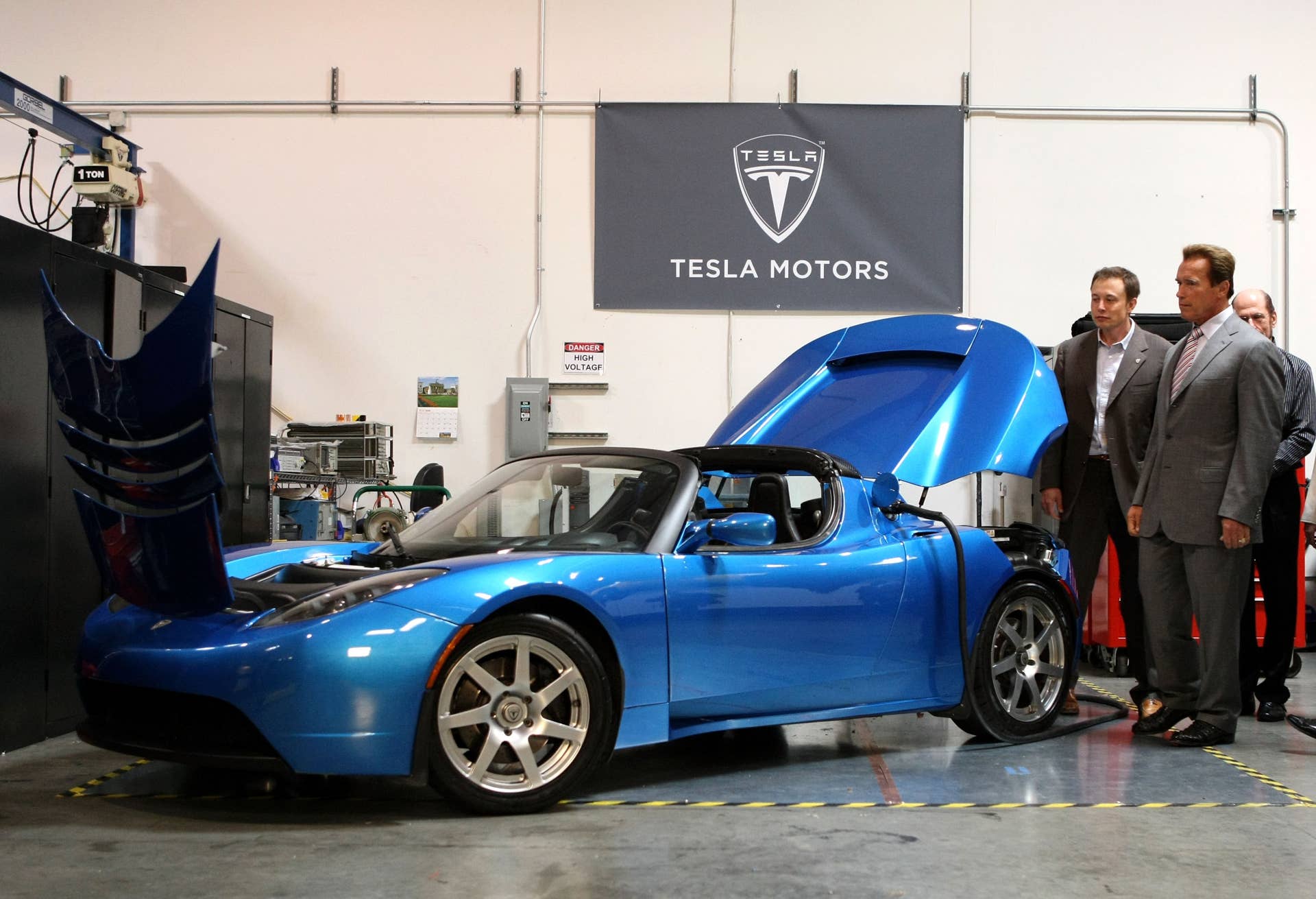
CEO Elon Musk is also polarizing, both from his work with the Trump Administration and his ability to shower favored political candidates with millions in campaign donations.
Tesla also has an additional challenge. Musk believes autonomous vehicles are the future. You call one, you get in, you get out at your destination, and the experience is supposed to be relaxing.
But how big the market really is remains unclear. I would guess it would work in large urban markets with lots of disposable income.
And Tesla is also developing a family of robots. But, like autonomous vehicles, the size of the market is not clear, and Forbes magazine notes that neither business is generating much in meaningful revenue.
Related: IBM spent $11 billion on growth as its own software stalls