The funny thing about capitalism is that it has a way of putting a price on priceless moments.
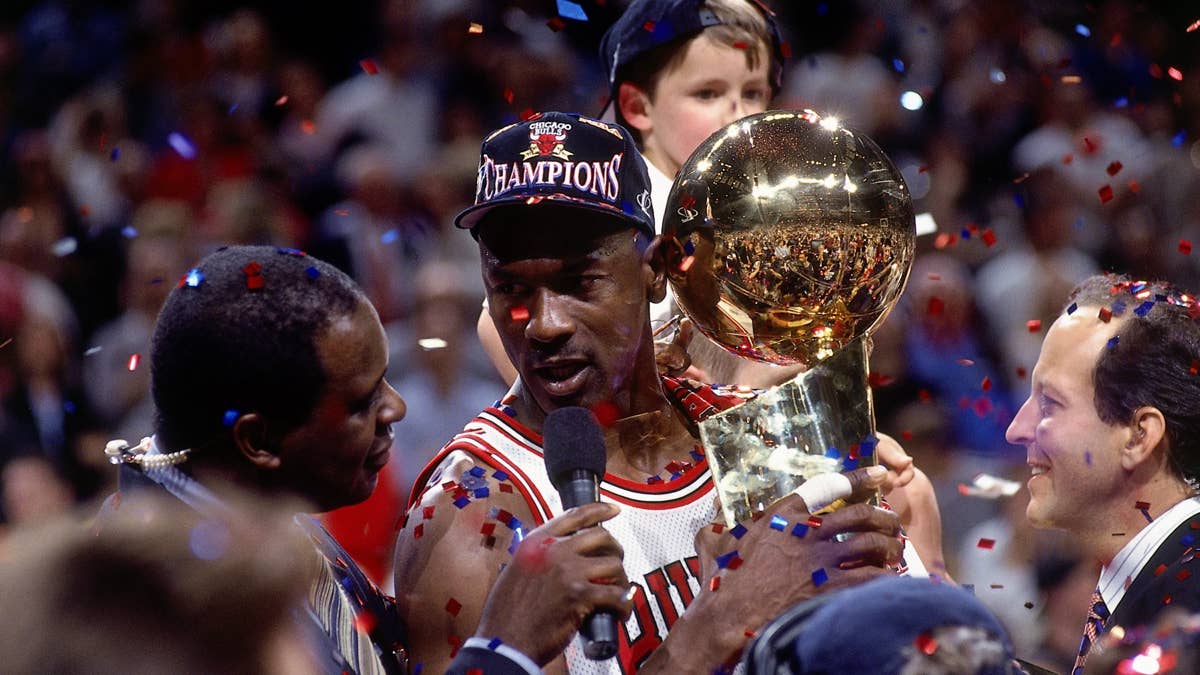
While no amount of money will ever be able to bring back the magic of the 1998 NBA Finals or the joy of watching Michael Jordan in his final postseason run with the Chicago Bulls, it turns out it can buy you a little piece of that moment in sports history.
In late September, a jersey Jordan wore in his final championship season with the franchise sold for a record-setting price, proving that, despite discretionary spending pullback, the sports memorabilia market is alive and well.
Jordan’s latest memorabilia sale shattered a major record
On September 29, a white No. 23 jersey, worn by Jordan during Game 3 of the 1998 NBA Finals sold on Joopiter, the online auction house founded by musician Pharrell Williams.
The winning bid? $12.26 million. A record for the most expensive piece of game-worn Jordan memorabilia ever sold at auction, according to the Chicago Sun-Times.
The jersey’s buyer has not been publicly identified.
“Few objects in the history of sport embody greatness as completely as Michael Jordan’s Game 3 jersey from the 1998 NBA Finals,” a note accompanying the item’s listing read.
“Worn during The Last Dance—the final championship run of the greatest basketball player of all time—it marks the culmination of an era that transformed basketball into a global cultural phenomenon,” it continued. “Today, it stands among the most important game-worn sports artifacts ever to come to market.”
Adding to the piece’s rarity is the fact that only four game-winning jerseys exist from the 1998 finals. To date, this is the only white version to have surfaced for public sale.
The sale surpassed Jordan’s previous record, set in 2022, when a red jersey from Game 1 of the Finals sold for $10.1 million at auction.
Why younger collectors are treating memorabilia differently
The jersey’s sale is demonstrative of a somewhat surprising phenomenon: the sports memorabilia market is booming even as consumers report pulling back on discretionary spending.
In January, Market Decipher valued the sports memorabilia market at $51.2 billion and projected that it would reach $334 billion by 2036 with a 19% CAGR.
“With record-setting prices, historic scarcity, and an NFT craze that is almost an everyday topic in sports news, the memorabilia market has steadily grown since 2019,” the report read.
Another report from the insurance company Chubb found that Millennials and Gen Zers are responsible for driving much of that growth.
Also read: Stephen Curry left $20 million on the table to stay a Warrior
One possible factor is the generations’ skepticism towards traditional investments.
A Bank of America report, cited by Chubb, found that 72% of investors ages 21-43 “believe it is no longer possible to achieve above average investment returns by investing solely in traditional stocks and bonds.”
So they’re turning to things like crypto and collectibles as a way to diversify.
“Sports memorabilia is increasingly viewed as more than a passion asset: it is attracting collectors who are interested in alternative investments with the potential to appreciate in value and hedge against inflation,” Chubb’s report said. “The acceleration of online platforms at major auction houses and dedicated sales have provided greater buyer confidence and accessibility for new investors.”
This could help explain why the sports memorabilia market is growing at such a rapid rate, and why sales like this are setting such extreme records.
Young consumers aren’t viewing these purchases as being part of a hobby or interest. Instead, they are alternative assets with the potential to appreciate over time.
Whether those investments ultimately pay off is another question.
But unlike a conventional financial product, like a stock or a bond, a game-worn jersey carries something more personal: a connection to a moment that millions of fans remember.
For the right buyer, that combination of nostalgia, scarcity, and potential financial value can turn a priceless moment into a million-dollar moment.
Related: Stephen Curry left $20 million on the table to stay a Warrior