Investors came into the Fed’s July 28–29 meeting, looking to clarify whether interest rate cuts were moving closer or slipping further away.
On July 29, the Fed held its benchmark rate at 3.50%-3.75%, even though three officials favored a quarter-point hike, but the real surprise wasn’t the decision itself.
Markets were looking for signals about what would change policymakers’ minds.
Instead, they came away with fewer clues about how the Fed may react to inflation, growth, or financial stress.
Wall Street was looking for direction, but the Fed delivered more uncertainty.
Mark Zandi, Moody’s veteran economist, now sees something more troubling in the Fed’s communication shift, and his concerns point to a stark risk that could spread well beyond the next policy announcement.
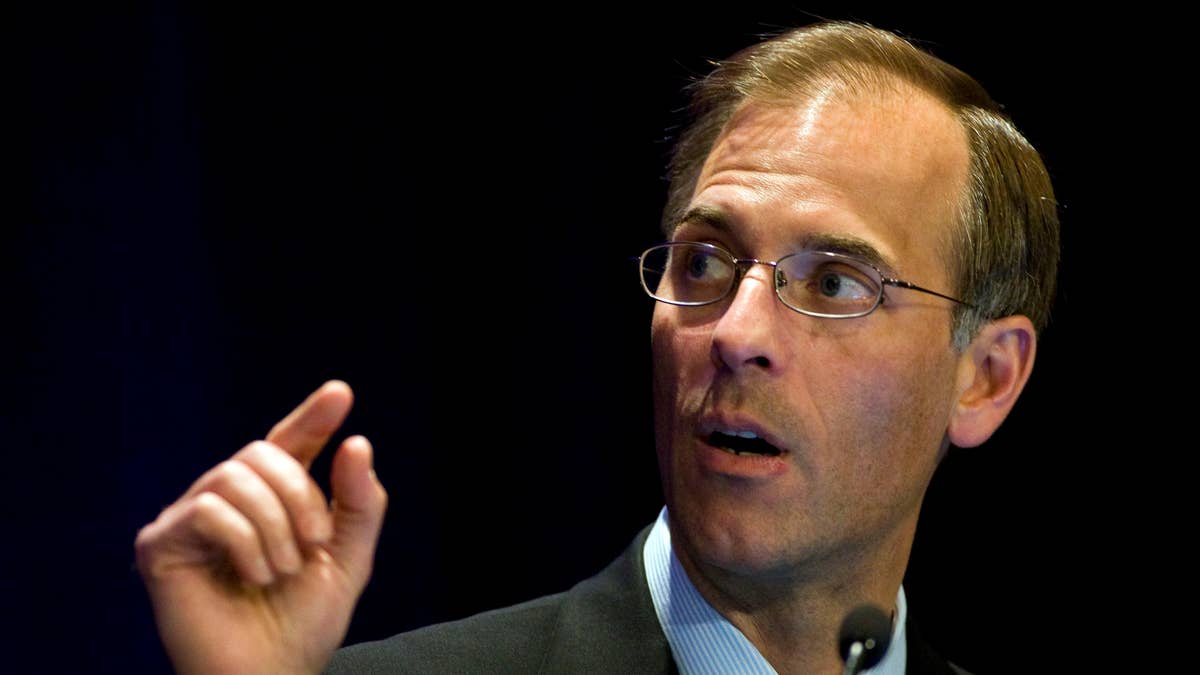
Chris Keane/Bloomberg via Getty Images
Who is Mark Zandi?
Zandi is Moody’s Analytics’ chief economist and is a bona fide veteran in the space.
More Economy:
- Bank of America CEO warns inflation will back Fed into a corner
- Bank of America just made a strong call on inflation, economy
- Goldman Sachs says Americans may pay for the AI boom
He has spent over 35 years studying the U.S. economy and holds a doctorate in economics from the University of Pennsylvania.
Moreover, according to Wikipedia, he co-founded Economy.com in 1990, before Moody’s acquired it in 2005.
His claim to fame is identifying the 2008 financial crisis early and warning that the housing collapse and surging foreclosures would push the country into recession.
On top of that, he identified the Covid-led downturn early and called the recovery underway near its eventual turning point.
Zandi has collaborated with former Fed Vice Chair Alan Blinder, regularly briefs policymakers, and often testifies before Congress on fiscal, monetary, and financial policy issues.
What is Zandi actually warning about with the economy?
According to a recent Business Insider report, Zandi’s primary concern about the economy is that the Federal Reserve is becoming much less willing to explain what could prompt its next big move.
Markets can typically absorb unpopular interest rate decisions when investors understand the Fed’s broader framework.
Traders might disagree with the decision, but they can usually estimate how the central bank might react if inflation rises, unemployment increases, or economic growth slows.
According to Zandi, the Fed isn’t offering even a broader version of that framework, typically described as its “reaction function.”
“I’m not concerned about the Fed’s decision to keep rates unchanged,” Zandi said. “My concern is that policymakers are unwilling to provide even a modicum of forward guidance.”
In the absence of that guidance, it’s tough for investors to gauge which economic indicators matter most, how policymakers balance inflation against employment, or what thresholds can trigger a rate hike or cut.
The result is that every Fed gathering becomes a “live” meeting. Instead of markets pricing in the likely outcome over several weeks, investors are forced to wait until the announcement itself.
That dynamic leaves traders vulnerable to being “repeatedly wrong-footed.”
“If the Fed continues down this increasingly opaque path, a future meeting could trigger a serious market sell-off, putting the broader economy at risk,” Zandi wrote.
Overall, Zandi still views the U.S. economy as expanding but increasingly fragile and near recession.
According to a Business Insider report covering his take, growth remains below its potential, the labor market is softening, and real household income has stalled. At the same time, he feels tariffs, restrictive immigration policies, and energy-driven inflation are squeezing consumers.
He feels healthy, and AI investment and productivity gains are preventing a downturn, but the Fed has little room to support growth as inflation remains elevated.
Consequently, according to Fox News, Zandi believes there’s a 40% chance of a recession within 12months, compared with a normal risk of about 15%.
Is the Fed genuinely becoming harder for markets to read?
Looking at the July 29 meeting as an example, particularly Chairman Kevin Warsh’s press conference, it’s not hard to see why Zandi feels the way he does.
Warsh was clear about the Fed’s 2% inflation target, but the path to get there was vague.
In fact, he openly acknowledged that the policy statement was “steering clear of forecasting.” Moreover, he said that the reduction in forward guidance was a deliberate choice and argued that investors should “play the ball, not the referee.”
When quizzed over what message he was receiving from markets, Warsh initially replied that “the message from markets is the message from markets.”
Similarly, Warsh was evasive when asked whether the decision to hold rates underscored a strong conviction or a close call. Instead of quantifying the balance, he argued that the current environment is a period of “watchful thinking, not watchful waiting.”
He also rejected describing the decision as a “pause,” saying the unchanged policy rate was only “the beginning of the story.”
Again, the comment keeps virtually every option open without indicating which option is becoming more likely.
Moreover, Warsh added further uncertainty when discussing inflation data.
Although the Fed usually targets PCE inflation, he argued that his lens was far broader and remarked that he was speaking “without fully revealing my cards.”
That preserves flexibility, but policy becomes a lot harder to model as investors are unaware of which indicators carry the most weight.
Where do rate expectations stand for 2026?
- CME FedWatch: Traders priced a 65.2% chance of a September hike, down from 81% before the Fed’s decision.
- Bank of America: Forecasts three 25-basis-point hikes in September, October, and December.
- JPMorgan: Expects a 25-basis-point December hike, with September possible if inflation jumps.
- Goldman Sachs: Predicts no rate change in 2026, with cuts delayed until June and December 2027.
- Citigroup: Remains the dovish outlier, forecasting cuts in October and December 2026, followed by another in January 2027
Sources: Reuters, CME FedWatch, Goldman Sachs Research, and BofA Global Research.
What does the warning mean for investors?
The immediate takeaway is that investors might need to place less confidence in the market’s consensus expectations before each meeting.
With fewer signals, probabilities implied by future markets become a lot less reliable.
That said, it would be wise for investors to consider how portfolios could react not only to the most likely decision but also to an unexpected hike, cut, or major shift in language.
Naturally, rate-sensitive areas, including technology stocks, banks, housing, utilities, and highly indebted companies, are likely to face sharp moves.
Long-duration growth stocks are also exposed, as their valuation depends on interest-rate assumptions. A sudden rise in yields lowers the value of profits expected several years into the future.
Moreover, banks typically face a more complicated effect.
Higher yields can support lending margins, but big moves in bond markets can also weaken loan demand, lowering the value of securities portfolios and increasing credit stress.
Also, it means investors would want to pay closer attention to what the Fed does not say.
That means the absence of guidance on inflation tolerance, weaknesses in labor markets, or future rate thresholds might itself become market signals.
Additionally, speeches, meeting minutes, and economic projections are likely to carry a lot more weight when the Fed’s press conference offers fewer clues.
Nonetheless, Zandi isn’t claiming that every meeting could cause a harsh sell-off.
His concern is that if the uncertainty becomes ‘business as usual,’ it raises the odds that an unexpected decision could eventually trigger a disproportionate reaction.
However, not everyone shares Zandi’s sentiment for the stock market.
JPMorgan’s Kriti Gupta recently said she foresees another strong end for the S&P 500 (expecting 8,200 by mid-2027), with stronger, AI-led productivity continuing to outweigh inflationary pressures.
On the flip side, Bank of America analysts foresee a weak August performance due to unfavorable seasonal trends.
Related: Morgan Stanley sends cautious Apple stock message after earnings