If you’ve ever sat through a mundane meeting that could’ve been an email, you can probably understand Microsoft’s (MSFT) pitch for artificial intelligence.
The company wants its Copilot AI assistant to handle more of the busywork in Word, Excel, Outlook, and Teams. For employers, that sounds like a lot of time saved. For Microsoft, it opens up a lucrative new business built on top of software millions already use.
Investors have bought into that promise, too, though it hasn’t been without hiccups. Microsoft shares have surged 10% in 2026 through Oct. 19, trailing the S&P 500’s near-12% rise, despite Wall Street’s enthusiasm for its AI ambitions, as reported by Seeking Alpha.
However, we’re now seeing that expectations are becoming harder to satisfy.
In an Oct. 19 research note shared with me, Morgan Stanley maintained its lofty $600 Microsoft stock price target, but analyst Adam Wood (4.40 star-rated by Tipranks) noted that improving sentiment and a higher valuation have raised the bar.
With Microsoft planning more than $50 billion in Q1 2027 CapEx, investors aren’t just looking for another impressive cloud-growth figure. They’re looking for proof that the spending is paying off.
Morgan Stanley sees Microsoft’s AI spending raising the stakes
Morgan Stanley’s Adam Wood believes that Microsoft’s recent success has created a problem.
According to him, its investors are getting used to being pleasantly surprised.
In the June quarter, Microsoft generated $90 billion in revenue, up 18% year over year. Azure and other cloud services grew 43%, while adjusted earnings reached $4.74 a share, beating Wall Street’s consensus by 50 cents.
More Tech:
- Meta and Microsoft just sent employees a memo about Anthropic
- Microsoft cutting off popular software with no extension Oct. 13
- Apple’s biggest AI advantage may face new privacy challenge
That followed earnings beats of 21 cents in the March quarter and 28 cents in December. Microsoft also topped estimates in the preceding September quarter, reporting adjusted earnings of $4.13 against expectations of $3.65.
That’s a lofty record to improve upon.
Morgan Stanley expects Azure growth of roughly 47% in constant currency in Microsoft’s fiscal Q1 2027, ahead of management’s guidance for about 45%. Wood also wants the following quarter’s outlook to show that growth can hold steady, rather than fade as more data-center capacity comes online.
And building that capacity isn’t cheap.
Microsoft dropped a whopping $41 billion on CapEx in the June quarter, as reported by Reuters. Its guidance for the September quarter calls for more than $50 billion, though changes in lease accounting complicate a direct comparison.
Morgan Stanley estimates Microsoft brought about 3.25 gigawatts of additional data-center capacity online in fiscal 2026 and could add another 4.25 gigawatts in fiscal 2027. Its model has Azure AI revenue rising from around $25.7 billion to $52.2 billion over those years.
Those are remarkable numbers, but they’ve also created some enormous expectations.
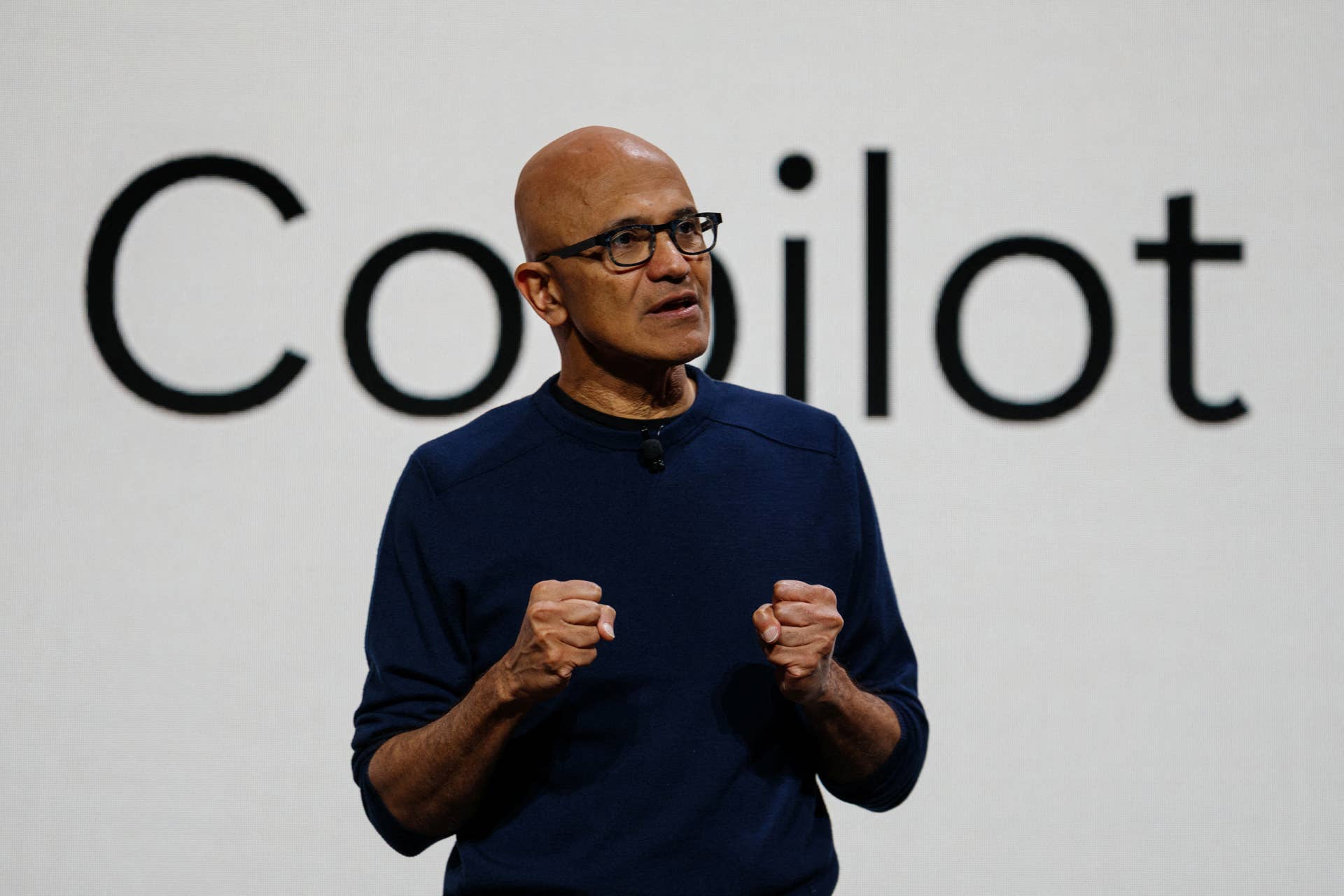
Microsoft’s Copilot customers face a different AI spending problem
Open Outlook, Teams, or Excel at work, and Microsoft is probably already collecting a subscription fee.
Now the goal is for employers to spend more on AI assistants that draft emails, summarize meetings, and eventually handle entire tasks.
For perspective, during Microsoft’s July 29 earnings call, CEO Satya Nadella told Morgan Stanley analyst Adam Wood that Copilot could potentially serve entire businesses through a combination of subscriptions and usage-based pricing.
“The TAM is much more expansive. We’re going to be very, very focused on driving customer value and then expanding with it,” Nadella said.
Microsoft already has more than 30 million paid Copilot seats, but Nadella didn’t provide a specific dollar estimate for the broader market opportunity.
Morgan Stanley sees plenty of appetite.
In its latest survey, 64% of 100 U.S. and European technology chiefs said they planned primarily to buy AI capabilities from vendors, compared with 17% planning to build them. A separate survey found 30% expected Microsoft to gain the biggest share of additional generative-AI spending, up from 27%.
But buying AI and making money from it aren’t the same thing.
Management says conversations per user nearly doubled year over year. Yet Morgan Stanley’s partner checks suggest more advanced, usage-based Copilot activity remains concentrated in selected workflows.
Premium E5 and E7 subscriptions could boost sales today, while AI tools and usage-based fees could bring in more down the road. However, customers need clear pricing and proof that these tools are worth the money.
That’s important for Microsoft’s bottom line.
However, third-party research raises questions about that payoff. Gartner reported on Oct. 19 that only 13% of surveyed CIOs had seen significant or transformational value from AI.
That said, Microsoft is betting the benefits will spread. Investors need to see whether stronger customer usage translates into sufficient revenue and profit to justify the expansion of the AI infrastructure bill.
Microsoft’s next earnings report could determine whether AI costs pay off
Microsoft’s Oct. 28 earnings report will once again reignite the debate over whether its massive AI capital expenditures can drive growth without hurting profitability.
That means listening closely to what management says about the capacity coming online. Is Azure finding paying customers as quickly as Microsoft can build? Are businesses using Copilot beyond basic subscriptions? And can profits keep growing while expensive data centers weigh on margins?
Morgan Stanley believes Microsoft can remain free cash flow positive in fiscal 2027. Still, its longer-term forecasts allow for more borrowing and fewer share buybacks as expansion continues.
None of this means the AI strategy is failing, though. It means investors may become less forgiving of growth that requires ever-higher spending.
Microsoft wants Copilot to become as routine at work as Outlook or Excel. The payoff depends on whether customers find it useful enough to keep paying.
Related: Elon Musk’s SpaceX could change how Americans buy iPhones