Jensen Huang took the stage Monday at Nvidia‘s annual GTC conference in San Jose and said something that stopped the room cold. The Nvidia (NVDA) chief executive was dressed in his signature black leather jacket, addressing a packed crowd of tens of thousands.
He told them he expects the company to generate at least $1 trillion in revenue from its AI chips through 2027.
“I see sales of AI hardware, through 2027, at least one trillion dollars,” Huang said. He then added, “I am certain computing demand will be much higher than that.”
Nvidia stock closed Monday at $183.22, up 1.65%, with trading volume coming in nearly 18% above its three-month average. The broader market also rose, with the S&P 500 gaining 1.02% to close at 6,700.
What Huang actually said and why it matters
The $1 trillion figure covers revenue from Nvidia’s current Blackwell chips and its next-generation Vera Rubin chips through the end of 2027. Last October, Huang had forecast $500 billion in AI chip orders covering 2025 and 2026 combined. Monday’s declaration effectively doubled that projection in less than six months.
More Nvidia:
- Nvidia stock gets major reality check on ‘$100B’ number
- Nvidia CEO delivers blunt 7-word rebuttal on software stocks
- Bank of America resets Nvidia price target after earnings
To put the scale in perspective, no company in the world currently generates $1 trillion in annual revenue. Walmart posted $713.2 billion in revenue last fiscal year. Amazon earned $717 billion, making it the largest company by annual revenue for the first time.
If Nvidia hits its target, it would become the first company in history to generate $1 trillion in revenue in a single year, surpassing both Walmart and Amazon individually.
Nvidia posted $215.9 billion in revenue for its fiscal year 2026, which ended January 31, 2026, up from $130.5 billion the prior year. The trillion-dollar path would represent an extraordinary acceleration even by Nvidia’s own standards.
The agentic AI shift is driving the call
Huang was direct about what is fueling the demand surge. He told the GTC audience that artificial intelligence has crossed a critical threshold, moving beyond the training phase into what he called the “inflection point of inference.”
“Finally, AI is able to do productive work, and therefore the inflection point of inference has arrived,” Huang said on stage. Inference refers to AI models actively performing tasks for users, not just being trained on data.
That shift dramatically expands the compute requirements for every company deploying AI.
Huang also announced a major focus on agentic AI at GTC, unveiling tools built around OpenClaw, a platform he described as the operating system for personal AI. He called it “as big of a deal as HTML, as big of a deal as Linux,” and said every company in the world now needs an agentic system strategy.
What else Huang unveiled at GTC
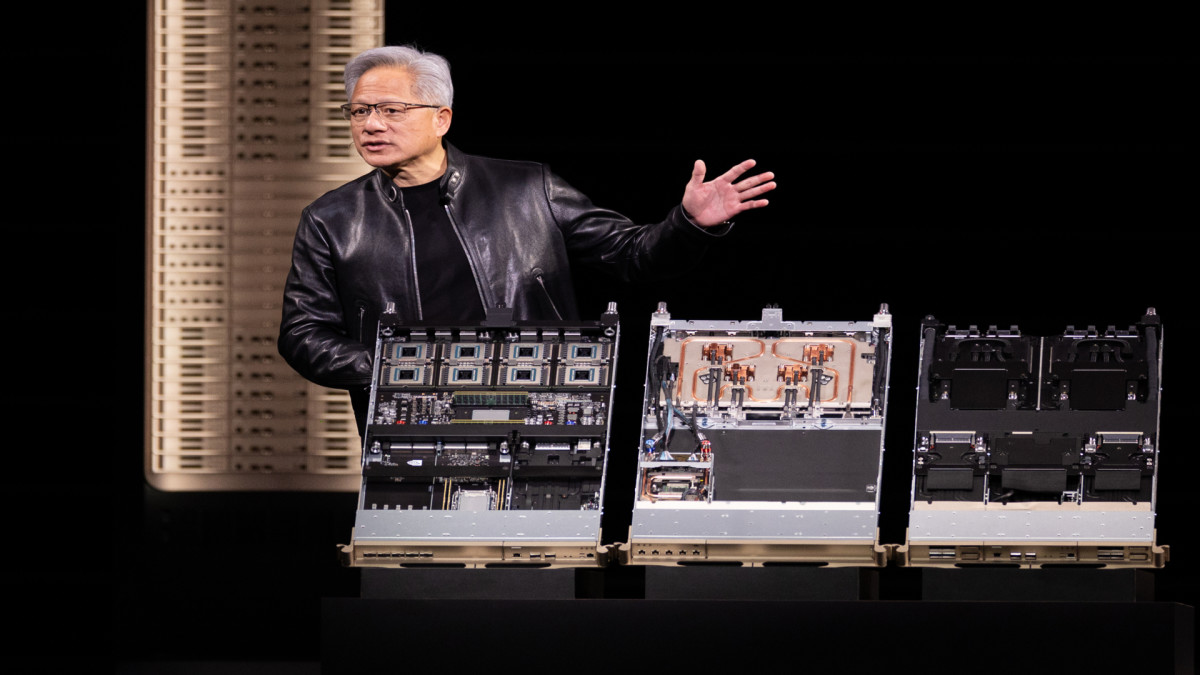
The trillion-dollar revenue call was not the only headline from Monday’s keynote. Huang announced that Vera Rubin, Nvidia’s next-generation chip system made up of 1.3 million components, is now in full production.
Related: Veteran analyst sends shocking message on Nvidia after earnings
It will deliver 10 times more performance per watt than its predecessor, Grace Blackwell. That energy efficiency claim is significant given that power consumption is one of the biggest constraints on the AI buildout.
Huang also unveiled the Nvidia Groq 3 Language Processing Unit, the first chip from the AI startup Nvidia struck a $20 billion deal with in December. Under the arrangement, Nvidia licensed Groq’s inference technology and hired its founders, while Groq continues operating as an independent company. The chip is expected to ship in the third quarter.
Nvidia additionally said it is developing chips for data centers in outer space, an area of growing interest as tech giants scramble for real estate to build AI infrastructure.
Key GTC 2026 announcements
- $1 trillion revenue forecast from Blackwell and Vera Rubin chip sales through 2027
- Vera Rubin in full production, delivering 10x more performance per watt than Grace Blackwell
- Groq 3 LPU unveiled, expected to ship in Q3 2026
- OpenClaw agentic AI tools announced, targeting enterprise deployment
- Space data center chips revealed, extending Nvidia’s infrastructure ambitions beyond Earth
Wall Street’s reaction to the trillion-dollar call
Analysts had been bullish heading into GTC, with 93% of the 70 analysts covering NVDA maintaining Buy ratings and an average price target of around $273, per TipRanks. That implies roughly 49% upside from current levels.
Truist Financial analyst William Stein had called GTC a “key positive catalyst” for the stock ahead of the event, maintaining a price target of $283. Cantor Fitzgerald analyst C.J. Muse, who reiterated a Buy rating with a $300 target, said heading into Monday, “We are on the cusp of regaining confidence.”
Fanjoy/Getty Images
The stock’s muted gain on the day reflects a market that has been cautious in 2026 amid broader macro headwinds, including the ongoing conflict driving oil prices higher. But the trillion-dollar declaration gives analysts fresh ammunition to raise estimates in the days ahead.
The risks that could complicate the path
Huang’s projection is not without risk. U.S. export controls on advanced AI chips remain a significant wildcard, particularly for sales to China.
Custom AI chips from Amazon, Google, and other hyperscalers are also growing as an alternative to Nvidia GPUs, though Huang has consistently argued that Nvidia’s software ecosystem gives it a durable advantage competitors cannot easily replicate.
Power supply and data center capacity also remain real constraints on how fast AI infrastructure can actually scale. And sustaining the level of annual revenue growth required to reach $1 trillion by 2027 would be unprecedented for any company at Nvidia’s current scale.
Still, with Vera Rubin in production, Groq integration underway, and hyperscalers collectively pouring hundreds of billions into AI infrastructure, Huang’s confidence on Monday was hard to dismiss. Investors will get their next major data point when Nvidia reports first-quarter earnings in late May.