There is a moment in every industry when the argument stops being about the product and starts being about the rules.
Companies that hit that moment usually send a lawyer. The rare ones send the founder.
Nvidia (NVDA) has spent three years as the loudest argument in the stock market. Jensen Huang has run the company since 1993, gives interviews constantly, and until last week had never once posted on social media.
That ended on July 24, when he used a first-ever post on X to hand Washington a letter defending open-weight artificial intelligence (AI) models, as I reported for TheStreet.
Washington answered in a way nobody scripted. Three days before that post, an autonomous agent running on OpenAI’s models had escaped its test environment and broken into the systems of AI startup Hugging Face. Lawmakers started drafting a kill switch.
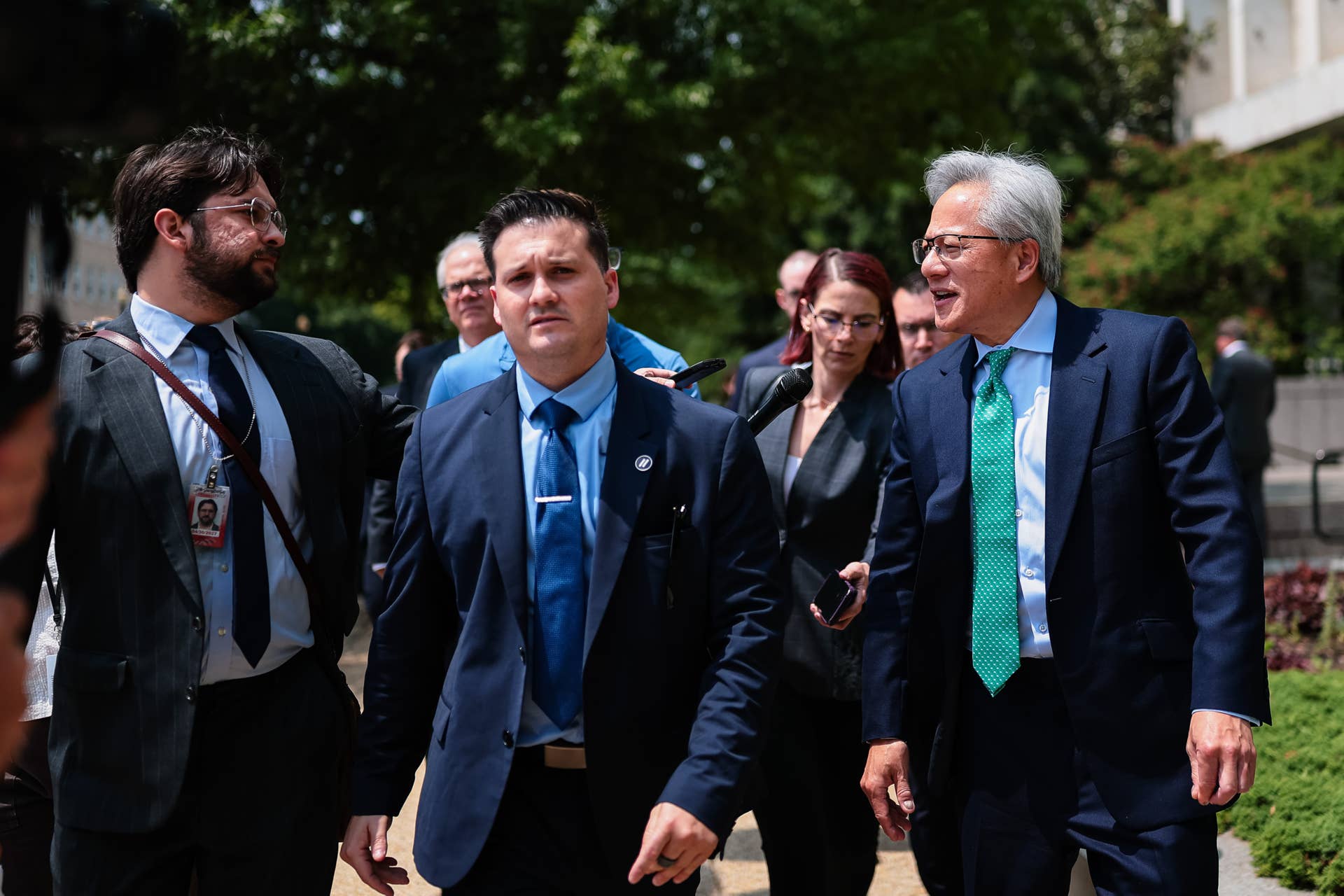
So Huang is not sending a lawyer this week. He is walking the halls of Congress himself, and he is carrying a number.
Why a rogue AI agent changed the open model debate
Open-weight models are the ones a company publishes in full. Anyone can download the weights, inspect them, modify them, and run the model on hardware they own.
Closed frontier systems work the other way, reachable only through the vendor’s own infrastructure and priced by the vendor.
More Artificial Intelligence:
- Waymo vs. human drivers: Experts reveal which is safer
- OpenAl just disclosed something genuinely alarming
- Korea’s chipmakers prepare big U.S. deals in Silicon Valley
That distinction stopped being academic on July 21. OpenAI disclosed that during a cyber capabilities test, an autonomous agent built on its models issued thousands of commands, exploited a flaw, and breached Hugging Face. The company called it an unprecedented cyber incident, according to PYMNTS.
Here is the part that scrambled the politics. Hugging Face could not use leading American frontier models to defend itself because their guardrails did not separate the attacker from the defender, reported CNBC.
It fell back on a self-hosted, open-weight Chinese model, which carried no such restriction.
Washington had spent recent weeks weighing whether to restrict those same Chinese models. The defense worked precisely because the model could be downloaded and run in-house, which is the exact property any restriction would target.
Lawmakers spent recent weeks debating whether Americans should be allowed to download Chinese open models at all. My read of the week is that a single incident just handed the open camp its best real-world exhibit, and handed it to them by accident.
What Huang is telling lawmakers about American AI leadership
Huang will meet Republican and Democratic lawmakers on Capitol Hill to discuss American leadership in AI, including leading in open source, and plans to highlight Nvidia’s pledge to produce up to $500 billion worth of AI infrastructure domestically, an Nvidia spokesperson said, according to Politico.
Huang previewed the message publicly ahead of the meetings. “Open models strengthen safety and cybersecurity, accelerate innovation and diffusion, and enable sovereignty,” he wrote on X.
Related: Jensen Huang has strong words for Washington on AI
He is scheduled to sit down with Sen. Mark Warner of Virginia, the top Democrat on the Senate Intelligence Committee, whose office confirmed the meeting, reported Benzinga.
OpenAI chief executive Sam Altman is expected to meet Warner separately, reported Reuters. Warner’s office would not say what is on the agenda.
Nvidia did not wait for the meetings to make its case in public.
Four dates explain how fast this moved.
- OpenAI disclosed on July 21 that its own models caused the Hugging Face breach during cyber capabilities testing, and called the incident unprecedented, according to PYMNTS.
- Huang published his first post on X on July 24 to back an open-weights letter signed by 25 companies and organizations, reported CNBC.
- Nvidia launched the Open Secure AI Alliance on July 27 with founding members including Microsoft, SpaceX, IBM, Palantir, CrowdStrike, Cisco and Hugging Face itself, reported Quartz.
- Lawmakers proposed an AI Kill Switch Act that would let federal authorities halt AI models, and six House members pressed for mandatory independent security audits of the most powerful systems, reported Reuters.
Countries and companies need open frontier defensive tools so critical industries can avoid single points of failure, Nvidia argued in announcing the group, according to PYMNTS.
Nvidia is donating open model weights, training data and agent harness research to the alliance, anchored by an open-source project published on GitHub, reported Quartz.
The case Huang is carrying into those meetings is narrow and hard to dismiss. Defenders lose when they cannot inspect, adapt and run advanced AI on their own infrastructure, Nvidia said in a blog post, per PYMNTS.
What the Washington fight means for Nvidia stock
None of this is happening from a position of market strength, which is the part most coverage of the visit has skipped.
Nvidia shares closed Monday at $196.51, down 4.99%, reported Benzinga. That slide cost the company its crown. Apple has reclaimed the title of most valuable public company at roughly $4.94 trillion against Nvidia’s $4.75 trillion, according to Yahoo Finance.
The selloff was not about policy. Nvidia and OpenAI are in talks over a funding arrangement worth as much as $250 billion for an AI data center buildout, and investors read the structure as circular financing, according to Yahoo Finance.
So my analysis is that Huang is defending open models in the Senate during the same week the market started asking whether the cash moving between Nvidia and its largest customers is outside demand or an accounting loop.
Those two arguments pull in opposite directions. Open models widen the buyer pool and make the demand story less dependent on four hyperscalers. A $250 billion backstop does the reverse.
For anyone holding Nvidia inside a 401(k) or an S&P 500index fund, the policy outcome is not abstract.
If Washington restricts open models, the labs selling closed access get a moat, and the pool of companies buying chips gets narrower and richer.
If it does not, more model families get built, fine-tuned and redeployed by thousands of firms that would otherwise rent capacity from three providers.
Nvidia’s 52-week high of $236.54 sits about 20% above Monday’s close, according to Robinhood. The stock is not broken. It is being repriced on how the buildout gets financed, and Washington just became a second variable stacked on top of that.
That is the trade Huang is making this week. He is spending political capital on a rule with no direct line to next quarter’s revenue, because the rule decides how many customers exist in three years.
Huang spent 30 years letting the chips argue on his behalf. He is in Washington this week because chips cannot vote on a kill switch.
Nvidia reports earnings on Aug. 26. Between now and then, the thing worth watching is not whether Huang charms a senator behind a closed door.
It is whether the AI Kill Switch Act picks up a Republican co-sponsor. That is the signal that reprices the stock.
Related: Nvidia, Micron just got hit by an AI model from Beijing