Jensen Huang has spent the past year fielding questions about chip supply, export rules, and whether Nvidia can keep growing at its current pace. Lately, he has pointed to a different problem, one having nothing to do with silicon.
The Nvidia CEO laid out the constraint not once but twice at Stanford events this spring. On April 9, he joined Congressman Ro Khanna at a Stanford Leadership Institute event hosted by GSB Dean Sarah Soule and moderated by General H.R. McMaster, where the conversation focused on U.S. AI leadership and policy.
Then, in May, speaking to students in Stanford’s CS153 Frontier Systems class, he put a number on the problem that stopped the room. Wall Street has spent weeks trying to size up whether he was right.
Jensen Huang’s 1,000x AI power warning, explained
Speaking to students in Stanford’s CS153 Frontier Systems class in May, Huang told the audience that computing’s energy needs are “likely probably 1,000 times more than we currently have.”
He offered no formal model behind the figure and even hedged it afterward, admitting, “I wouldn’t be surprised if we’re off by a couple orders of magnitude,” according to The Motley Fool.
The comment traces back to a shift Huang has described before. Today’s AI runs mostly on demand, answering a prompt, then going idle. The future he described at Stanford involves AI agents running continuously, day and night, across millions of parallel tasks.
That always-on model consumes power at a completely different scale than a search engine ever did.
More AI:
- Workers just sent AI companies an ultimatum
- Palantir CEO has a blunt verdict on OpenAI and Anthropic
- Elon Musk pulls no punches with AI rivals as Grok 4.5 debuts
Huang made a related point at Nvidia’s GTC conference in March 2025, when he said the computation needed for reasoning and agentic AI was already roughly a hundred times more than Nvidia had expected a year earlier.
More recent research on agentic workloads suggests the computational burden could climb much further as AI systems take on longer, multi-step tasks.
Nvidia has backed the broader framing with its own numbers, too. The company expects global annual data center capital expenditure to scale toward a $3 trillion to $4 trillion AI infrastructure opportunity over the next five years.
This reflects Huang’s broader argument that AI will require vastly more computing infrastructure as reasoning and agentic workloads expand, as TheStreet reported.
Goldman Sachs data on AI’s surging power demand
Huang’s estimate is directional. Goldman Sachs Research has done the modeling, and its numbers point in the same direction. The bank’s commodities team projects U.S. data center power demand will climb from 31 gigawatts in 2025 to 41 gigawatts in 2026 and 66 gigawatts in 2027, more than doubling in just two years, according to Goldman Sachs Research.
That increase would lift data centers’ share of total U.S. peak summer power demand from 4.1% in 2025 to 8.5% by 2027, according to Goldman analysts Hongcen Wei, Daan Struyven, and Samantha Dart. The forecast assumes U.S. data center capacity reaches roughly 95 gigawatts by end-2027, more than doubling from end-2025 levels, at a 70% capacity utilization rate.
Duke Energy CEO Harry Sideris has echoed the same alarm from inside the utility industry. Speaking at the Edison Electric Institute’s annual conference in Las Vegas in June, Sideris said Duke’s electricity demand load growth is now running at roughly 10 times the pace it did over prior decades.
The U.S. Department of Energy’s own projections reinforce the scale of the challenge. The agency estimates data centers could draw between 6.7% and 12% of all U.S. electricity by 2028, up from about 4.4% in 2023.
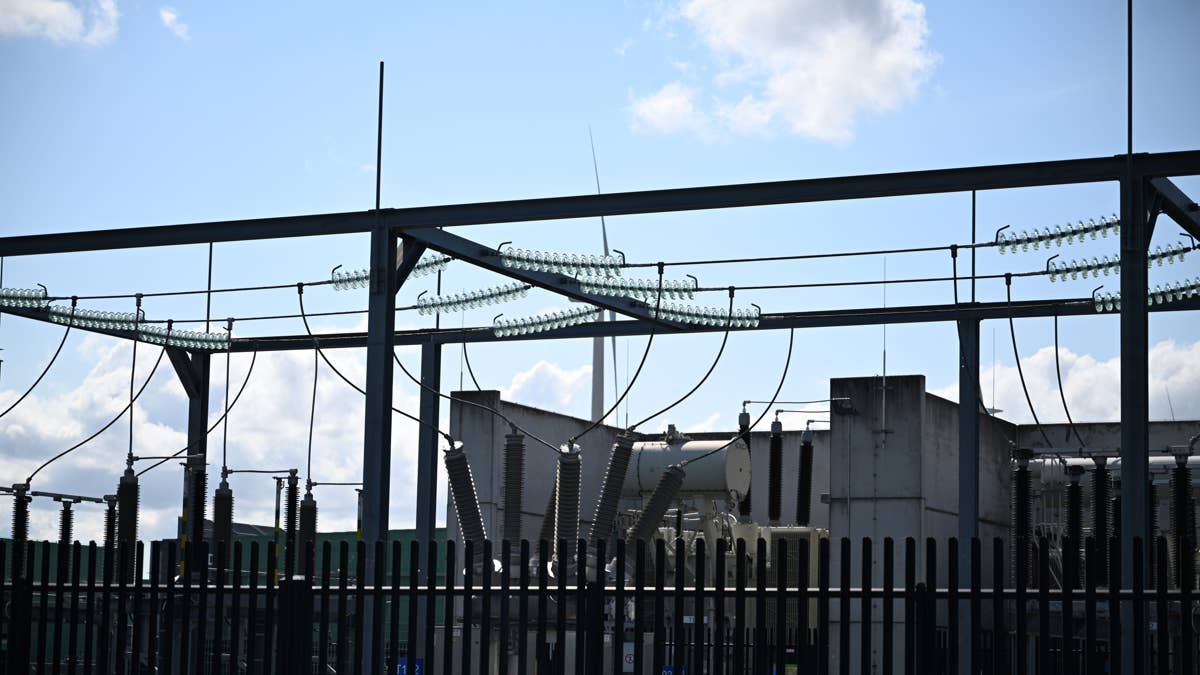
Taim/Getty Images
Why Goldman Sachs says the U.S. power grid is AI’s bottleneck
Goldman’s research goes further than the demand number, arguing that generation capacity is not even the main constraint. The bank estimates the grid itself may need roughly $720 billion in spending through 2030 to support rising electricity demand from data centers, according to Goldman Sachs Research.
That bottleneck is already showing up in consumer costs. PJM Interconnection, the grid operator serving roughly 65 million people across 13 states and Washington, D.C., saw its capacity price jump from $28.92 per megawatt-day in the 2024-2025 delivery year to $329.17 per megawatt-day for 2026-2027.
Data centers were responsible for roughly 63% of that increase, adding an estimated $9.3 billion in capacity costs, according to IEEFA.
Gartner’s Linglan Wang has her own numbers on this. She projects worldwide data center power demand will jump 27% in 2026 alone, hitting 132 gigawatts. By 2030, she sees it reaching 290 gigawatts. That’s more than double in four years, driven almost entirely by AI workloads.
How Caterpillar is cashing in on the AI power crunch
Caterpillar is an unlikely name in this story, better known for bulldozers and mining trucks than power infrastructure. But its generators, battery storage systems, and gas turbines are increasingly being deployed as fast-to-power solutions for data centers racing to secure electricity faster than new grid connections can be built.
Caterpillar’s power generation retail sales surged 44% year over year, the fastest growth of any Caterpillar business line, according to Investing.com. “It’s not a demand issue for us,” CEO Joe Creed said on the earnings call.
“It’s really going to be can we bring on the supply faster?” Management expects the Power and Energy segment to help lift annual company sales growth to a 5% to 7% range through 2030, compared to around 4% in recent years.
Huang may be off by an order of magnitude on the 1,000x number. Goldman’s modeling and Caterpillar’s backlog suggest the direction is correct, regardless.
The power crunch isn’t coming. It’s here. The only open question is how quickly the grid can catch up.