Three days. That’s how long the peace deal Trump and Iranian President Masoud Pezeshkian signed on June 17 lasted before Iran’s military command said it was closing the Strait of Hormuz again. Iran also sent a negotiating team to Switzerland at basically the same time, which is its own kind of confusing, Seeking Alpha reported.
Iran is blaming Israel. The official line out of Tehran is that continued Israeli strikes in Lebanon violate the truce framework signed June 17, so the closure is framed as a response, not a fresh act of aggression on Iran’s part. Whether that distinction matters to oil traders is a different question.
The timing is the part that actually stands out here. Technical talks between Iran and the US were set to start in Switzerland on Sunday, June 21, the day after the closure announcement, with Iranian negotiators reportedly already packing for the trip when the military statement went out. A government planning to walk away from negotiations usually doesn’t keep its delegation booked.
Why this one waterway moves the whole oil market
The Strait of Hormuz is about 21 miles across at its narrowest, sitting between Iran and Oman. Roughly a fifth of the world’s seaborne oil passes through it on a normal day, somewhere near 20 million barrels, plus a big chunk of global LNG.
There’s no real backup plan for that volume. Saudi Arabia has pipelines to the Red Sea. Oman has its geography. Neither gets close to replacing Hormuz if it actually shuts down. So the market doesn’t wait around for confirmation. It prices the risk the second a credible threat shows up, sometimes before anyone even knows if ships are still moving.
More Oil and Gas:
- Goldman Sachs quietly resets oil price forecast for 2027
- JPMorgan sends another message on strait of Hormuz, oil prices
- Exxon CEO delivers blunt message on oil prices and the economy
That’s basically what happened again here.
US Central Command pushed back hard on Iran’s claim. CENTCOM spokesperson Captain Tim Hawkins said flatly that Iran does not control the strait and that traffic was continuing, with US forces watching the situation.
The command’s own numbers backed that up: 55 merchant ships moved through on June 20, carrying more than 17 million barrels, among the highest single-day totals since the war started, even while Iran was telling state media the strait was shut, CNN reported.
So you had two governments making opposite claims about the same waterway on the same day. That gap alone is usually enough to move prices, regardless of which version is closer to true.
What this actually does to oil prices
This isn’t new territory. Brent has been all over the place since the war started in late February, spiking to $124.68 in early April, dropping hard whenever a ceasefire looked real, then climbing right back every time the truce cracked.
The pattern by now is fairly predictable. Closure headline hits, prices jump on fear. If it turns out to be partial or short, the jump fades in a few days once shipping data shows tankers still moving. If it actually holds for a while, the market stops treating it like a one-off and starts repricing the whole supply picture, which is a slower, more painful kind of move for anyone short the trade.
The June 14 reopening announcement, which TheStreet covered at the time, had pulled prices down off their highs.
This new closure threatens to wipe that move out inside a week. What happens next probably comes down to two things: how much shipping actually slows in the next few days, and whether the Switzerland talks produce anything real or just collapse like the last few rounds did.
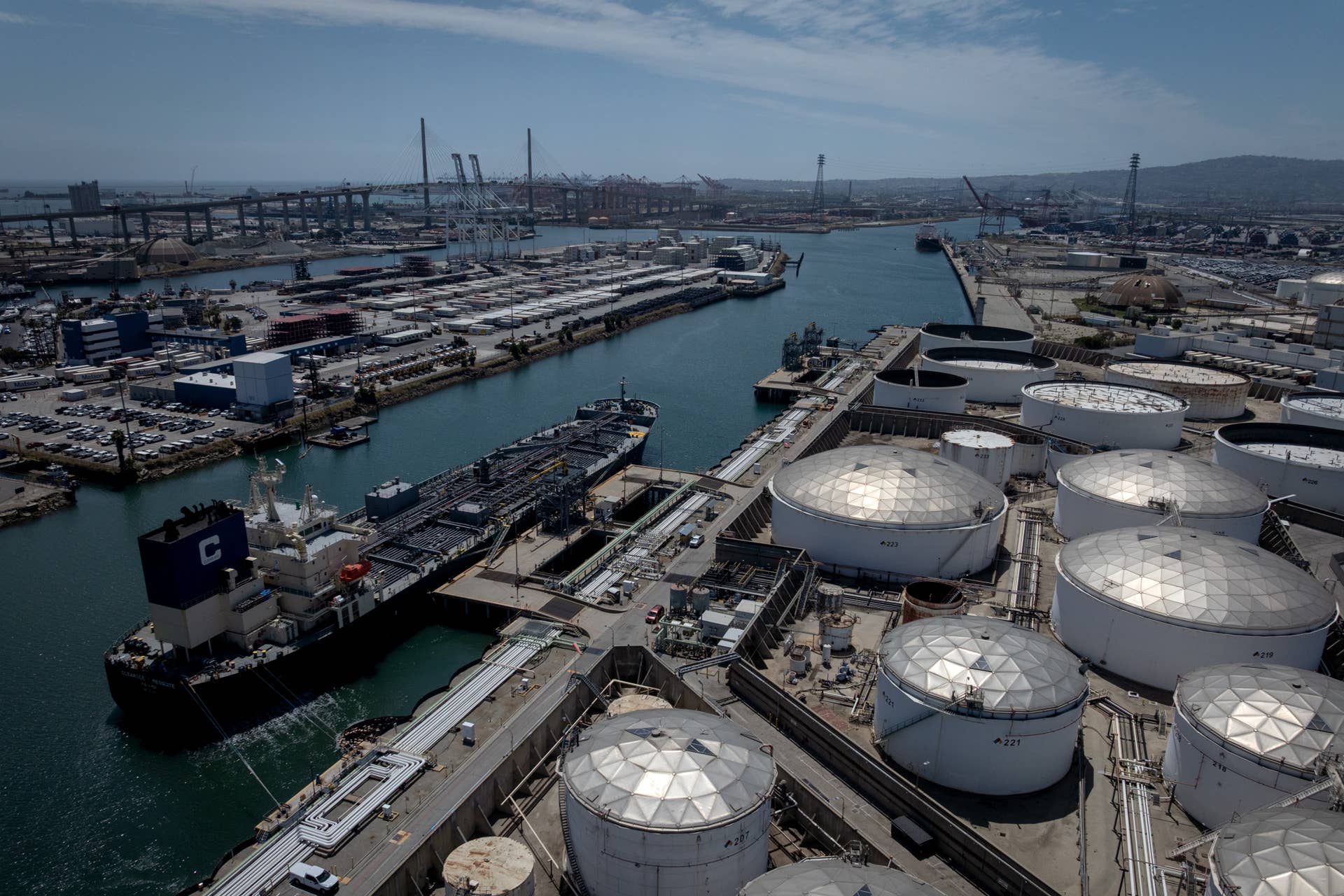
Thayer/Getty Images
How high prices could realistically go
JPMorgan has put numbers on this scenario more than once. The bank’s commodity desk has warned Brent could hit $120 to $130 near term if disruptions persist, with $150 possible if things get worse, a call JPMorgan has repeated through different stages of this conflict.
Bruce Kasman, the bank’s global head of economics, has said a full month of blockade would be consistent with Brent climbing toward $150.
Goldman Sachs has run similar math in its own notes, with scenarios putting Brent in triple digits for months if the strait stays mostly closed.
Some traders have floated $200 oil in the worst case, the scenario where prices climb high enough to actually force people to drive and fly less, what economists call demand destruction.
What it means for your gas bill and the Fed
Higher crude shows up at the pump eventually, usually with a two-to-four-week lag.
Gas prices have already climbed a lot since February, and a real closure pushes that further, which squeezes household budgets and any business that runs on fuel and shipping.
This is also a Fed story, not just an energy story.
US inflation has stayed sticky through the conflict, and another leg up in crude flows straight into transportation and manufacturing costs within weeks. That makes any path toward rate cuts a lot harder to defend.
Could oil actually come back down from here
Yes, but it needs real proof the closure won’t stick.
Earlier in this same conflict, prices dropped fast once diplomatic signals improved or shipping data showed tankers still moving despite the threats. Iran’s negotiators still heading to Switzerland is itself a tell.
Vice President JD Vance sounded almost upbeat about it on Fox News, saying tanker traffic had actually rebounded sharply.
“We actually got 16 million barrels of oil out of the Strait of Hormuz yesterday,” he said. “That is a record going back to even before the conflict started,” according to NPR.
None of that proves the closure is fake. It just means the people closest to the negotiation don’t seem to think it’s the end of anything. For oil traders, that’s still not much to go on. It’s hard to price a threat properly when even the side making it doesn’t seem fully committed to how far it’s actually willing to go.
Related: JPMorgan pulls no punches on Strait of Hormuz, oil prices