June 11 began with President Trump writing that the United States would hit Iran hard again to try to force real negotiations to end the war between Israel and the United States and Iran that erupted on Feb. 28.
“Hitting Iran hard” also included a presidential threat to seize Kharg Island, a coral island in the western Persian Gulf.
That caused military and oil experts to sit up quickly. For good reason.
A key component of Iran’s economy
Kharg Island is not just any island in the Persian Gulf. Located about 16 miles off the Iranian mainland, the coral island is Iran’s primary oil port. Before this year’s Iran War, about 90% of Iran’s oil exports were loaded on oil tankers at the oil-terminal complex at Kharg.
Anybody who has thought much about possible armed conflict in the Persian Gulf knows about Kharg Island, as I wrote a year ago.
U.S. planes have attacked the island at least twice since this year’s war began, but the attackers were careful to steer clear of Kharg’s giant storage tanks and the loading systems.
More on oil prices:
- Jim Cramer drops blunt 7-word verdict on oil prices
- JPMorgan sends another message on strait of Hormuz, oil prices
- Oil’s 4% spike revives Wall Street’s rate-hike fear
Iran needs oil revenue to support its economy. Kharg is the cash register.
Nonetheless, Trump said on Truth Social at 9 a.m., “At some point in the not too distant future, we will be taking Kharg Island and other oil infrastructure points, and assume total control of their oil and gas markets, much like we have with Venezuela, which is working out brilliantly for both Venezuela and the United States of America.”
Oil prices moved higher on the threat. But not too much higher. Light sweet crude, the U.S. benchmark, hit as high as $93.64, up 4%. Brent crude peaked at $95.50.
The peak prices since Feb. 28 came on March 9, when crude oil peaked at $119.48 per 42-gallon barrel and Brent peaked at $119.50.
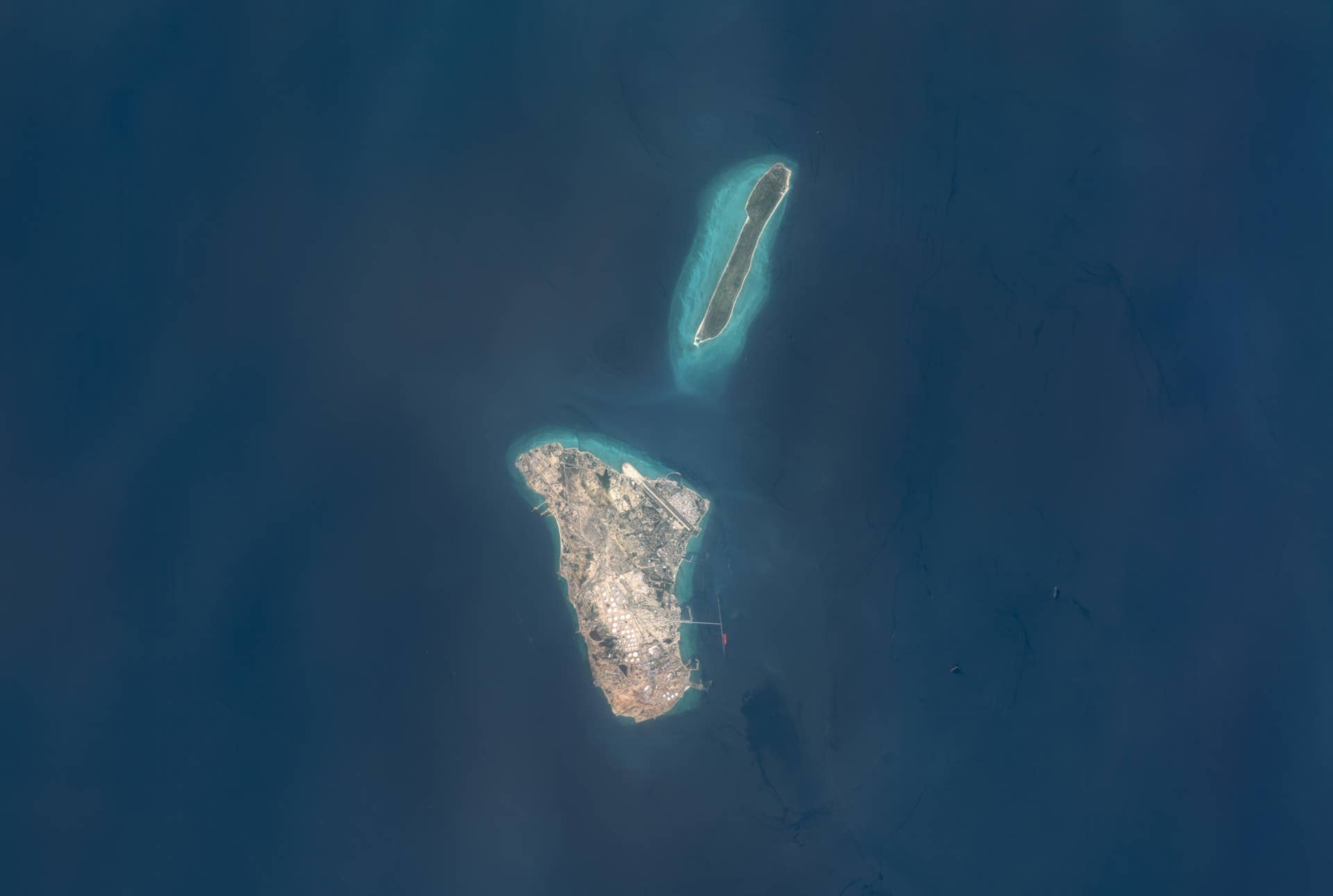
Maps4Media / Getty Images
Invading Kharg carries huge risks
Oil traders have long thought about and understood the risks of trying to grab targets like oil terminals in the Persian Gulf. It involves
- An invasion and a commitment of sizable numbers of troops. The U.S. has upwards of 20,000 ground troopers deployed in and around the Persian Gulf.
- A commitment of ground equipment.
- A commitment of air cover.
Especially when the invasion is so close to the Iranian mainland.
And, of course, the financial stakes are so big. Time magazine estimated the oil flowing through Kharg was generating around $80 billion a year in oil revenue for the Iranian government. So, an operation to seize the island would almost certainly be greeted with resistance.
Markets react significantly
But traders have also understood that, with President Trump, a threat is not an an attack. In fact, he told Fox News he always wanted to take Kharg Island. But, he added, “You’d make a fortune, but I don’t know that America has the stomach, I think they’d like to see us come home.”
So, slowly but surely, oil prices fell back until, finally, at about 2 p.m. ET, another Trump post said the Iranian government has agreed to negotiate and was “on the verge of signing a peace agreement.” The attack he had said was coming was cancelled.
Iran has not confirmed the president’s statement.
Markets cheered seriously.
Crude oil fell back hard. Brent fell to $90.38 a barrel, a 5.4% drop from the day’s highest level, according to Wall Street Journal data. Light sweet crude settled at $87.71, down $2.32 on the day and a 6.3% decline from its high.
Gasoline prices were falling anyway. AAA’s price was at $4.129 a gallon, down 0.5% the day. GasBuddy’s national average was $4.078, down 0.8%.
Both are down substantially from their mid-May peaks.
Exxon Mobil and Chevron led energy stocks lower.
Stocks overall, however, swung from small losses in the morning to big-time gains. The S&P 500 was up 1.8%. The Dow Jones industrials shot up to a 927-point gain.
Related: Goldman Sachs drops contrarian take on the jobs market