Software stocks have had a rough year. The fear driving them down is real: AI agents are getting good enough to automate tasks that enterprise software used to handle, and investors have been cutting valuations across the board.
The debate has been running all year with no clear answer.
On Aug. 3, one CEO stepped into that debate with 11 words. “Our entire business nearly doubled in the span of 12 months,” Palantir Technologies CEO Alex Karp wrote in his investor letter, according to The Motley Fool.
Palantir (PLTR) just reported results that ask a pointed question: Is AI killing enterprise software, or is it making the strongest players untouchable?
What Palantir’s business doubling means for PLTR stock
Karp did not stop at the investor letter. On the earnings call, he told investors to “forget consensus” and said to his knowledge, as CNBC reports, “no businesses at our scale has even grown half this much.”
He called the quarter “otherworldly” and told analysts the current growth pace “looks like this is going to go on for at least another 18 months.”
More Palantir:
- Palantir CEO admits AI would make him 20 times richer
- Microsoft CEO adds fuel to Palantir CEO’s AI warning
- Palantir CEO has a blunt verdict on OpenAI and Anthropic
The market moved fast. Palantir shares jumped nearly 15% in after-hours trading on Aug. 3, rising from a regular-session close of $125.65 to around $144.45. The next day, Aug. 4, shares closed at $162.66, a gain of roughly 29.5% on the session, as TheStreet reported.
Chief Revenue Officer Ryan Taylor called the results expected rather than surprising. “Our Q2 results are unprecedented but entirely unsurprising, as the abrupt market shift in LLMs that we’ve been warning you about for years is now here,” Taylor said.
Palantir Q2 2026 earnings results and record numbers
The quarter was a clean beat across every major metric. Here is what Palantir reported.
Q2 2026 key financial results:
- Total revenue: $1.935 billion, up 93% year over year, the highest growth rate in company history
- U.S. commercial revenue: $764 million, up 149% year over year
- U.S. government revenue: $809 million, up 90% year over year
- GAAP net income: $1.06 billion, a 55% margin
- Adjusted EPS: $0.41, beating the $0.35 consensus estimate
- Adjusted free cash flow: $1.22 billion
- Rule of 40 score: 155%
- Deals closed over $1 million: 220, including 73 worth over $10 million
- U.S. commercial bookings: $2.13 billion, up 153% year over year
Palantir raised its full-year 2026 revenue guidance to $8.15 billion to $8.158 billion, up from prior guidance of $7.65 billion to $7.66 billion. U.S. commercial revenue guidance rose to more than $3.424 billion, implying at least 134% growth.
Both represent the largest full-year guidance raise in the company’s history. Management set Q3 2026 revenue guidance of $2.16 billion to $2.164 billion, ahead of the $2 billion analyst consensus.
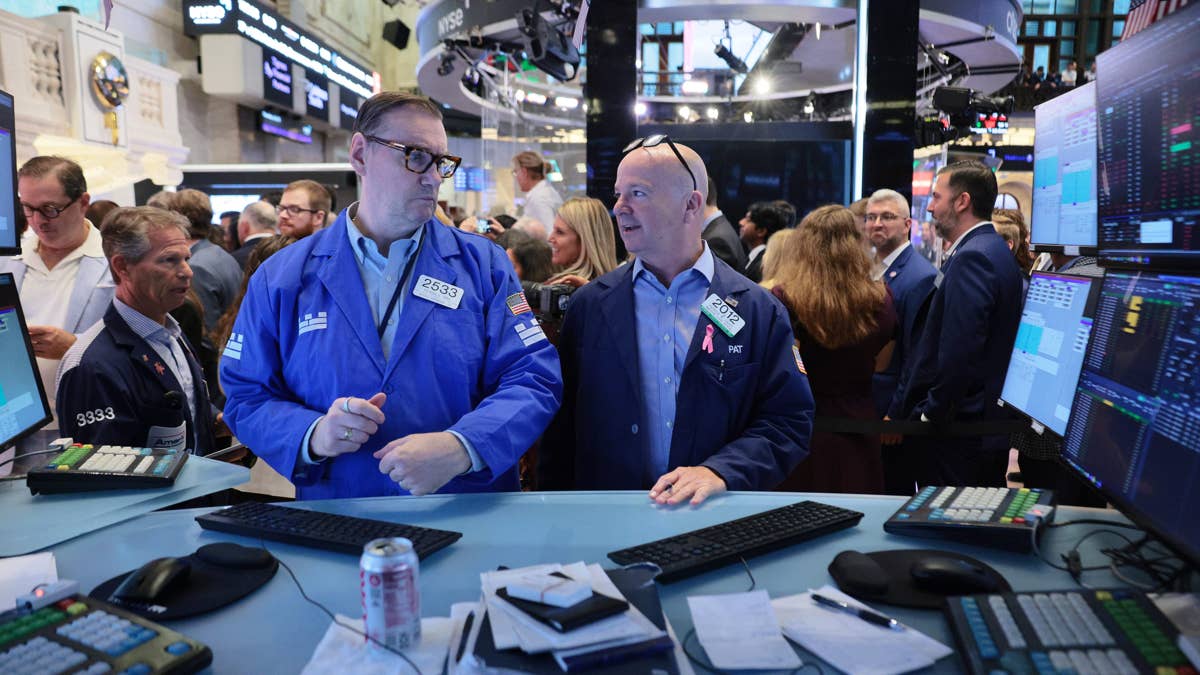
Michael M. Santiago/Getty Images
Why U.S. government and commercial growth reinforce each other
Palantir’s results were strong across both segments, not carried by one side. U.S. commercial customer count grew 35% year over year to 653, a figure Karp called “anomalously strong.”
Commercial customers are using Palantir’s Artificial Intelligence Platform to fold AI capabilities into existing workflows without handing control of their data to a third party. Government agencies are deploying the software for mission-critical decision systems that need both security and speed.
That combination gives Palantir something most technology companies do not have: trusted relationships with defense and intelligence customers alongside expanding commercial contracts across manufacturing, energy, health care, and financial services.
Legacy SaaS vendors and government contractors have not attained both. Karp told CNBC that AIP gives customers “a completely sovereign stack,” meaning full control over their data, metadata, and AI reasoning traces.
U.S. commercial revenue has jumped 380% since 2024 on a compounding basis, according to CNBC. Total contract value across all segments hit $3.37 billion for the quarter, up 49% year over year.
That is not a one-quarter story. Palantir’s boot camp events, where prospective customers run live AI prototypes with their own data, have been converting at unusually high rates throughout 2026.
Is Palantir’s valuation at $162 a share justified?
Palantir shares closed Aug. 4 at $162.66, giving the company a market value of roughly $418 billion and a trailing price-to-earnings ratio near 183, according to TheStreet. That is a high multiple for any company, let alone one that was down roughly 29% for the year before the earnings print.
Investors at that valuation are not paying for Q2 2026. They are pricing in years of growth at or near this pace, margins continuing to expand, and Palantir holding its position as both governments and enterprises build out AI infrastructure. A P/E near 183 is not a valuation built for a miss. The stock dropped 29% earlier this year on slower growth fears. It can move fast in both directions.
Karp is betting those misses do not come. He pushed back in the call on critics who say Palantir’s valuation is disconnected from fundamentals, telling investors to measure the company by its AIP adoption and sovereign AI contracts rather than traditional software metrics.
Whether the market agrees with that framing will determine where the stock goes from here. Long-term investors watching the stock can approach it the same way Karp described the business itself: through discipline rather than momentum chasing.
In a market still separating AI’s real beneficiaries from its casualties, Palantir has put up numbers in Q2 2026 that are hard to argue with.
Related: Palantir CEO admits AI would make him 20 times richer