There are two kinds of shoppers in the world: those who like Crocs and those who don’t.
For Crocs, of course, the business is not nearly that simple.
For years, the footwear company has been trying to prove it is more than its Classic Clog, expanding into sandals, ballet flats, and newer sport and fashion styles.
And this strategy could prove particularly useful as Crocs faces another challenge: rising costs.
Higher oil prices could make it more expensive for Crocs to produce and ship its shoes, according to a Bank of America research note shared with TheStreet.
Also read: DoorDash wants customers to stop using its app to order food
BofA expects higher fuel costs to show up first in shipping expenses later this year.
If oil prices remain elevated, Crocs could also face higher material costs in 2027.
The question is whether Crocs will absorb those higher costs or eventually ask shoppers to pay more.
BofA analyst Kendall Toscano believes the company has some pricing flexibility, noting that Crocs has not raised the price of its Classic Clog since 2021.
For shoppers, that is worth watching.
The standard Classic Clog is currently listed at $49.99 on Crocs’ U.S. website, and so far, Crocs has not announced plans to raise that price.
Crocs warns consumers are already under pressure
If there are any pricing decisions, they will come at a difficult time for shoppers.
In its latest quarterly filing, Crocs said consumers are feeling the effects of inflation, elevated interest rates, and expected price increases, which are putting more pressure on discretionary spending.
The company also said elevated oil prices related to geopolitical conflict have increased and could continue to increase its raw-material and transportation costs.
More Retail:
- Forget deals, Amazon goes after Walmart’s biggest edge
- Albertsons closes more stores at chain it saved from bankruptcy
- T-Mobile reduces a generous discount as customers see prices rise
Crocs has therefore been trying to find growth elsewhere by getting shoppers interested in different shoe types.
The company said its North American strategy includes product innovation, expansion in key categories such as sandals, and maintaining stricter pricing discipline across the marketplace.
Bank of America sees evidence that the effort is working.
The firm said demand is becoming more diversified, with the Classic Clog stabilizing while Crocs gains traction across sandals, ballet flats, newer sport and fashion clogs, and its Mellow recovery line.
Coincidentally, one of my first Crocs was also not its classic clog, but the low wedge sandal.
BofA also sees a strong pipeline of new products extending through the second half of 2026 and into the first half of 2027.
I read it as more options for holiday shopping.
Shoppers can already see that strategy on Crocs’ website.
It’s newer Classic Ballet, for example, brings the Crocs design into a ballet-flat silhouette, along with the Classic Crafted Clog, which replaces the traditional molded upper with washed canvas.
They are all listed at different price points, with some closer to the Classic Clog’s $49.99 price point and some higher, such as Crocs’ sportier Echo Gum RO Clog, at $74.99.
This expansion is relevant because it reduces Crocs’ reliance on a single shoe, and potentially gives the company greater flexibility in what shoppers pay across its assortment.
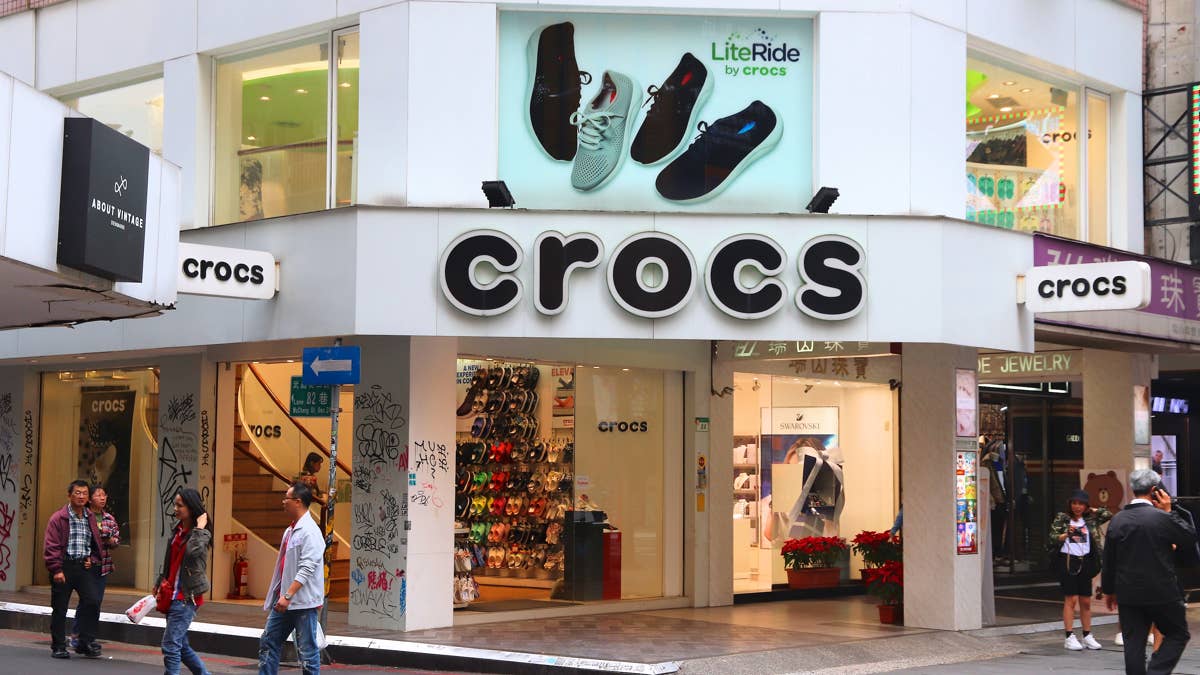
Crocs says shoppers are responding to new products
Crocs’ own latest results provide some evidence that shoppers are responding.
The Crocs brand surpassed $1 billion in quarterly revenue for the first time in the second quarter.
Direct-to-consumer revenue for the brand jumped 12.9% to $559 million, while North American revenue edged 0.4% higher.
CEO Andrew Rees said the results reflected strong consumer response to new product innovation, according to the company’s second-quarter earnings release.
“Our results reflect broad consumer demand across both brands, healthy direct-to-consumer growth, and strong consumer response to new product innovation,” said Rees.
Yet, BofA forecasts that North American direct-to-consumer sales will fall 7%, compared with the Street’s roughly 5% decline estimate.
But the firm says much of that decline comes from a change in how Crocs classifies sales from a large partner, moving the business from the direct-to-consumer (DTC) channel to wholesale.
BofA estimates the shift will reduce reported North American DTC growth by about 12 percentage points over the next four quarters.
Excluding that change, BofA estimates underlying North American DTC sales would actually be growing about 5%, consistent with the first half of the year.
In other words, the headline DTC decline may look worse than what shoppers are actually doing.
BofA remains encouraged by stabilization in the Classic Clog and growing contribution from newer footwear styles.
This leaves Crocs with an interesting consumer equation.
Its iconic clog has gone years without a price increase, even as the company faces fresh pricing pressure.
At the same time, Crocs is selling shoppers a much broader range of products at different price points, which gives it the much-desired pricing flexibility.
It remains to be seen how Crocs uses this flexibility and whether the costs are ultimately borne by consumers.
Related: T-Mobile reduces a generous discount as customers see prices rise