As someone who spends most of every day working on a computer, I’ve come to appreciate how much we depend on digital storage. Between saving documents, downloading files, and backing up photos, it’s easy to forget how quickly all that data adds up.
And even when I move files to the cloud, that information still has to live somewhere. Somewhere, a data center is holding those files, and demand for storage keeps growing.
Seagate (STX) closed fiscal 2026 with $12.2 billion in revenue, up 34%, non-GAAP EPS of $15.58, and a record $3.1 billion in free cash flow. In the fourth quarter alone, it earned non-GAAP EPS of $5.71 on $3.6 billion in revenue.
In the fiscal year 2026 report, CEO Dave Mosley said AI is speeding up data creation, giving the company “durable long-term demand for mass capacity storage.”
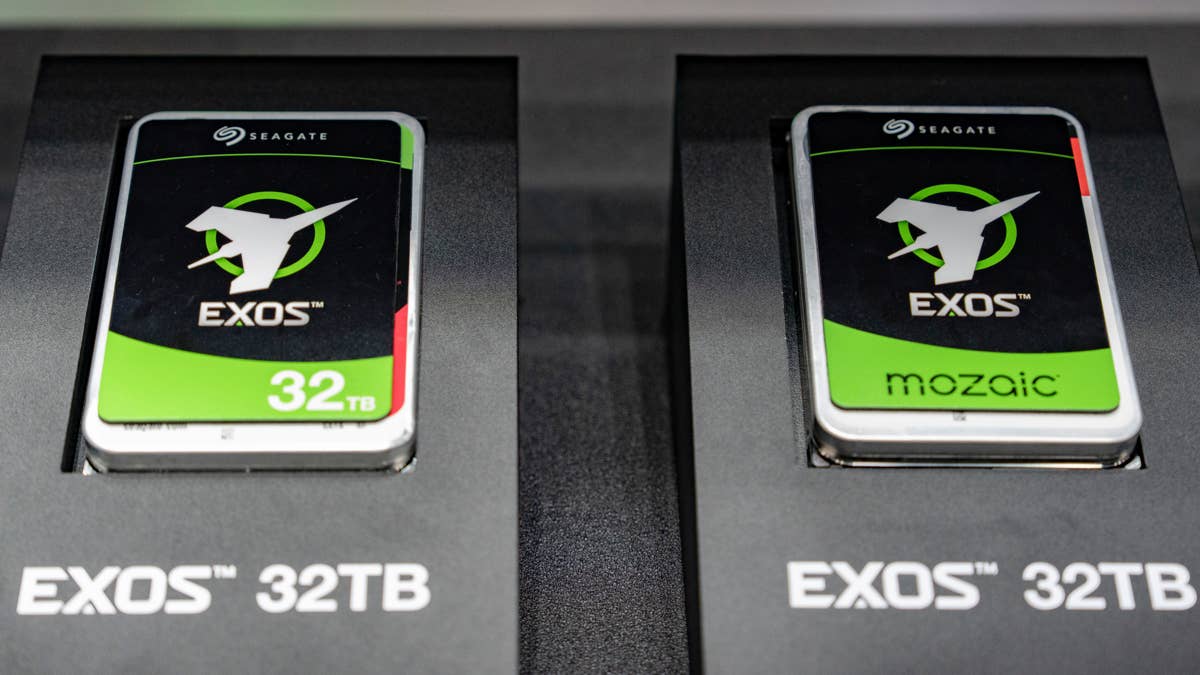
Seagate is well positioned to address strengthening exabyte demand through our Mozaic platform and differentiated HAMR technology roadmap, enabling customers to scale efficiently while supporting our ability to drive profitable growth and value creation.
He added that cloud data-center demand is driving results and that he sees the momentum continuing in 2027. However, one manufacturing hurdle could limit how much of that demand Seagate can turn into sales.
Also Read: Seagate Technology Holdings PLC Latest News
Seagate’s demand is running ahead of plan
In a note shared with TheStreet, Bank of America reiterated its Buy rating and raised its price target to $1,200 from $1,150. BofA says demand for nearline hard drives, the kind used in data centers and cloud storage, should stay above Seagate’s long-term target of mid-20% annual growth in exabyte shipments.
BofA built the target on 16x fiscal 2028 EPS of $76.24, reflecting a stronger growth outlook and margins approaching peak levels. The bank expects favorable pricing and margins to persist into 2028.
The market has noticed already. Seagate shares have returned 133.94% this year, 200.36% over the last 1 year, and 922.11% over the last three, according to Yahoo Finance.
More Bank of America:
- Bank of America’s bad news may not be what investors think
- Bank of America CEO addresses a troubling banking problem
- Bank of America just drew a line in the sand for the stock market
Seagate reports fiscal first-quarter 2027 results Oct. 27 after the close. Seagate guided to revenue of $4.1 billion, plus or minus $100 million, and non-GAAP EPS of $7.30, plus or minus 20 cents, including the dilutive impact of its 2028 exchangeable notes.
Bank of America expects $4.2 billion and $7.60 at the top of the revenue range, and above the EPS range. Consensus is $4.14 billion and $7.41. Seagate’s guidance assumes minimal impact from tariffs or the conflict in the Middle East.
Why AI is pulling Seagate’s prices higher
Pricing is doing much of the work. The bank forecasts revenue per terabyte to be up about 22% year over year in the first quarter and about 20% in the following quarters, and with sequential revenue and profit growth through fiscal 2027. It raised its fiscal 2027 revenue estimate to $18.7 billion from $17.5 billion and EPS to $36.53 from $32.06.
The fourth quarter showed a margin effect, with non-GAAP gross margin of 52.7% compared to 46.1% for the full year. Seagate retired $302 million in debt and returned $283 million to shareholders in the quarter.
Related: BofA sees more upside in Seagate’s AI storage trade
From my side of the screen, I see how quickly storage needs can grow. Between work documents, downloaded files, and everything I keep backed up. What once seemed like plenty of space doesn’t feel like much anymore. And I certainly know I’m not the only one noticing.
That demand is physical. Seagate is moving customers from conventional perpendicular magnetic recording drives to heat-assisted magnetic recording, or HAMR, which should lower the cost per terabyte and support margins. Its Mozaic platform is built to let customers scale efficiently, Mosley said, as AI makes data more valuable.
Here is the catch. Bank of America warns that Seagate’s growth could be limited by how quickly it improves production yields on its Mozaic 4+ platform. Yield is the share of drives that come off the line working, and a slow ramp would cap supply while demand stays strong.
Bank of America sees $1,200, but the chart calls for a little patience
My own read of the chart is that it’s not the time to strike yet. Seagate has printed three straight red bearish candles. This week is the fourth. I am sure you are not trying to catch a falling knife. It’s a deep pullback from its June 2026 all-time high of $1,145.
It may find support around $560 on a weekly ascending trendline that has held since July 2025 and tested more than five times.
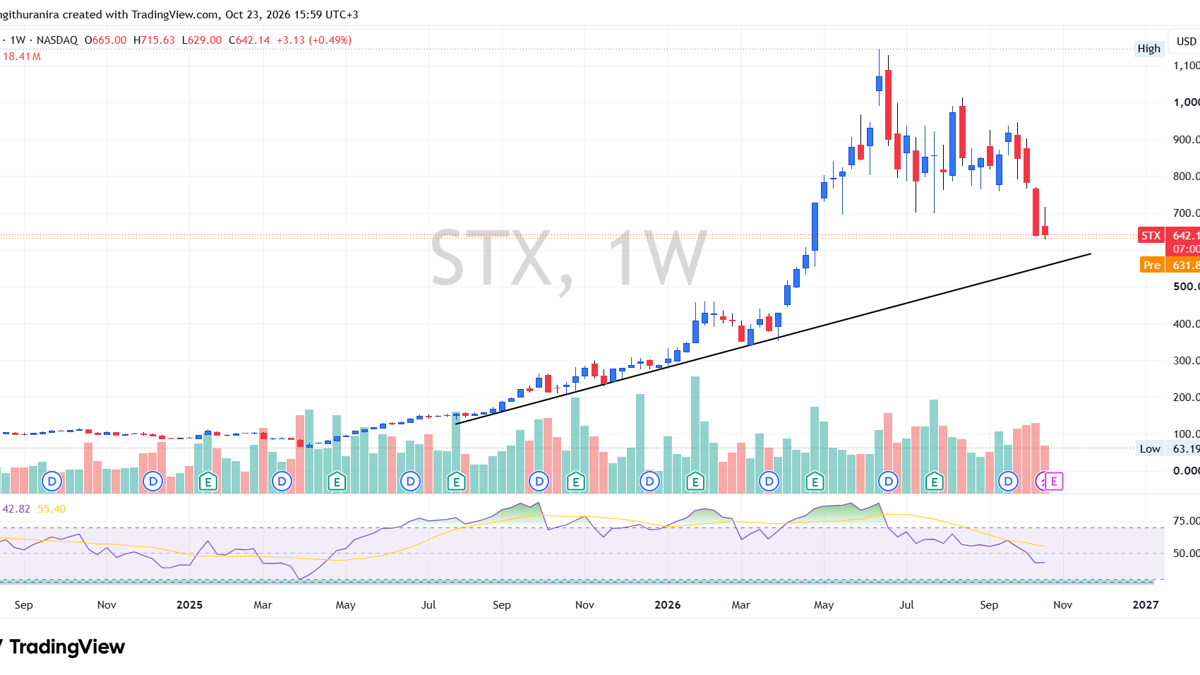
The relative strength index is at 42, still above the 30 level that signals oversold levels. In past tests of the 27-30 zone, going back to 2016, the stock bounced aggressively.
A bounce around those key support levels, plus a strong Oct. 27 report, would strengthen the case, but that is a read of the chart. If bullish confirmations appear, I think it would be the best timing to buy your shares to maximize your returns.
For investors, Bank of America’s message is that demand is strong and pricing and margins should hold into 2028. The open question is whether Seagate can build enough high-yield drives to meet it. If the Oct. 27 report shows the yield ramp on track, the bank’s case holds.