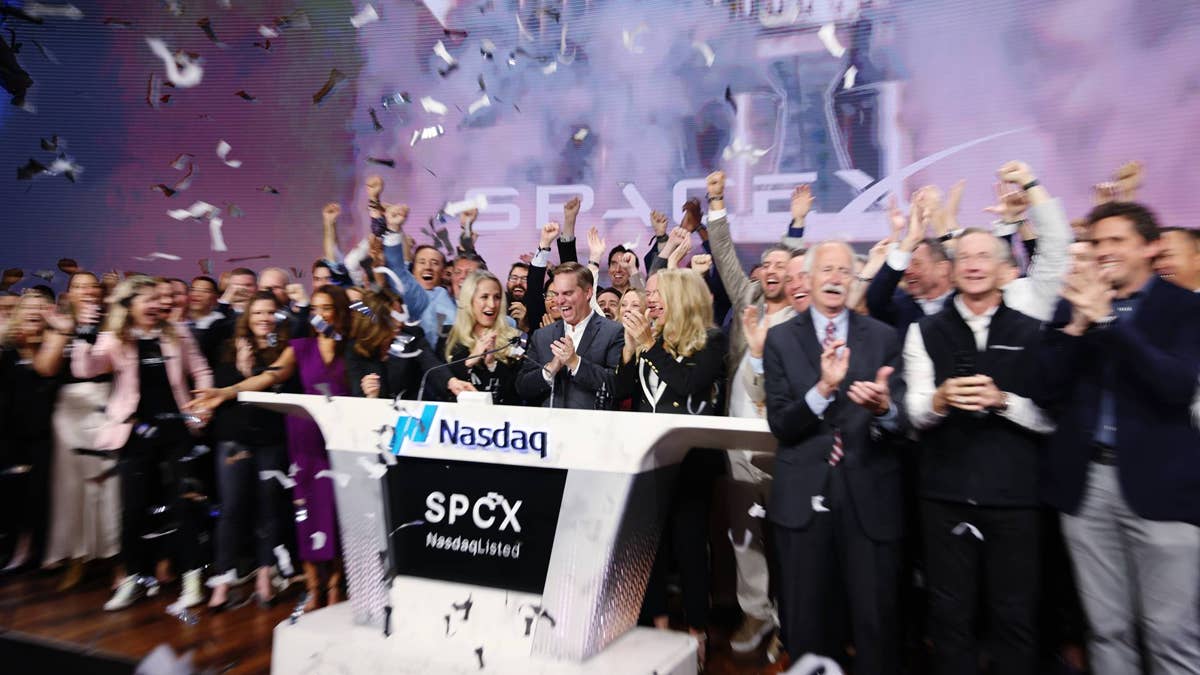
Less than two weeks ago, SpaceX became the most valuable company ever to go public, raising $75 billion at a valuation north of $1.7 trillion and closing its debut session up 19%, according to CNBC.
On June 22, SpaceX posted its worst single-day loss as a public company, plunging 16% to close at $154.60, just 14% above its $135 IPO price and barely above its $150 opening-day trade, CNBC reported.
The stock now sits roughly 32% below its all-time high, and a prominent Wall Street analyst is arguing the sell-off may accelerate a move Musk has been assembling for months.
Four reasons why SpaceX should merge with Tesla
Below are four reasons a SpaceX-Tesla merger would make the combined entity more appealing to long-term investors, as outlined by Daniel Foelber of The Motley Fool.
1. Simplification
While Tesla has been a public company for longer, SpaceX has been the one slowly absorbing Musk’s other ventures.
In 2025, xAI bought social media platform X (the former Twitter), TechCrunch reported. Then, earlier this year, SpaceX bought xAI, but the bulk of Musk’s robotics, energy storage, and autonomous-vehicle ideas remain within Tesla.
Wedbush Securities Managing Director and Senior Equity Research Analyst Dan Ives said it’s likely that SpaceX will ultimately merge with Tesla, Benzinga noted.
I think that’s the step process that they’ll go through, and then ultimately a merger with Tesla… I think 80%, 90% type of chance.
Merging Tesla with SpaceX would bring all these ideas and creativity under one umbrella, eliminating the operational confusion that currently splits Musk’s empire across separate corporate structures.
2. Terafab collaboration
In March, Elon Muskgave a presentation on a collaborative effort among Tesla, xAI, and SpaceX to build the world’s largest chip plant, Terafab, and Intel joined the project as a foundry partner in April.
Musk discussed why Tesla, xAI, and SpaceX are builders and have already accomplished once-impossible feats. This is yet another signal that “we” refers to the collective efforts of Musk-led companies.
SpaceX is designing its AI compute satellites to operate on Nvidia graphics processing units and has a reference design for Alphabet’s Tensor Processing Units.
But AI compute capacity will be a limiting factor in scaling AI satellite production. xAI built the world’s first gigawatt-scale AI training cluster, and SpaceX believes it is the only company capable of building orbital AI compute at scale.
3. xAI as a key ingredient
Merging SpaceX and Tesla would give xAI a straightforward path to support both companies, rather than having Tesla serve as both a partner and a customer.
SpaceX’s boldest idea is to build constellations of AI compute satellites in space. In theory, these orbital data centers would harness the power of free, predictable solar energy at radiation levels higher than those at Earth’s surface.
In its Form S-1 filing with the Securities and Exchange Commission, SpaceX said it could launch millions of AI satellites in sun-synchronous orbit, The Motley Fool reported.
This route provides predictability, but it can also cause significant light pollution when satellites pass over dark skies at night. Most current Starlink satellites do not use sun-synchronous orbit.
4. Energy storage in space
SpaceX’s orbital data center plan has a glaring problem that Tesla could help solve.
Tesla could theoretically help SpaceX meet the power-hungry needs of orbital AI data centers without operating in a route that would be invasive to nighttime sky viewing for the naked eye and astronomers.
Tesla’s deep expertise in solar energy and battery storage, developed through its SolarCity acquisition and its Megapack product line, positions it to address the energy challenges posed by orbital computing infrastructure.
Wedbush sees SpaceX-Tesla merger as Musk’s endgame
Ives sees a SpaceX-Tesla combination happening in the first half of 2027, he told Schwab Network in April, Benzinga noted.
Ives views the IPO itself as the financial scaffolding that makes a formal union possible, setting exchange ratios and establishing a public float capable of absorbing a stock-for-stock deal.
More SpaceX:
- Elon Musk sets SpaceX IPO price in blunt message to Wall Street
- Veteran hedge fund manager makes a brazen SpaceX bet
- Franklin Templeton CEO sends strong message on SpaceX
Wedbush’s argument rests on accelerating operational overlap, including Tesla’s $2 billion investment in xAI before SpaceX absorbed it, shared supply-chain relationships, and the joint Terafab semiconductor project in Texas.
Ives maintains a $600 price target on Tesla, the highest on Wall Street, according to Wedbush research notes reported by Benzinga.
What SpaceX earnings could reveal about a Tesla combination
SpaceX’s first quarterly earnings report as a public company is estimated for August 6, according to Investing.com, and the call will be parsed for any merger language.
The company’s amended S-1 already stated it “may issue a significant amount of equity in connection with future transactions,” a clause several analysts interpreted as legal groundwork for a stock-for-stock acquisition.
A formal merger could create enormous value, or destroy it, and the answer hinges on which camp of Wall Street analysts proves right. SpaceX’s 32% plunge has made the conversation urgent in a way the IPO euphoria never could.
Related: SpaceX’s $600 billion wipeout tests investor patience