The riskiest moment for any new technology is not the prototype. It is the morning somebody takes away the backup.
For roughly 60 years, the American car has been engineered around a single assumption, that a person can always take over.
Federal safety rules are built on it. Airbags assume a driver. Mirrors assume a driver. The brake pedal assumes a driver.
Automakers have layered software on top of that assumption for a decade now, and even the most aggressive driver-assistance systems keep a steering wheel within arm’s reach. That wheel is the apology engineered into the product, the quiet admission that the software might be wrong and a human will need to fix it.
Tesla (TSLA) has spent the better part of a decade arguing that the apology is unnecessary, that cameras and neural networks will eventually be good enough that the wheel becomes dead weight. Investors have priced that argument in. Regulators have mostly stepped aside for it.
This week, the company finally picked the date it stops arguing and starts proving.
Tesla began sending out invitations to a Cybercab launch event in Austin, Texas, on Sept. 3, according to Teslarati. Attendees are being asked to come “experience the future of full autonomy,” and each guest can bring one person, though not a content creator.
Why the Cybercab is different from every Tesla robotaxi so far
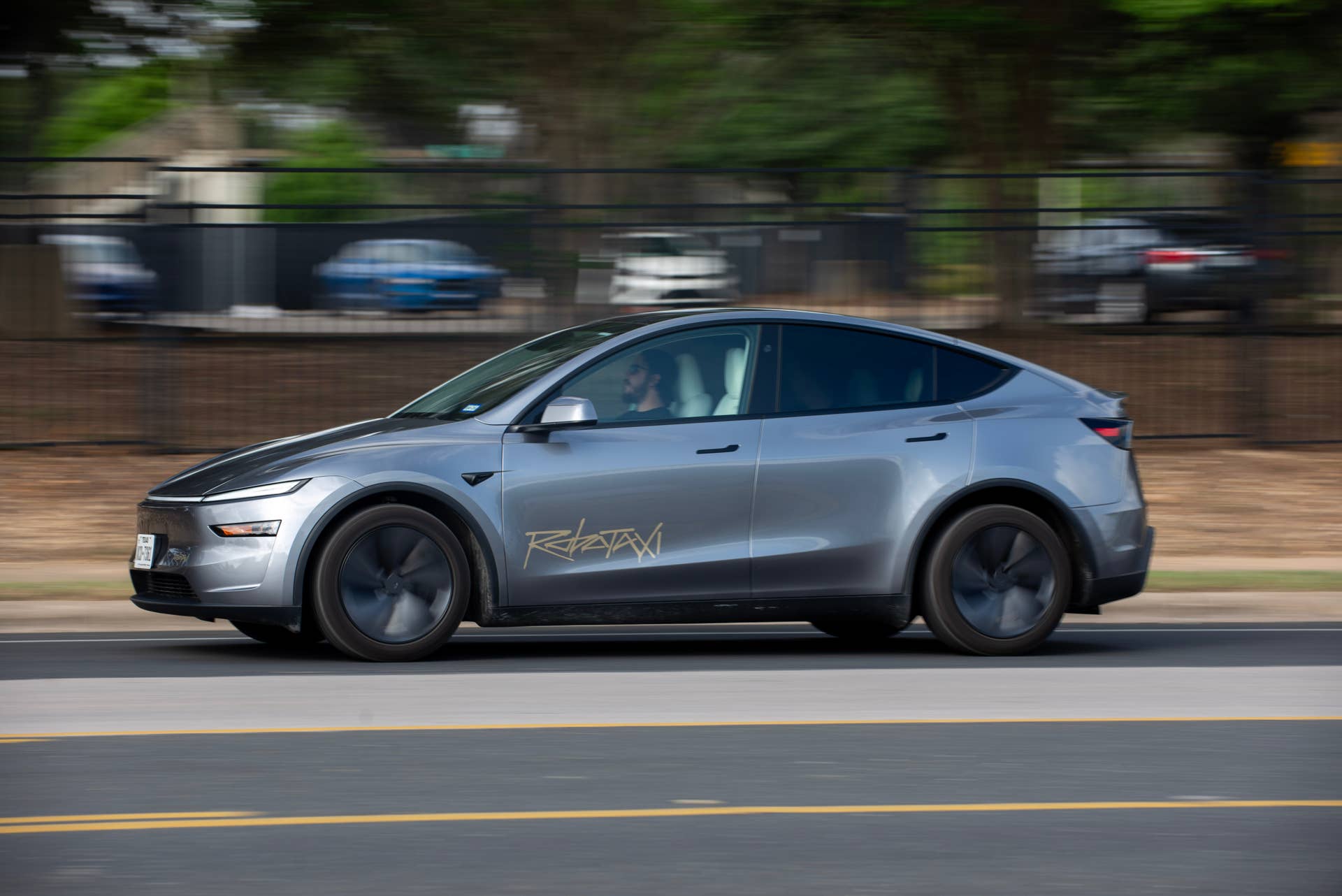
Tesla has been running a driverless ride-hailing service in Austin since June 2025, and it has expanded that service to Dallas, Houston, Miami, Orlando and Tampa. Every one of those rides has happened in a Model Y.
That matters more than it sounds. A Model Y running Full Self-Driving still has a steering wheel, pedals and mirrors. If the software gets confused, the hardware for a human rescue is physically present in the car.
More Automotive:
- Tariffs just pushed Hyundai deeper into America
- Automakers are quietly changing what’s in your engine
- Lamborghini’s most extreme car just sold out its future
The Cybercab has none of it. Two seats, a screen, no wheel, no pedals. Tesla has been producing them at Gigafactory Texas since February and confirmed continuous production on its first-quarter call, reported Electrek.
The company has been building a car for six months that it has not been able to put a public passenger in. Sept. 3 is the day that changes.
The regulatory gap Tesla is launching into
Here is the part that got my attention when I mapped Tesla’s launch sequence against its competitors.
Texas lets autonomous vehicles operating at SAE Level 4 or higher skip the steering wheel and pedals under a self-certification model. That is why Austin works. But Tesla has not secured the Federal Motor Vehicle Safety Standards Part 555 exemption that would let it charge passengers commercially at scale or expand freely beyond Texas, reported Automotive World.
Amazon’s Zoox took the other road. It applied for and received a federal exemption covering up to 5,000 steering-wheel-free vehicles over two years, clearing it to convert a demo fleet into a paid commercial service, according to Axios.
Related: Tesla Robotaxi takes a big step toward Elon Musk’s ultimate vision
Tesla’s position is that it does not need the exemption, because it designed the Cybercab to self-certify against every existing federal standard. That theory has never been tested by an incident.
The regulator has been moving in Tesla’s direction, and the National Highway Traffic Safety Administration has been streamlining exemptions and drafting the first federal performance standards for automated vehicles. But drafting is not finished, and a rule that does not exist yet cannot protect anybody.
Musk understands the exposure better than his critics assume. “If we injure even one person, it’ll be worldwide headline news, and regulators will immediately clamp down on our activities,” he said on the second-quarter earnings call, according to Yahoo Finance.
Where the driverless race actually stands right now:
- Waymo delivers roughly 500,000 paid robotaxi rides a week across 10 U.S. cities, according to TechCrunch.
- Tesla runs about 50 robotaxis in Austin, a city of more than 1 million people, based on TheStreet’s reporting on Austin wait times.
- Clark County, Nevada, cleared Tesla to operate up to 5,000 driverless vehicles in its first year there, reported The Motley Fool.
- Zoox holds federal clearance to charge passengers commercially, which Tesla does not, according to Axios.
What a launch this size means for your portfolio
Tesla is one of the 10 largest companies in the S&P 500. If you own a target-date fund, an S&P 500 index fund or most any large-cap blend product in your 401(k), you own Tesla whether you chose it or not.
That is why my analysis keeps coming back to the multiple rather than the vehicle. Tesla trades near 292 times earnings, and Wall Street holds a consensus Hold rating with an average price target around $385, according to TipRanks. Shares closed Friday at $362.86 after jumping 5.1% on the Nevada approval.
A 292 multiple is not a price. It is a promise.
Tesla’s second-quarter operating income came in at $398 million, which is not a number that supports a $1.2 trillion company on its own. The gap between those two figures is autonomy, and it is being carried entirely by expectation.
That works right up until it doesn’t. Musk already told investors robotaxi “likely will not see material revenue until at least 2027.” So the near-term case for the stock is not cash. It is the absence of a disaster.
The asymmetry here is worth sitting with. A flawless Sept. 3 event probably moves Tesla shares a few percent, because a successful launch is roughly what the current multiple already assumes. A single serious injury involving a car with no steering wheel moves them a great deal more, in the other direction, and it does so on a timeline set by regulators rather than by Tesla.
Shares are already down about 25% this year and sit well below the $498.83 record close set in December, so the market is not exactly pricing in perfection. It is pricing in something closer to eventual inevitability.
What to actually watch on Sept. 3
Ignore the reveal. The Cybercab has been photographed, spec-sheeted and driven on a closed lot at Warner Bros. Studios back in October 2024. Nothing about the car itself will be news.
Watch three things instead. Whether the Cybercabs carry non-employee passengers on public Austin streets rather than a controlled loop. Whether Tesla names a service area and a fleet size. And whether anyone from Tesla addresses the federal exemption question directly.
A launch event that shows a car is a demo. A launch event that puts strangers in a vehicle with no steering wheel, on public roads, under a legal theory Tesla wrote itself, is something else.
The company has spent six months building inventory for this moment. Austin finds out on Sept. 3 whether the software was ever the point, or whether the real bet was that nothing goes wrong before the rules catch up.
Related: Tesla, Toyota expose surprising auto industry truth