Every American car sold in the last 60 years arrived on the road the same way. The company that built it filled out a form saying it followed the rules.
That is not a loophole. It is the system. Federal regulators write the safety standards, automakers certify their own compliance, and the government audits after the fact rather than approving anything in advance.
The arrangement holds because it rests on a shared assumption. Everyone is building roughly the same object, a metal box with a person at the controls, and the rules describe that object in granular detail.
Mirrors the driver can see. A pedal the driver can reach. A wheel the driver can turn.
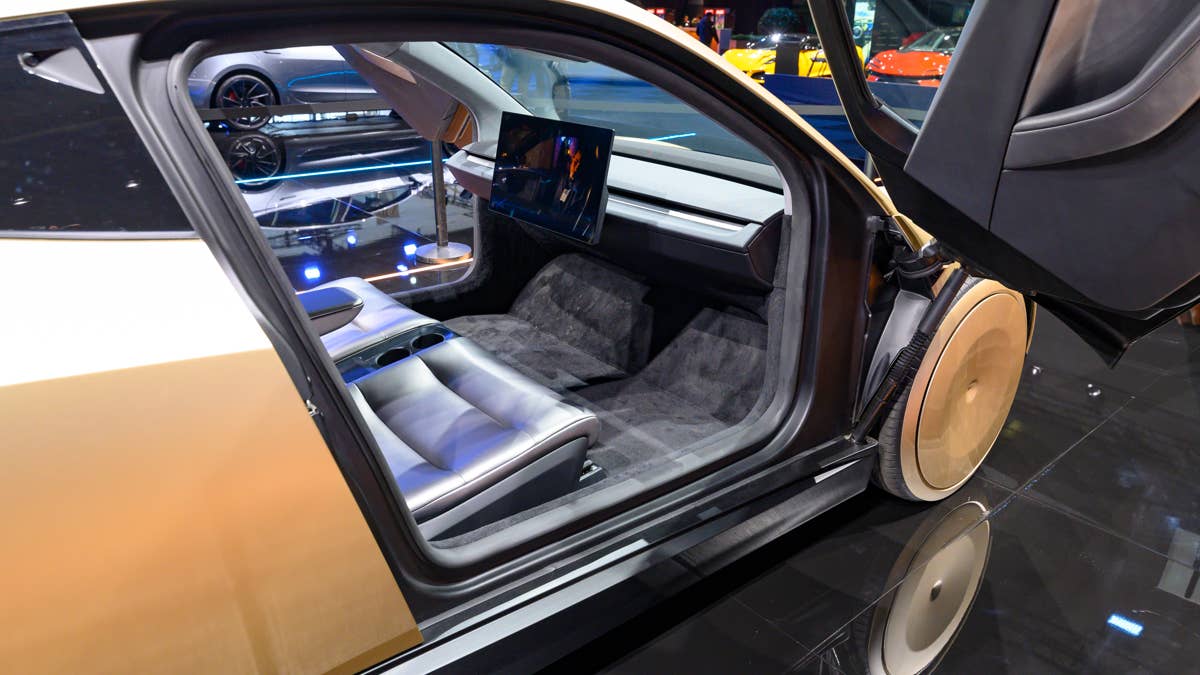
Tesla (TSLA) just put a car on public streets in Austin, Texas, that has none of those things, and the company filled out the form anyway.
The federal government read that form and decided it had questions. The National Highway Traffic Safety Administration opened an audit query into roughly 1,000 Cybercabs on Sept. 4, one day after the first paying passengers climbed into a two-seater with no steering wheel.
Why a car with no steering wheel is a certification problem
The Federal Motor Vehicle Safety Standards were written by people who could not imagine the Cybercab. Dozens of the rules assume a human being is sitting there.
One standard governs where hand-operated controls go. Another requires rear-view mirrors. Others describe braking and steering systems built for human inputs.
More Tesla News:
- Tesla uses data transparency to get what it wants
- Elon Musk sends a strong message to Tesla and SpaceX investors
- Tesla stock investors stand to gain from U.S. power grid
A car without a driver’s seat does not fail those rules so much as fall outside them. That leaves a manufacturer two options.
Option one is to build the car with the equipment anyway. Option two is to petition the agency for a temporary exemption under Part 555, a process automakers have used for decades to put unusual vehicles on the road.
Tesla picked neither. The company decided that several of those standards simply do not apply to a vehicle designed without a human driver station, and certified the Cybercab as fully compliant on that basis.
I flagged this exact theory two weeks ago, when Tesla set the launch date and I wrote that it had never been tested. It has now been tested, and not by a crash.
What the NHTSA audit query actually asks Tesla to prove
The investigation is formally an Open Audit Query, and the agency will “assess the basis for Tesla’s self-certification,” according to NHTSA. It will examine the technical data and internal processes behind the compliance claim.
The specific question is narrower and sharper than a general safety review. Regulators want to know how Tesla concluded that certain standards were inapplicable rather than merely inconvenient.
Related: Tesla just set a date for its riskiest launch yet
An audit query is an investigative step, not an enforcement action. Nothing about it stops a Cybercab from picking up a rider in Austin this afternoon.
“We need to ensure that all of our laws are followed,” said NHTSA Administrator Jonathan Morrison.
The agency was careful to note that it is already rewriting the relevant rules, with eight rulemakings underway covering brake pedals, windshield wipers, lighting and rear-view mirrors. The Department of Transportation formally proposed scrapping the brake pedal requirement for autonomous vehicles in June, reported TechCrunch.
None of that is finished. Until it is, the old rules are the only rules.
The 2,500-vehicle cap behind Tesla’s whole strategy
Here is where my analysis departs from most of the coverage, which has framed this as a safety story. Read the numbers and it looks like a capacity story.
The exemption route Tesla skipped comes with a ceiling. Part 555 petitions cap deployment at 2,500 vehicles annually, according to Reuters. That number is workable for a demonstration fleet and useless for a company promising a national Robotaxi network.
Asked directly on X whether the cap would apply to the Cybercab, Tesla vehicle engineering chief Lars Moravy answered “No,” reported Electrek.
That single word is the strategy. Tesla did not avoid the exemption process because of a legal technicality. It avoided the process because the process comes with a number it cannot live with.
Where the gap actually sits:
- The audit covers roughly 1,000 Cybercabs, according to NHTSA.
- Wells Fargo (WFC) counted about 45 Cybercabs registered in Austin at launch, reported Invezz.
- Part 555 exemptions are capped at 2,500 vehicles a year, according to Reuters.
- The pending SELF DRIVE Act would raise that ceiling to 90,000, reported Electrek.
Look at the spread between 2,500 and 90,000 and you can see what Tesla is actually playing for. If the self-certification holds, none of those ceilings apply and the company scales as fast as Gigafactory Texas allows.
If it does not hold, Tesla lands in the same queue as everyone else, at a volume that makes the robotaxi math impossible.
What the Zoox timeline says about the next year
There is one company that has run this play before, and the result is not encouraging for Tesla.
Amazon (AMZN) subsidiary Zoox self-certified its own purpose-built robotaxi in 2022, a vehicle with no steering wheel and no pedals. The company “tried the self-certification route and failed,” reported Reuters. NHTSA opened a special order, then an audit query, and Zoox eventually withdrew the certification claim.
Zoox got a federal exemption for limited commercial deployment in July of this year, roughly four years after it started. It is now permitted to charge for rides. It is also capped.
Tesla is not Zoox, and the regulatory climate has shifted hard in the industry’s favor since 2022. NHTSA said as much in its own announcement, framing the rule overhaul as removing barriers to American autonomous vehicle innovation.
But shifting is not shifted. Investors treated the gap as real on Sept. 4, sending Tesla shares down about 6% to close at $354.08, and Wells Fargo held an underweight rating with a $130 price target, reported CNBC.
The Cybercab won’t disappear from Austin over a paperwork audit. What is genuinely in play is the slope of the ramp, and the ramp is most of what the stock is priced on.
Tesla spent two years telling investors the Cybercab would arrive without asking anyone’s permission. It arrived. The question now is how long the government takes to answer.
Related: Tesla recalls 20,000 vehicles over issue every driver hates