Estate planning decisions often come down to a deceptively simple question: Should parents divide their estate equally among their children, or allocate assets based on need?
That tension between fairness and equality is one of the most common sources of conflict after a parent dies. In an interview, Harry Margolis, author of “Get Your Ducks in a Row,” said those disputes often arise because families never discussed the plan ahead of time.
Below is a transcript of that interview, edited for clarity and brevity.
Discussing estate plans with family
Robert Powell: How might you talk to your family about your estate plan in a way that reduces conflict and addresses the difference between fair versus equal inheritances? Here to talk with me about that is Harry Margolis, author of “Get Your Ducks in a Row.”
Harry, I’m sure this is a question you get all the time: fair versus equal.
Why equal inheritances are common
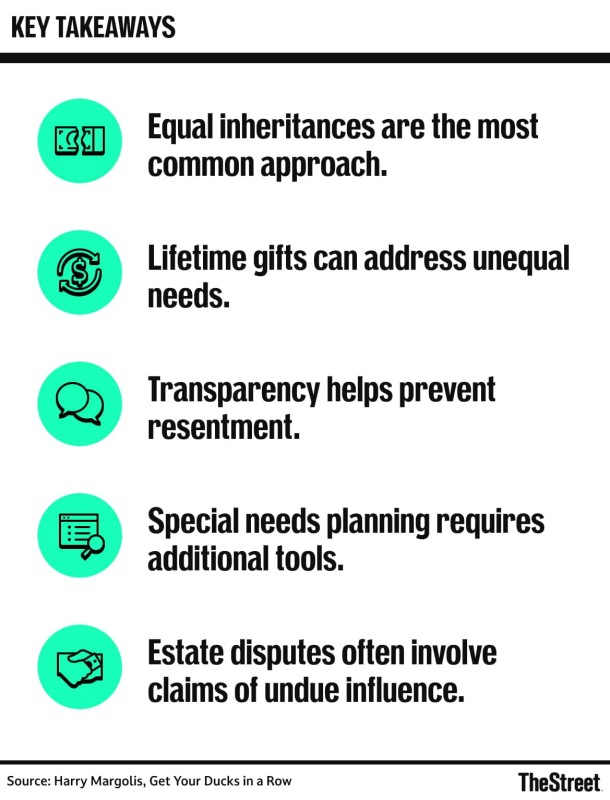
Harry Margolis: We don’t get the question all the time, but we definitely hear it because in most cases people divide their estate equally among their children. When everything is split evenly, it usually doesn’t become an issue.
But children can be in very different places, economically and financially. They may also face other challenges such as illness, divorce, or raising children with special needs. Because of those differences, you may want to help one child more than the others, or you may be closer to one child and estranged from another.
The problem is that money is often equated with love. When children inherit less than their siblings, they may feel neglected. That can create resentments that continue long after the parents are gone. And that’s something most parents want to avoid.
So the question becomes how to balance different needs and circumstances without creating conflict.
What many people choose to do is keep their estate plan equal for everyone but help children during their lifetime. If one child needs help because they are about to face foreclosure or have run into other challenges, the parents help them out while they’re alive.
Then, in the estate plan itself, everything is divided equally. What you do with your own money during your lifetime is your business. But the legal documents treat everyone the same. That’s one solution.
When unequal distributions may make sense
Harry Margolis: In other cases, the needs really are very different.
You might have one child who is an investment banker, and whatever you leave them would be pocket change. Another child might be a home health worker earning much less, or someone who chose a nonprofit career and is scraping by financially.
In those cases, parents may want to provide more support to the child who needs it most.
But if you’re going to do that, I think it’s better to explain the decision while you’re alive. Talk about it openly rather than letting it come as a surprise after your death. That conversation can help families work through the emotions and avoid misunderstandings later.
Planning for a child with special needs
Harry Margolis: Another situation where unequal planning often arises is when a family has a child with special needs.
In many cases, parents set up a special needs trust to be funded after they pass away. The child’s needs are greater, but parents may still want to divide the estate equally among the children.
One strategy is to split the estate evenly, with the child’s share going into the special needs trust. Parents may then purchase life insurance to provide additional funding for that trust.
The life insurance ensures there will be money available for the child with special needs, even if the parents’ assets are depleted later in life by long-term care or other expenses. The only cost to the estate is the insurance premiums paid during life.
When estate plans lead to disputes
Robert Powell: You mentioned explaining decisions in advance as a way to reduce conflict. Have you seen situations where conflict couldn’t be avoided, where family members challenged the will or the distribution of assets?
Harry Margolis: Yes. We’ve certainly seen situations where people were very upset when they discovered how the estate was divided.
Also worth reading
- Retirees may want to rebalance as markets broaden, volatility rises
- Why “breaking even” on Social Security is the wrong goal
- The $83,250 secret every solo entrepreneur needs to know for 2026
- Medicare mistakes seniors wish they’d known sooner
- Elon Musk says stop retirement saving: Experts call it ‘nonsense’
- Social Security benefits could drop 7% in 2032
Actual legal challenges often arise when a parent changes their estate plan shortly before death. That can happen when the parent has physical or cognitive impairments and has been receiving help from one child.
In those cases, the other siblings may claim the change was the result of undue influence.
But if someone is clearly competent when they make their decisions, the law generally allows them to do whatever they want with their money.
The risk of undue influence
Robert Powell: When it comes to undue influence, it may not always be a child. I’ve seen cases where a visiting nurse or home health aide somehow ends up inheriting the bulk of someone’s estate.
Harry Margolis: Yes, those cases do happen, and they often end up in litigation. In many situations, it ultimately isn’t worth the effort for the person who tried to take advantage of the situation.
Final advice for families
Robert Powell: So the key advice for reducing conflict is to explain decisions in advance and be aware of the different strategies available to make things equal or fair.
Harry Margolis: Exactly. Even though it may not always feel that way, equal treatment in a will is usually viewed as fair.
If you’re not going to divide your estate equally, it’s important to make the reasons clear and discuss them openly with your family. That transparency can go a long way toward preventing disputes later.